AI未来科技绘画进阶:人工智能与明日世界的前沿概念视觉设计
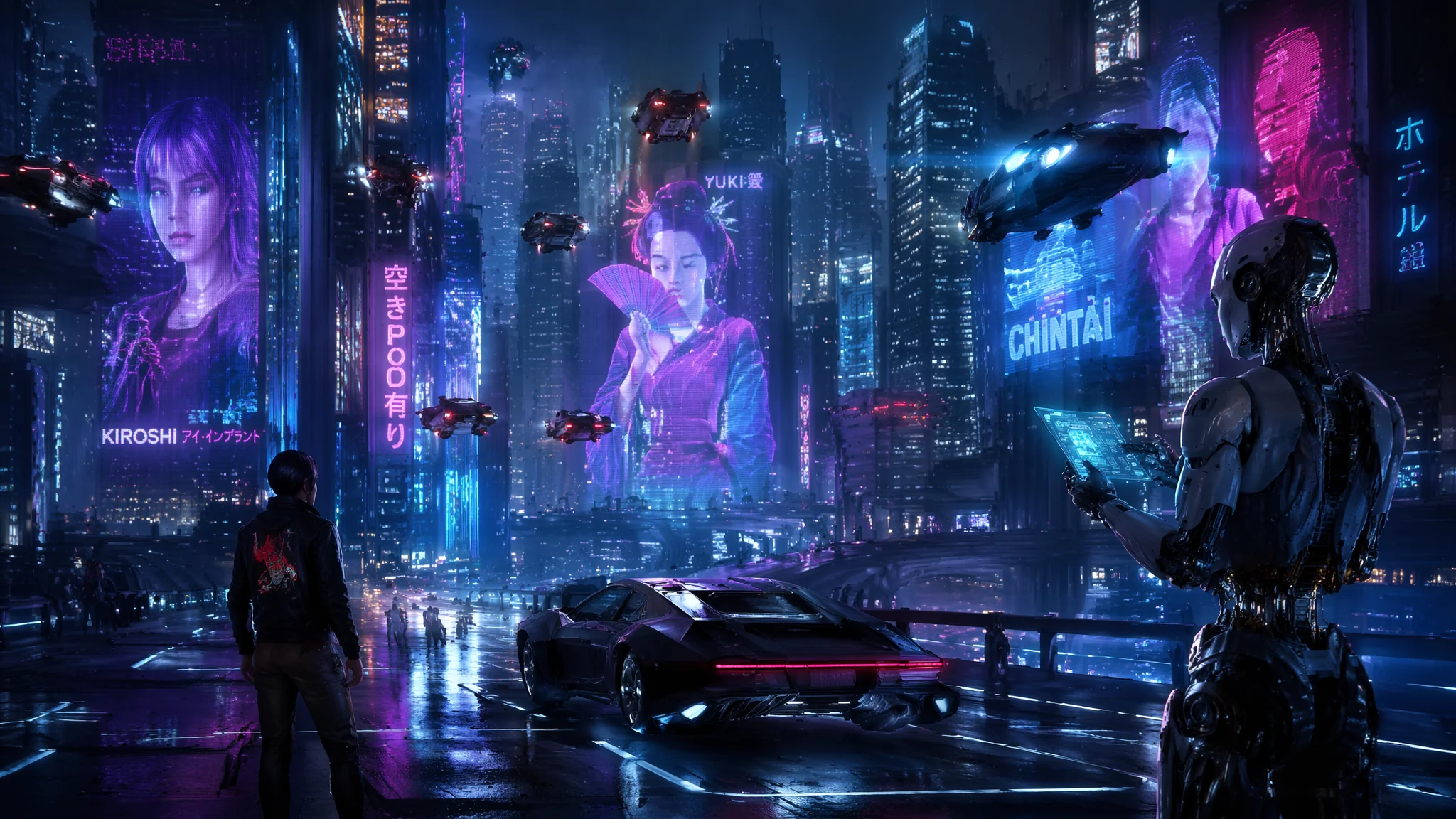
我本科读的是工业设计——大二上过一门叫"设计未来学"的选修课,老师让我们每人设计一件五十年后的日用品。我当时设计了一个"能在手掌上投射全息菜单的智能勺子"——现在回头看,那就是典型的"用当下的视觉语言表现未来的科技概念"。后来用AI画未来科技场景的时候,我发现AI犯的错误和我当年一模一样:它画的"未来"其实是过去三十年科幻电影的视觉混搭——蓝色全息、银色金属、六边形网格、发光的电路板纹路。这些东西在1982年的《银翼杀手》里是革命性的,在1999年的《黑客帝国》里是标志性的,但在今天的新概念设计里——它们已经是视觉陈词滥调了。这篇不讲基础赛博朋克,聊的是怎么用AI画出真正有"明天感"的未来——而不是昨天的未来。
逃离赛博朋克——为什么"蓝色+黑色+霓虹灯"不是唯一的未来视觉
过去三年我大概看了不下五百张AI生成的"未来城市"——至少四百张是蓝色调+黑色天空+粉色霓虹灯+全息广告牌的变体。这个配方的问题不是"不好看"——问题是你第一次看觉得酷,第十次觉得还行,第一百次开始觉得所有未来都在下同一种雨。未来的视觉语言需要从科幻电影的"风格遗产"中走出来,回到科技发展本身的逻辑上去寻找视觉灵感。
当代前沿科技暗示了几种完全不同的未来美学方向:生物科技未来——不是金属和电路,是培育出来的材料、活的建筑、与人体共生的技术。"a future where technology is grown not built——buildings are living structures grown from engineered mycelium, personal devices are bio-luminescent organisms that live symbiotically on the skin, the color palette is warm organic whites, soft greens, and biological pinks——nothing is sterile or metallic"。太阳能朋克(Solarpunk)——不是阴雨霓虹,是清洁能源+绿色城市+社群主义的明亮未来。"a solarpunk city where Art Nouveau architecture is integrated with solar panel skin and vertical gardens, the sky is blue not dark, people move through green public spaces, technology is visible but it serves nature rather than dominating it"。后数字物质主义——不是满天的全息广告,是数字技术融入物理世界后变得"不可见"。"technology has retreated into the background——interfaces are projected directly onto any surface when needed and disappear when not, the city looks like a well-designed European town from a distance but up close every surface is responsive and adaptive, the aesthetic is warm minimalism not cold high-tech"。
这三个方向的共同特征:没有霓虹灯、没有蓝色滤镜、没有无处不在的雨。它们各自是一套完整的视觉系统——不是把赛博朋克的蓝色换成绿色就叫"新风格"。关于场景视觉系统的构建,AI美学未来风照片中有从色彩哲学到材质选择的系统拆解。
材料即世界观——纳米碳、自修复混凝土与生物皮革的视觉语言
设计课上老师说过一句话我记到现在:"未来感不在形状,在材料。"你给一把明朝的木椅子加上纳米碳纤维的质感,它立刻就变成了明代美学的未来版。反过来,你给一个"未来感形状"的东西贴上普通塑料的渲染——它看起来就像一个廉价的科幻玩具。
纳米碳材质的Prompt逻辑:"the surface is made of carbon nanotube composite——it has a matte black finish that absorbs 99.9% of light, the darkest black you have ever seen——like staring into a hole cut in reality, the material has a subtle woven texture visible at close range, it feels impossibly light and impossibly strong"。自修复混凝土——"the building surface is a bio-concrete that heals its own cracks——faint spider-web patterns visible on the surface are not damage but healed fracture lines filled with calcite, the texture is like stone that has been alive for centuries, moss and lichen grow in the healed cracks"。生物皮革(实验室培育的皮革,不是杀的动物)——"clothing made from lab-grown leather bio-printed to the wearer's exact measurements——the material has a subtle organic pattern that follows the contours of the body, the surface has the warmth and texture of living skin"。
每种材料都在无声地讲述世界观:纳米碳=高精尖、资源富足;自修复混凝土=时间长、文明悠久;生物皮革=伦理先行、技术人性化。选材料就是选世界观。科幻材质的设计参考可以在Material ConneXion的材料库中找到大量前沿材料的分层结构和显微图像——对AI Prompt的精细化非常有帮助。
科技物件的"使用痕迹"——打破AI的出厂全新洁癖
AI画科技产品有一个隐形假设:所有未来的东西都是刚从包装盒里拿出来的——零划痕、零灰尘、零磨损。但不管是2260年还是2026年,日常使用的东西一定会旧。给科技物件加"使用痕迹"不是降低科技感——是增加可信度。
旧化逻辑分三个层次:表面磨损——"the device's surface shows micro-scratches visible only in raking light, the edges where the hand grips are slightly polished smooth from years of handling, there is a faint patina of skin oils on the frequently touched areas"。维修痕迹——"one panel of the device is a slightly different shade than the rest——a replacement part from a different production batch, the seams don't align perfectly because the device has been opened and repaired"。个性化改装——"the owner has added personal modifications——hand-painted details on the casing, a sticker from a place that no longer exists, the device has been customized to the point that it no longer looks like the factory model"。这些旧化细节把"未来科技"从一张概念图变成了一件有历史的、真实存在于某人生活中的物品。
关于物件使用痕迹在角色表现中的应用,AI腹肌帅哥绘画中提到的"功能性体型"思路可以迁移——使用痕迹是"功能性真实感"在科技物件上的体现。
四种前沿未来风格——从生物朋克到后奇点
生物有机未来:"a medical bay in a biotech future——the walls are not metal but living tissue that monitors vital signs, surgical tools are organic——they resemble symbiotic creatures that merge with the patient's body during procedures, the lighting is warm and amber, the air is filled with a fine healing mist, the overall feeling is organic and womb-like rather than sterile and clinical"。更多生物与机器融合的设计思路在AI外星人绘画中有异星生物设计的迁移逻辑。
后奇点极简:"a post-singularity living space——technology has become so advanced it is indistinguishable from empty space, a seemingly empty room where the occupant gestures and invisible fields shape light and matter, the aesthetic is radical minimalism——a single piece of furniture that reconfigures itself, a window that is also a telescope and a display and a light source, the room feels like a zen temple designed by an AI god"。后奇点风格的核心是"科技消失"——不是没有科技,是科技变得像空气一样不可见。
海平面上升适应型:"a coastal city adapted to a 3-meter sea level rise——the old streets are now canals, buildings have been retrofitted with floating foundations, bridges connect upper floors that have become the new street level, the lower floors are submerged and converted to aquaculture, the city is a hybrid of Venice and a climate adaptation laboratory, the color palette is sea-weathered blues, rusted oranges, and living greens"。最前沿的气候适应概念设计可以参考ArchDaily上的气候适应性建筑案例。
文化科技融合型:"a future where traditional culture and advanced technology are not in opposition——a Shinto shrine augmented with quantum computing infrastructure, the torii gate has subtle photonic circuits inlaid in the wood that activate at dusk, a priest performs an ancient ritual while wearing smart fabric robes that display shifting sacred patterns, the coexistence is seamless——the technology serves the tradition rather than replacing it"。
常见问题
写"futuristic"这个词AI就给蓝紫色调——怎么突破AI的色彩惯性?
"futuristic"在训练数据中90%关联蓝色/紫色调——所以只要你写了这个词,配色方案就已经被预定了。突破方法:用具体的时代或文明来做色彩锚——"a future city with the color palette of an African sunset——deep orange, terracotta, warm ochre, and dusty rose""a future interior inspired by traditional Japanese indigo dyeing——rich blues that are warm rather than cold, natural wood tones, paper-white light"。用地球上的地域色彩做参考比用抽象词汇更有效,因为AI对"African sunset colors"或"Japanese indigo"有明确的视觉数据——但对"warm future"没有。
怎么画"AI实体化"——一个有物理形态的人工智能长什么样?
AI实体化最忌讳的设计是"一个机器人上面写个AI"或者"一团发光的蓝色大脑"。有趣的AI实体设计应该从AI的核心特征出发——非人、分布式、数据处理。"a physical manifestation of an AI——it is not a single entity but a swarm of thousands of small geometric modules that hover in the air and reconfigure continuously, the swarm moves like a murmuration of starlings, it can form a face or a shape temporarily when communicating but dissolves back into the cloud when not, the modules are matte white ceramic with a faint internal glow——not tech blue but warm candlelight"。关键词是"distributed""swarm""temporary form"——这些特征暗示非人类智能,比任何"机器人头"都更有说服力。
未来科技场景中的人类穿什么——不想画紧身连体衣?
科幻服装的默认选项是紧身连体衣/太空服——但现实中的服装进化方向是:智能织物(看起来像普通布料但能变温变色)、个性化3D打印服装、以及文化复古(技术越新,人越想穿"老东西"来平衡)。"people in the future city wear clothes that look surprisingly familiar——a mix of traditional garment forms made from advanced materials, a kimono-style jacket that is actually a single piece of smart fabric that adjusts its insulation, street fashion that combines Victorian silhouettes with self-cleaning textiles, the overall impression is that people still care about style and culture——they are not all wearing identical utilitarian jumpsuits"。服装与身份表达的逻辑在AI女生服装绘画中有从面料到廓形的详细拆解,科幻服装只是换了一种面料技术。