AI加查软件绘画:GachaLife与GachaClub风格的二次元角色创作
我表妹今年十三岁——她的iPad上有一个我用不来的App叫Gacha Club。她可以在上面花整个周末:捏脸、配衣服、搭场景、编剧情、然后截屏做成"小剧场"发到B站。她给我看过她的"作品"——虽然画质粗糙、动画靠切屏、剧情全是狗血校园+异能觉醒——但她已经靠这个攒了三千多粉丝。有一天她问我:"哥你不是会AI画画吗——能帮我把我捏的角色画成"真正好看的"吗?"我当时在Midjourney里敲了"Gacha Life style cute anime girl"——出来的结果和她手机里的画面差了十万八千里。AI完全不知道"Gacha风格"到底是什么。从那天起我花了大概三周时间专门研究怎么用AI工具来"复刻+升级"Gacha风格的二次元角色,这篇就是我的全部心得。
Gacha风格的视觉DNA——大头、小身子、几何化头发和"有故事的眼睛"
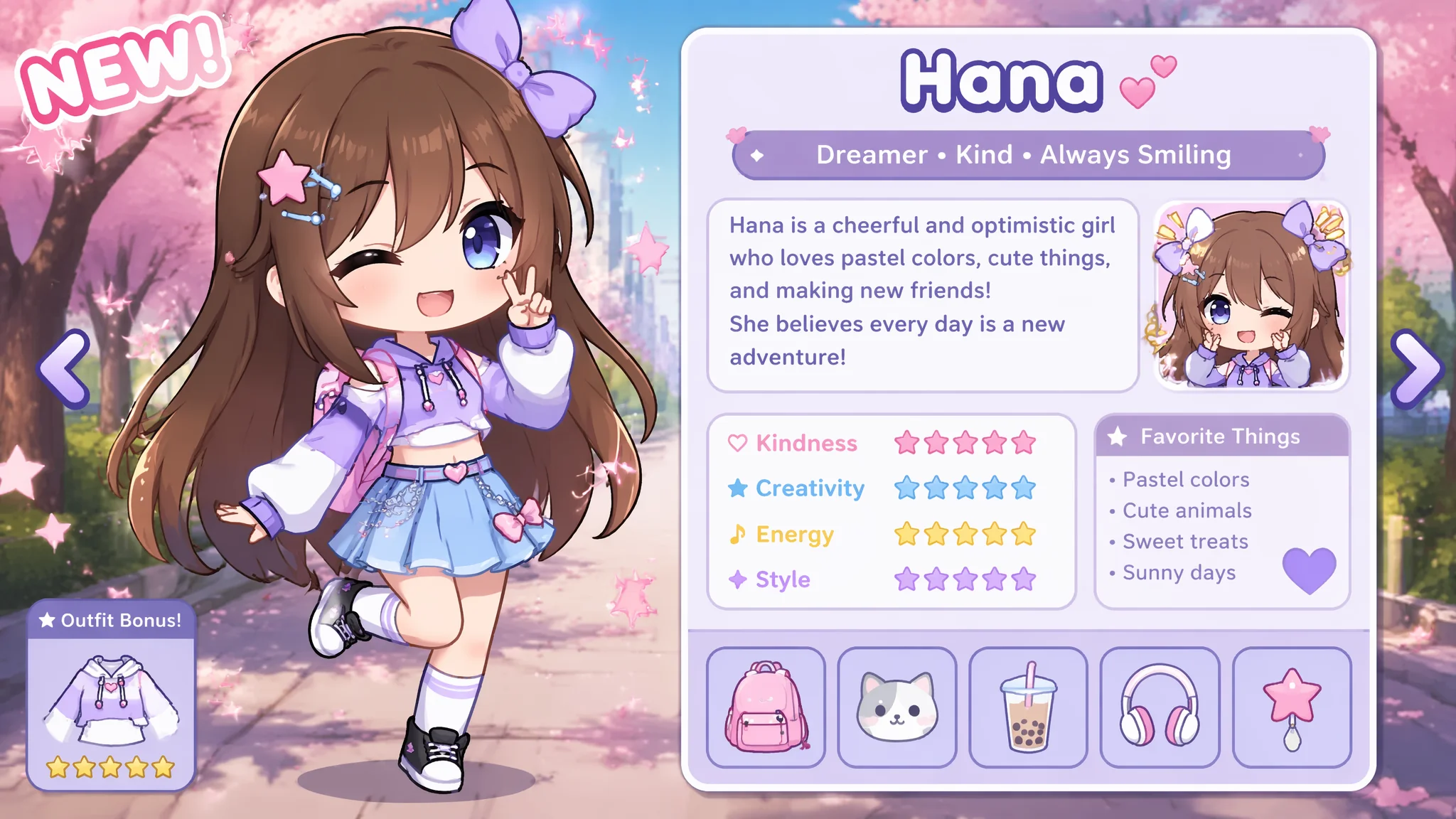
Gacha Life/Club的视觉风格不是"普通的Q版"——它有一个非常具体且高度一致的视觉系统,由四个核心DNA组成。DNA一:头身比。Gacha角色的头身比例是"3-5头身"区间——不是2头身的"超Q婴儿比例"也不是6头身的"少年比例"。"the character has approximately 3.5 to 4.5 heads tall proportions——the head is notably large compared to the body, about 1/3 to 1/4 of the total height, the neck is very short or almost nonexistent, the torso is compact, and the limbs are simplified and slightly stubby but still articulated"。这个头身比是Gacha区别于"chibi"(2头身)和"标准动漫"(6-7头身)的核心参数。
DNA二:眼睛的语言。Gacha眼睛不是"大"而已——它有一套特定的几何构成:上眼睑是粗黑线条、下眼睑是细线或无线条、瞳孔大而圆占据虹膜约70%、高光通常有两个(一个大的在上方、一个小的在侧下方)。"the eyes are the dominant facial feature——they occupy roughly 40-50% of the face width, the upper eyelid is drawn with a thick clean black line that extends beyond the eye at the outer corner (the anime 'eyelash line'), the lower eyelid is thin or absent, the iris is large and round with a clearly defined pupil, two white catchlights——one large oval highlight in the upper portion and one small dot in the lower portion, the eyebrows are thin simple arcs floating above the eyes"。DNA三:头发是一块一块的,不是一根一根的——"the hair is composed of clean simplified geometric blocks, not individual strands, the bangs are divided into 3-5 distinct chunks with sharp edges, the back hair falls in 2-3 large unified shapes, cel-shaded with 2-3 flat tones (base, shadow, highlight)"。更多Q版角色比例的控制技法见AI Q版角色指南。
从Gacha捏人到AI生成——角色设计的"翻译"流程
Gacha Club里的捏人系统本质上是一个"角色设计工具"——你在App里选发型、眼睛、服装、配饰的过程,就是你在设计一个角色。把这些设计"翻译"成AI能理解的Prompt需要一个系统化的转换流程。第一步——提取"角色设计单":把你捏的角色拆解成以下维度的参数:发型(刘海形状+后面头发的长度和形状+发色)、眼睛(形状+虹膜颜色+高光类型)、肤色、服装(上衣类型+下装类型+鞋子+颜色+图案)、配饰(头饰+眼镜+翅膀+尾巴等)、整体气质(可爱/酷/优雅/暗黑/校园)。
第二步——把设计单翻译成Prompt,以Gacha Club中一个常见的"猫耳萌妹"角色为例:"a cute anime girl in Gacha Club style——approximately 4 heads tall with a large expressive head, the hair is pastel pink in twin tails——each ponytail is a simple geometric shape tied with white ribbon scrunchies, the bangs are cut in a neat blunt fringe with clean edges, the eyes are very large and round with purple irises and two white catchlights, a tiny cat mouth (a small 'w' shape), the skin is fair and smooth with cel-shaded soft blush marks on the cheeks, wearing a cute pastel blue and white school uniform with a sailor collar and a bow at the chest, white knee-high socks and pink mary jane shoes, a pair of white cat ears sits on top of the head, a matching white cat tail curls behind, the overall mood is sweet and playful"。第三步——用AI生成2-3版后,对比你的原始Gacha角色检查:头身比对吗?发型的大块结构保留了吗?眼睛的"Gacha语法"(粗上眼睑+两大高光)对吗?如果偏差大,回头修改Prompt中对应的参数。关于从游戏截图转AI的更多技法见AI游戏角色转插画。
Gacha风格的五种变体——从"还原"到"升级"
纯粹还原Gacha Club的游戏画风在AI里是可以做到的——但这可能不是你表妹真正想要的。她说"画得好看"的时候,心里想的大概率是"在保留角色特征的前提下把画质提升到精美插画水平"。这里有五种从"还原"到"升级"的风格变体。变体一——原汁原味Gacha风:"Gacha Club style, cel-shaded, flat colors, bold outlines, chibi proportions, the character looks like a screenshot from the game"。变体二——精致插画升级(最推荐):"the same Gacha character but rendered as a high-quality anime illustration——the proportions remain chibi-esque with a large head and small body, but the coloring is more detailed with soft gradients and subtle textures, the outlines are thinner and more refined, the overall quality is like official art from a high-budget mobile game"。
变体三——日系轻小说封面风:"the character reimagined in a light novel illustration style——slightly elongated proportions (around 5 heads tall), more detailed hair and clothing with fabric folds and subtle highlights, a beautiful ethereal background with lens flare and floating particles, the overall feel is dreamy and premium"。变体四——Q版3D渲染风:"3D rendered chibi character——like a high-quality figure or Nendoroid, the character has a smooth plastic-like surface with subtle glossy highlights, soft ambient occlusion adds depth to the folds, photographed in a studio setting with soft lighting on a plain background"。变体五——韩系Q版插画风:"Korean webtoon chibi style——soft airbrushed coloring with no harsh outlines, the proportions are chibi but the rendering is soft and pastel, the character looks like a KakaoTalk sticker come to life, the mood is cozy and comforting"。风格升级后的输出分辨率和细节量可以参考Pixiv上的Gacha风格标签和DeviantArt的Gacha社区中的高质量粉丝艺术作品。
Gacha场景创作——从"单角色立绘"到"小剧场画面"
Gacha的核心玩法除了捏人还有"做场景和讲故事"——很多Gacha玩家的创作是"多角色+对话+场景"的小剧场形式。AI画Gacha场景时需要同时控制三个以上的角色、他们之间的空间关系、以及场景环境。多角色场景的Prompt技巧:不要一个一个角色描述——AI会把描述链断裂。要描述"群像的整体构图+每个角色的关键区分特征"。"a scene with three Gacha-style characters hanging out after school——the composition shows all three standing or sitting in a casual group, the first character (left) has short blue hair and is looking at her phone, the second character (center foreground) has long pink twin tails and is laughing with her hand covering her mouth, the third character (right) has dark purple hair in a ponytail and is carrying a sports bag, they are in a school courtyard with cherry blossom trees, the lighting is warm afternoon sun, the interaction between the characters feels natural and friendly"。
关键技巧:用"位置标签"(left/center/right/foreground/background)来帮AI分配角色在画面中的空间位置。如果要加对话气泡——"empty speech bubbles or text boxes are visible in the composition, waiting to be filled with dialogue"。Gacha场景的更多创意参考可以在YouTube上的Gacha小剧场中找到——观察那些热门Gacha视频的"关键帧"构图方式,对AI场景Prompt写作有直接参考价值。配合更自由的场景设计见AI加查场景创作。
常见问题
AI画的Gacha角色"手"特别奇怪——手指像树枝或者直接糊成一团?
这在Q版小身体+AI手部处理的叠加下是重灾区。Gacha风格中手本身就被简化——手指通常只有3-4根且短粗。但如果AI画的更糟(手指数量不对、形状诡异),试试以下修正:一,在Prompt中加入手的具体描述——"the hands are simplified in the chibi style——small rounded mitten-like shapes with 3-4 short chubby fingers, the fingers are simple without individual knuckles or nails"。二,如果手仍然崩——让角色的手"有事可做":手里拿个东西(手机、书包带、饮料杯)、手插在口袋里、手藏在长袖子里只露指尖。三,使用负面Prompt——"bad hands, extra fingers, fused fingers, long fingers, realistic hand details, detailed knuckles"。四,终极方案——用ControlNet的OpenPose来控制手部姿势,虽然Gacha角色尺寸小,但正确的骨骼结构仍然可以引导AI画出合理的手。
Gacha角色的"服装配件"特别多——AI怎么不把配件画成一团乱?
Gacha角色的魅力之一就是"细节控配件"——头上有猫耳、蝴蝶结、发卡、耳环,脖子上有项链、领结,手腕上有手链、袖口,背上有翅膀、尾巴、飘带。AI面对这么多配件时的默认行为是"随机混合"——把蝴蝶结画成猫耳、把项链和领结融为一体。解决方法:用"从大到小、从主要到次要"的配件描述顺序,并在每个配件后加上位置限定。"wearing accessories from top to bottom——on the head: a pair of white cat ears (on top), a red bow (on the left side of the head), a small star hairpin (on the right); around the neck: a simple black choker; on the wrist: a thin silver bracelet on the left wrist; on the back: small white feathery angel wings"。按"位置→物品→颜色/材质"的顺序排列每个配件——这个结构帮助AI将每个配件"分配"到正确的位置。
能不能用LoRA训练一个"我的专属Gacha角色"——保持跨图一致性?
完全可以,而且这是目前解决"跨图角色一致性"问题的最佳方案。训练流程:一,在Gacha Club里给你的角色截取10-15张图——不同表情(开心/难过/生气/平静)、不同角度(正面/45度/侧面)、不同服装(日常服/校服/特殊服装)、纯色背景。二,用kohya_ss训练一个LoRA——建议参数:network_dim=32, network_alpha=16(LoRA规模小因为Gacha角色结构简单),repeat=10, epoch=10-15。三,训练完成后,在任何Prompt中加入你的LoRA触发词,AI就能在不同的场景、姿势和风格中保持你的角色形象一致。这是目前Gacha创作者群体中最流行的"AI升级"路线——先用Gacha Club设计角色,再用LoRA固化角色,然后用AI把角色放进各种精美场景中。