AI诸神绘画全攻略:希腊北欧埃及中国神话神明视觉设计的Prompt宝典
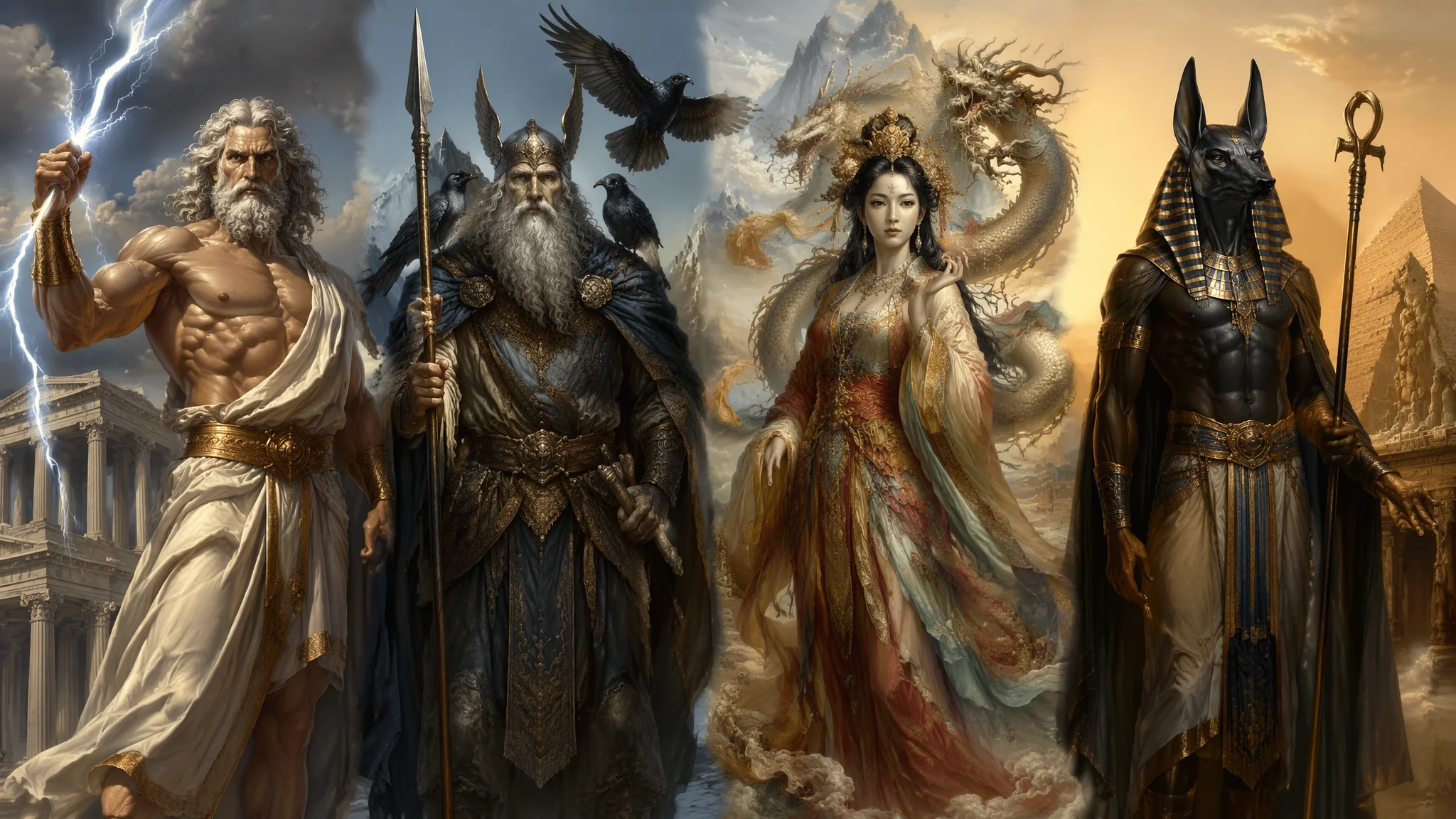
AI画神明是所有题材里最不需要担心"画得对不对"的——因为根本没人见过神长什么样。但也正因如此,AI画神最容易画成两种极端:要么画成穿着古装的普通人,要么画成毫无辨识度的光团乱闪。神明和凡人的视觉边界在哪——这是整个题材最难也最核心的问题。这篇把四大神话体系的神明AI绘画一网打尽。
前两天刷到一个博主用AI画了一套"中国上古诸神"——帝俊、西王母、东皇太一、烛龙。图确实好看,但评论区炸了。有人说"你这画的不是中国神,是《雷神》电影里的阿斯加德人套了一层汉服皮肤"。说实话他说得没错——那套图的光影逻辑、肌肉质感、甚至战甲的切割方式全部是漫威电影体系的。把宙斯的闪电换成"雷公凿"不等于画出了雷神。
这件事让我开始系统性地思考一个问题:不同神话体系的神明,在AI绘画里到底应该怎么区分?不是靠"换皮肤"——是靠"换视觉逻辑"。中国神仙的视觉逻辑是"藏"——法力内敛、衣带飘飘、气质空灵。希腊神的视觉逻辑是"露"——肌肉外显、比例极致、神性体现在"完美肉体"上。北欧神的视觉逻辑是"苍"——粗粝、严酷、神性体现在与自然对抗的痕迹上。埃及神的视觉逻辑是"兽"——人兽合一、符号化、神性体现在"半人半兽"的不合理融合中。
这套分析框架放在这里,后面每个体系都照着填。
希腊众神:完美肉体的极限推演
希腊神的AI绘画核心就是两个字——"完美"。不是凡人对"好看"的定义,是数学意义上的比例完美:八头身、黄金分割、每一块肌肉的起止点都符合解剖学教科书。你画一个希腊神如果有肚腩,或者肩膀不够宽——这不是"另一种风格",是"画错了"。
希腊诸神Prompt通用骨架:"ancient Greek god/goddess, idealized classical anatomy with perfect golden ratio proportions, marble-like luminous skin with subtle olive undertone, wearing flowing white chiton with intricate gold trim, standing in a temple of white marble columns under Mediterranean sunlight, contrapposto pose, Phidias sculptural aesthetic, divine aura as subtle warm glow not explosive light show"。
几个希腊神系专属细节:
宙斯——核心视觉符号是"雷电+权杖+鹰"。最容易画砸的是雷电太小家子气,像静电火花。Prompt加"massive lightning bolts striking from the heavens, storm clouds churning around him, the bolts are thick jagged tree-root-like structures not thin lines"。宙斯的力量感在于"雷电不是他手上的一道光——是他头顶整片天都在他的情绪里翻滚"。
海神波塞冬——不要画成"一个拿鱼叉的男人"。波塞冬的核心视觉是"他的身体就是海洋的一部分":下半身被翻涌的海水包裹、胡须像海藻一样漂浮、皮肤上有海浪的纹理。Prompt:"Poseidon emerging from a turbulent sea, his lower body transforming into crashing waves and sea foam, coral growing from his trident, beard flowing like seafoam, skin with subtle scale pattern reflecting deep blue, ancient power, not a man holding a pitchfork"。关于水体质感的表现技法可以参考AI湖水绘画教程里的水面渲染方案。
雅典娜——最容易画成"穿铠甲的美女"。雅典娜是智慧女神,她的"战力"不是肌肉——是策略。视觉上应该是"全副武装但神情沉静":戴着头盔但面甲推起来露出平静的脸、手持盾牌但身体姿态是沉思而非战斗。Prompt:"Athena in full battle armor but her helmet visor is raised revealing a calm contemplative face, owl perched on her shoulder, holding a spear like a staff not a weapon, wisdom in her stillness, Parthenon in dawn light behind her"。
北欧众神:风雪和伤痕里的神性
北欧神跟希腊神的气质差了一整个地中海。希腊是阳光、大理石、完美比例;北欧是风雪、粗铁、征战痕迹。AI画北欧神最容易翻的错就是用希腊的"完美滤镜"套在北欧神身上——画出来的奥丁像个穿了皮草的希腊雕像。
北欧众神Prompt通用骨架:"Norse god in a harsh frozen landscape, weathered scarred skin from countless battles, rough-hewn iron and leather armor not polished gold, fur-lined cloak heavy with frost, the god's power evident in survival not in beauty, dark muted color palette of grey steel deep brown and icy blue, Norse mythology aesthetic not Marvel Thor aesthetic"。
奥丁——核心符号:"独眼+双鸦+长矛"。他的"智慧"是有代价的——他失去了一只眼睛来换取智慧之泉的一口水。画奥丁一定要画那只凹陷的空眼眶,不能画成"闭着一只眼"。Prompt:"Odin the Allfather, one eye socket empty and dark from the sacrifice at Mimir's well, the remaining eye piercing blue and unnervingly sharp, two ravens Huginn and Muninn perched on his shoulders, holding the spear Gungnir which glows with faint runes, ancient wanderer in a grey cloak, snow falling around him, the weight of knowing everything in his weathered face"。
雷神索尔——最容易跟漫威版本混淆。北欧神话的索尔是红发红胡子的大汉,不是金发帅哥。他的锤子Mjolnir柄很短(因为锻造时出了岔子),不是双手长柄锤。Prompt必须强调这些非漫威特征:"Thor with wild red hair and thick red beard, muscular but bulky not sculpted, wearing iron gauntlets and a belt of strength, wielding the short-handled hammer Mjolnir crackling with raw lightning, goat-drawn chariot in storm clouds, the god of the common people not a prince"。
洛基——最被误解的北欧神。他不是"邪恶的阴谋家",是"麻烦制造者"——他的恶作剧往往最终帮了诸神。视觉上应该是"让人不自在的英俊"——嘴角总挂着一丝你说不清是什么但肯定不是好事的微笑。Prompt:"Loki with sharp elegant features, a half-smile that never reaches his eyes, flame-red hair slicked back, wearing fine clothes slightly disheveled as if he's been up to something, shapeshifter ambiguity in his form, the faintest suggestion of chains on his wrists, the most charming person in the room and the most dangerous"。
北欧神话体系的整体氛围基调在AI冰川绘画那篇有很好的环境参考——北欧的神性跟自然环境的严酷是分不开的。
中国神仙:空灵内敛的"非展示型"神性
中国神仙最让AI困惑的一件事:他们的力量不是通过"发光"来表现的。一个真正厉害的中国神仙站在那里,你可能根本看不出他是神仙——没有光环、没有雷电特效、没有肌肉爆裂。他的"神性"在一举手一投足的气质里:衣袍无风自动、脚下有若隐若现的祥云、整个人笼在一层极淡的柔光里。
中国神仙Prompt通用骨架:"Chinese celestial being in flowing silk robes that move as if underwater even without wind, jade-like luminous skin with an inner glow barely visible, long flowing black hair, standing on or surrounded by ethereal mist and clouds, the divine presence conveyed through tranquility not power display, traditional Chinese ink painting aesthetics with subtle color, East Asian immortal not Western superhero"。
几个中国神系关键角色:
女娲——人身蛇尾,但最关键的是她的"创造者"气质——她手中捏着泥人、身边有未成形的生灵。Prompt:"Nuwa the creator goddess, human upper body with serpentine lower body coiled among clouds, hands gently shaping a clay figure that glows with the spark of life, primordial chaos giving way to order around her, five-colored stones floating nearby, compassionate expression, dawn of creation atmosphere, Chinese mythology"。女娲的蛇尾不应该画成西方的"蛇怪"质感——应该像神兽的尾巴,有鳞片但鳞片的质感是玉石的而非动物的。
观音——重点不是"好看"而是"慈悲"。AI画观音最容易画成"古装美女闭着眼"。观音的神情应该是"已经看透了一切苦难但仍然选择留在世间"——这个表情AI很难精确刻画,但对Prompt方向有要求:"Guanyin bodhisattva in flowing white robes, serene compassionate expression that conveys both wisdom and gentle sorrow for the world, holding a willow branch and a vase of pure water, standing on a lotus pedestal, soft golden halo behind the head, thousand-armed form optional but each hand should hold a different symbolic object, Chinese Buddhist art style, the face is not beautiful in a decorative way but in a transcendent way"。中国神佛题材的色彩和氛围可以参考AI国画绘画完全指南。
青龙——四象之首,最容易画成"一条绿色的中国龙"。青龙和普通龙的区别:青龙是"星宿的化身"而非"水里的生物"——它的身体由星辰和气流构成,是半透明的、带有星光的。Prompt:"Azure Dragon of the East, celestial constellation dragon, body made of starlight and cosmic energy flowing between visible asterisms, translucent scales that reveal constellations within, antler-like horns, soaring through the night sky surrounded by the seven mansions of the Eastern Palace, not a physical creature but an astral manifestation, Chinese mythology"。
埃及众神:人兽合一的符号化神性
埃及神是四大体系里最难画的——因为AI对"半人半兽"的理解非常不稳定。你把一个胡狼头放在人类身体上,AI要么画成毛绒玩具头接错脖子,要么画成恐怖片里的变异怪物,就是画不出"神圣的半兽"。
埃及神的核心审美是"符号化的庄严"——他们不是"动物成精变成了人",而是"神选择了动物的面孔来象征自己的权柄"。这微妙的区别决定了画埃及神的时候,动物头部的处理不能太"生物感"——应该像雕塑、像黄金面具、像一种"被艺术化处理后的符号"。
埃及众神Prompt通用骨架:"ancient Egyptian deity, human body in regal posture, animal head rendered like a polished ceremonial mask of gold and lapis lazuli not organic fur or flesh, wearing the nemes headdress and usekh broad collar, holding an ankh and was scepter, standing before hieroglyph-covered temple walls, the merger of human and animal is sacred and sculptural not biological, warm desert light, ancient Egypt art style"。
阿努比斯——胡狼头,但气质是"审判者"的肃穆而非"野兽"的凶残。Prompt:"Anubis god of embalming, jackal head like a polished obsidian ceremonial mask with gold inlay, tall erect ears, human body wrapped in linen-like divine robes, holding the scales of judgment with a feather of Maat on one side, standing at the threshold between life and death, solemn and dignified not monstrous, ancient Egyptian art"。
根据 大都会艺术博物馆的埃及艺术研究,古埃及神像的"半兽"特征不是对动物的写实描绘——而是一种高度风格化的"视觉文字"——每种动物的选择都对应着一种特定的神性职能。这个理解对于AI绘画的Prompt设计非常关键:不要在Prompt里写"realistic wolf head",要写"stylized ceremonial mask shaped like a jackal"。
关于神话题材的角色设计与奇幻场景的结合,AI巫师绘画全攻略里有一整套从角色到场景的奇幻设计方法论可以共用。
常见问题
AI画的神明总是像游戏角色或者漫画人物,怎么去掉这种"二次元感"?
这个问题的根源在于AI的训练数据里"神"类图片大量来自游戏原画和动漫设定集。去二次元感的核心Prompt加"classical fine art, oil painting style, museum quality, not video game concept art, not anime style, not comic book illustration, the divine presence should feel ancient and sacred not designed for entertainment"——这串否定词把AI从娱乐视觉体系里拽出来。风格关键词选"Renaissance painting"或"academic art"能最大程度地避免游戏感。
不同的神话体系能不能混搭?比如"赛博朋克希腊神"?
能,但有一个原则:只混搭"视觉风格",不混搭"文化符号"。把希腊神画成赛博朋克风格——宙斯的闪电变成数据流、雅典娜的盾牌变成全息投影——这个可以,因为混搭的是风格层。"赛博朋克宙斯拿着雷神之锤"就不行了——你把希腊和北欧的文化符号混在一起,在文化逻辑上是乱的,观众会出戏。
AI画宗教神祇(如佛像、耶稣)有没有特殊注意事项?
有。宗教题材的神跟神话体系的神在受众感知上是完全不同的两件事。画释迦牟尼和画孙悟空不是同一套规则。对于仍在被广泛信仰的宗教中的神祇——保持敬畏和准确是底线。不要让他们"摆pose"、不要让他们处在滑稽的语境里、不要把他们的神圣符号给替换或恶搞。佛像可以参考AI静物环境绘画里的"庄严氛围"构建思路。
画神这件事,说到底不是技法问题——是对"人类在不同文明中如何想象终极存在"这件事的理解。希腊人把"完美"定义为神性、北欧人把"坚韧"定义为神性、中国人把"空无"定义为神性、埃及人把"秩序"定义为神性。你画的神应该体现的不是你的审美偏好——是那个文明抬头看天的时候,脑子里浮现的那个形象。
觉得有用的话分享给对神话感兴趣的朋友吧。