AI国风场景绘画进阶:古装剧级中国风环境与建筑的概念设计
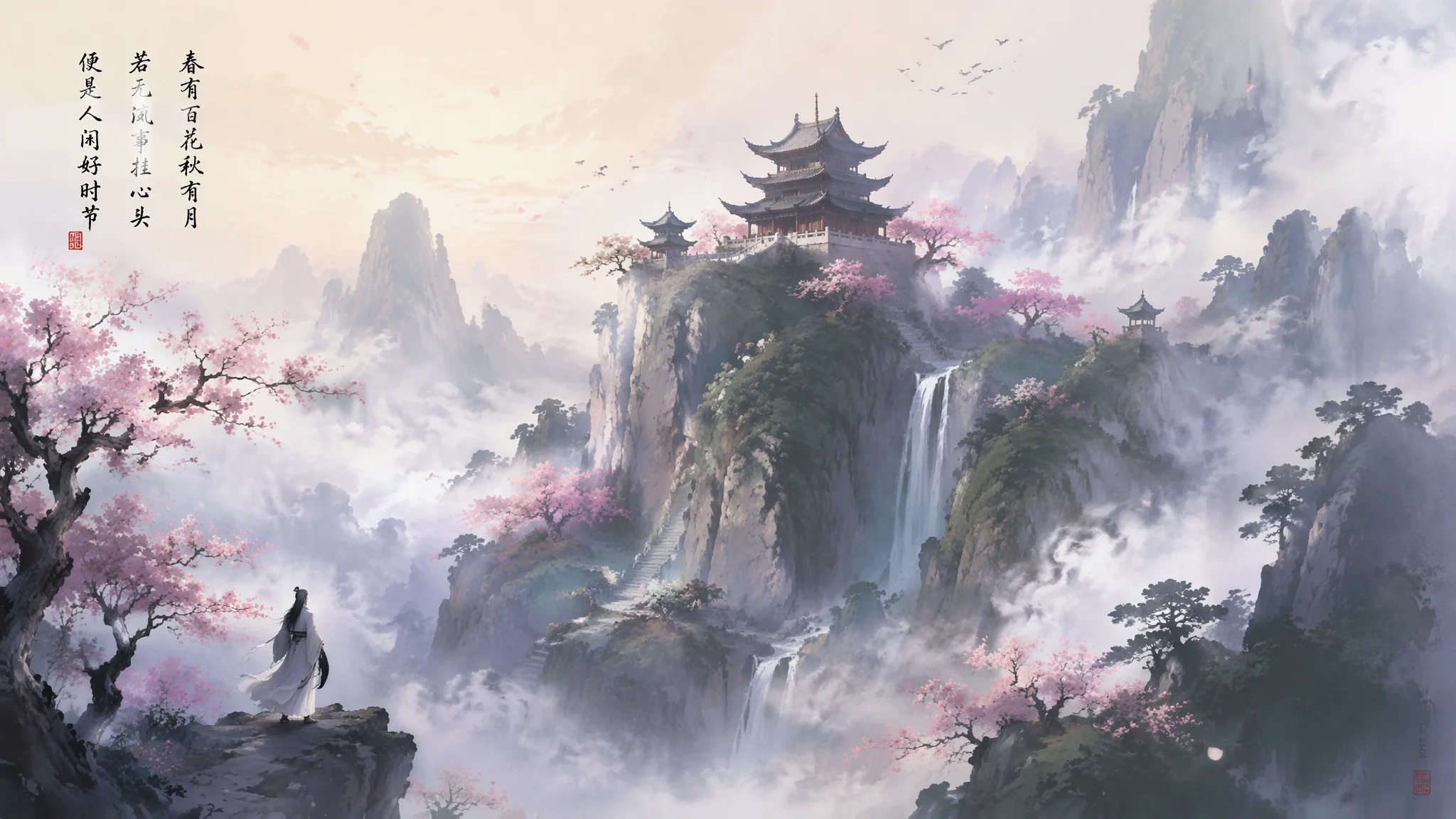
2019年我去了一趟山西——专门去看佛光寺的东大殿。那座唐代木构站在你面前的时候,你会产生一种很奇怪的感觉:它和你在古装剧里看到的"古建筑"完全是两回事。电视剧里的古建筑是横店影视城——斗拱是泡沫做的、颜色是油漆刷的、比例为了镜头服务被改过。而佛光寺的斗拱是真的——巨大、深沉、每一层木头都承载着实际的重量,唐代的红色不是鲜红而是褪了一千二百年之后的那种暗沉的铁锈红。回来之后我用AI尝试画"真正的唐代建筑"——结果AI给我的全是横店风。斗拱被简化成装饰性方块、屋顶的曲线被夸张成日本唐破风那种尖角、颜色是PS里拉过饱和度的正红正绿。试了不知道多少张之后我意识到:AI对"中国风"的理解来自影视剧截图和旅游照——不是来自梁思成的测绘图。这篇就是关于怎么把AI的训练偏差掰回来。
断代——唐宋明清的建筑不是一个"古风"可以概括的
写"ancient Chinese architecture"得到的结果是一个大杂烩——唐的斗拱+宋的格子门+清的彩画+日的枯山水堆在一起。因为AI不知道"中国古代"不是一种风格,是四个完全不同的建筑体系。解决这个问题的第一步是把Prompt里的"ancient Chinese"换成具体的朝代。
唐代建筑特征——雄大、简洁、结构外露。"Tang Dynasty Chinese architecture——the scale is monumental and masculine, the roof is broad and spreading with a gentle upward curve at the eaves (not an exaggerated curl), the dougong bracket sets are massive——each bracket is structural and functional not decorative, the columns are thick and unadorned, the color scheme is simple——vermilion columns, white walls, grey-black roof tiles, green glazed tile edges on important buildings, the overall impression is dignity and power not delicacy"。关键区分词:"monumental""structural dougong not decorative""vermilion+white+grey"。
宋代建筑特征——秀丽、精细、装饰化倾向。"Song Dynasty Chinese architecture——more refined than Tang, the proportions are slender and elegant, the dougong brackets are smaller and more intricate——transitioning from structural necessity to decorative system, the roof curves are more pronounced, the columns are thinner with subtle entasis, the color palette shifts toward cooler tones——deep greens, soft ochres, celadon and blue-grey, lattice windows and carved balustrades add delicacy"。关键区分词:"slender""intricate dougong""celadon tones"。
明代建筑特征——规整、严谨、开始出现繁复装饰。"Ming Dynasty Chinese architecture——rigorous and orderly, the dougong has become smaller and more decorative, the roof maintains the classic sweeping curve, the color scheme introduces more variety——blue-green painted beams under the eaves (hexicaihua), golden roof ornaments (chilong), carved stone balustrades with cloud patterns"。清代建筑特征——极度繁复、色彩艳丽、装饰过剩。"Qing Dynasty Chinese architecture——the most ornate and colorful, dougong is entirely decorative and very small, the roof is covered in yellow glazed tiles for imperial buildings, the beam painting is extremely elaborate with gold dragon patterns, the columns are lacquered deep red, every surface is decorated——the aesthetic is maximalism"。
写清楚朝代=写清楚了建筑的DNA。关于国风建筑与环境的更多系统知识,在AI中国古代风绘画中有从汉服到建筑的全套朝代视觉体系。
山水画的空间逻辑——不是消失点,是"可游可居"
用AI画国风山水场景最大的困难不是"画不出来山"——是画出来的山"只有一层"。西方风景画用线性透视(近大远小、所有平行线消失在同一个灭点)组织空间;中国山水画用"层叠"组织空间——近山、中景水面或云雾、远山层层叠上去,每层之间有云雾隔开。
"三远法"在Prompt中的实践——高远(范宽的《溪山行旅图》式):"gaoyuan (high distance) composition——the viewer stands at the foot of a colossal mountain that fills the upper two-thirds of the frame, a narrow waterfall cascades from the misty heights, small figures and a mule train at the bottom emphasize the mountain's overwhelming scale, the lower corner has detailed rocks and ancient pines that frame the view upward"。深远(郭熙的《早春图》式):"shenyuan (deep distance) composition——multiple mountain ranges recede in overlapping layers, each layer separated by bands of mist, the eye travels through valleys and behind peaks, a winding path or stream leads the viewer into the depth, there is no single vanishing point——depth is created by occlusion and atmospheric perspective"。平远(倪瓒的《容膝斋图》式):"pingyuan (level distance) composition——a horizontal expanse across water or plains, the foreground is a sparse bank with a few dry-branch trees and a simple pavilion, the middle ground is empty water, the distant mountains are pale ink-wash silhouettes on the horizon, the overall feeling is vastness and solitude"。
这三种空间逻辑加在Prompt里能立刻把"CG渲染的山水"变成"有中国画空间思维的山水"。关于中国山水画与AI视觉的逻辑结合,AI古诗词绘画中也有从诗意到山水空间的转化思路可以参考。
写意与写实的天平——全写实像3D渲染,全写意AI理解不了
国风场景在"写实"和"写意"之间的平衡是最难控制的。如果用纯写实Prompt——"photorealistic"——AI会给出一个像网游场景渲染的效果:材质是PBR的、光照是HDRI的、所有东西都太"硬"了。如果用纯写意Prompt——"ink wash painting"——AI会给出墨迹在宣纸上洇开的效果:好看但是完全是2D的,没有空间感。
解决方法是搭建"半写实-半写意"的混合Prompt系统:"the scene is rendered in a style between photorealism and traditional Chinese ink painting——the architecture and rocks have realistic three-dimensional shading and material texture, but the atmosphere and distant elements dissolve into ink-wash softness, the foreground is detailed and tactile while the background is atmospheric and suggestive, the lighting is naturalistic but the color palette is restricted to the classical Chinese palette——ink black, mineral green, cinnabar red, azurite blue, and the warm tone of aged silk"。关键句:"the foreground is detailed and tactile while the background is atmospheric and suggestive"——近处实、远处虚。这是中国画的"虚实相生"在AI Prompt里的翻译。
配色系统也需要手动限定——AI默认的"Chinese style"颜色方案是红+金+黑,但真正的中国古典色板是:石青(azurite blue)、石绿(malachite green)、朱砂(cinnabar red)、赭石(ochre)、藤黄(gamboge yellow)、花青(indigo)。把这些颜色名写进Prompt——"the color palette is classical Chinese pigments: azurite blue for distant mountains, malachite green for foreground vegetation, cinnabar red for architectural details, and warm ochre for the earth and rocks"。国风色彩的系统分析可以参考大都会博物馆的中国绘画馆藏——在线资源中的唐宋元明清各朝代绘画高清图是配色参考的最佳来源。
四种国风场景风格——从仙侠到历史正剧
仙侠奇幻国风:"a floating immortal realm——pavilions and pagodas suspended on levitating rock islands connected by chain bridges, waterfalls cascade off the edges of the floating islands into a sea of clouds below, giant twisting pine trees cling to the rock faces, cranes fly between the islands in formation, the sky is a gradient from deep azure at the zenith to golden mist near the horizon, crystal spires and jade staircases suggest an otherworldly cultivation sect"。仙侠系的关键在"重力异常"——悬浮、水倒流、建筑长在不可能的位置。
历史正剧写实:"a historically accurate Tang Dynasty palace courtyard——grey brick flooring with moss between the cracks, a large bronze incense burner in the center emits a thin wisp of smoke, vermilion columns support the covered corridor that wraps around three sides, the dougong brackets cast geometric shadows on the white walls in the afternoon sun, a few fallen leaves on the stone steps, no people present, the mood is the quiet dignity of a thousand-year-old institution"。历史正剧的核心是"人不在场,但人的存在感极强"——被磨光的石板路、半掩的门、石阶上的落叶。
武侠江湖写意:"a solitary inn at a mountain pass——a simple two-story wooden building with a swaying lantern at the gate, snow covers the roof and the surrounding bamboo forest, a single trail of footprints leads from the inn's door into the snowy forest, the distant mountains are barely visible through the falling snow, warm yellow light spills from the inn's paper windows——the only color in a monochrome world"。武侠场景的核心在"人的叙事痕迹"——雪地上的脚印、门上晃动的灯笼、窗纸透出的暖光。更多武侠相关的场景设计在AI古战场绘画中有从大场面到细节的全套Prompt方案。
新中式极简:"a contemporary space that channels the spirit of a Song Dynasty scholar's garden——a single Taihu rock (scholar's rock) stands in a shallow reflecting pool, a wall with a circular moon gate frames a distant bamboo grove, the architecture is reduced to clean geometric forms in warm grey stone and dark wood, the space is nearly empty——every element is intentional, the light is soft and diffused, the mood is contemplation"。新中式是"去掉装饰,保留空间逻辑"——月亮门、太湖石、借景(从窗框望出去的竹林)这些是真正的中国空间逻辑,不是贴在表面的纹样。中国建筑摄影可以参考ArchDaily上的中国当代建筑项目——贝聿铭的苏州博物馆等作品展示了如何用现代材料诠释传统空间。
常见问题
AI画的中国古建筑屋顶翘角像日本神社——怎么区分中国飞檐和日本唐破风?
日本唐破风(karahafu)是一个独立的弧形山墙——像一道拱形曲线贴在建筑正面,和屋顶不是一体化的。中国飞檐是屋顶在四个角逐渐向上翘起——是屋顶本身的结构延续。Prompt中明确区分:"Chinese flying eaves——the entire roof eave line gradually curves upward at the four corners, the curve is subtle and continuous——not a separate gable, the upturn is most pronounced at the very tips of the eaves where ornamental roof figures (zongshou) perch, NOT a karahafu gable——no separate arched element attached to the front of the building"。如果还不能区分,用ControlNet传入一张佛光寺或应县木塔的照片做建筑结构参考。
山水的"皱法"(皴法)怎么用AI表现——斧劈皴和披麻皴的区别?
皴法是国画中表现岩石和山体纹理的笔法系统。AI不能真正"运笔",但你可以通过描述纹理特征来模拟皴法的视觉效果。斧劈皴(表现北方花岗岩山峰的硬朗切面):"the mountain rock faces have sharp angular texture——like the surface was axed, hard-edged facets catch the light and create strong geometric shadows, the texture suggests hard granite"。披麻皴(表现南方土质山峰的松软圆润):"the mountain slopes have a soft rope-like texture——long flowing lines that follow the contour of the terrain like unravelled hemp fibers, the surface feels eroded and earthen rather than hard and rocky"。卷云皴(表现石灰岩的圆润卷曲):"the rock formations have rounded cloud-like textures——circular swirling patterns that make the stone look like frozen clouds"。在Prompt中加入这些皴法的纹理描述,AI会在材质层面产生相应的视觉偏向——即使它不理解"皴"这个概念。
怎么用AI画"没人的古代城市"但不变成"鬼城"——要生活感但不要人?
纯去人化会让古代城市看起来像刚被疏散——需要"生活的痕迹"来暗示人的存在。街道上——"a street vendor's stall is set up but the vendor has stepped away momentarily——the wok still has steam rising from it, a half-eaten bowl of noodles on the counter"。建筑中——"a scholar's study with an open book on the desk, the ink stone is still wet, a cup of tea has a thin wisp of steam——the scholar just left the room"。水边——"a fishing boat is tied to the dock, the nets are spread out to dry, a fishing rod leans against the railing with the line still in the water"。这些"刚刚离开"的叙事痕迹比画一个活人更能激发观众的想象力——也避免了AI画人物带来的各种解剖问题。