AI橘子水果绘画进阶:柑橘类水果的多品种写实质感与色彩渲染
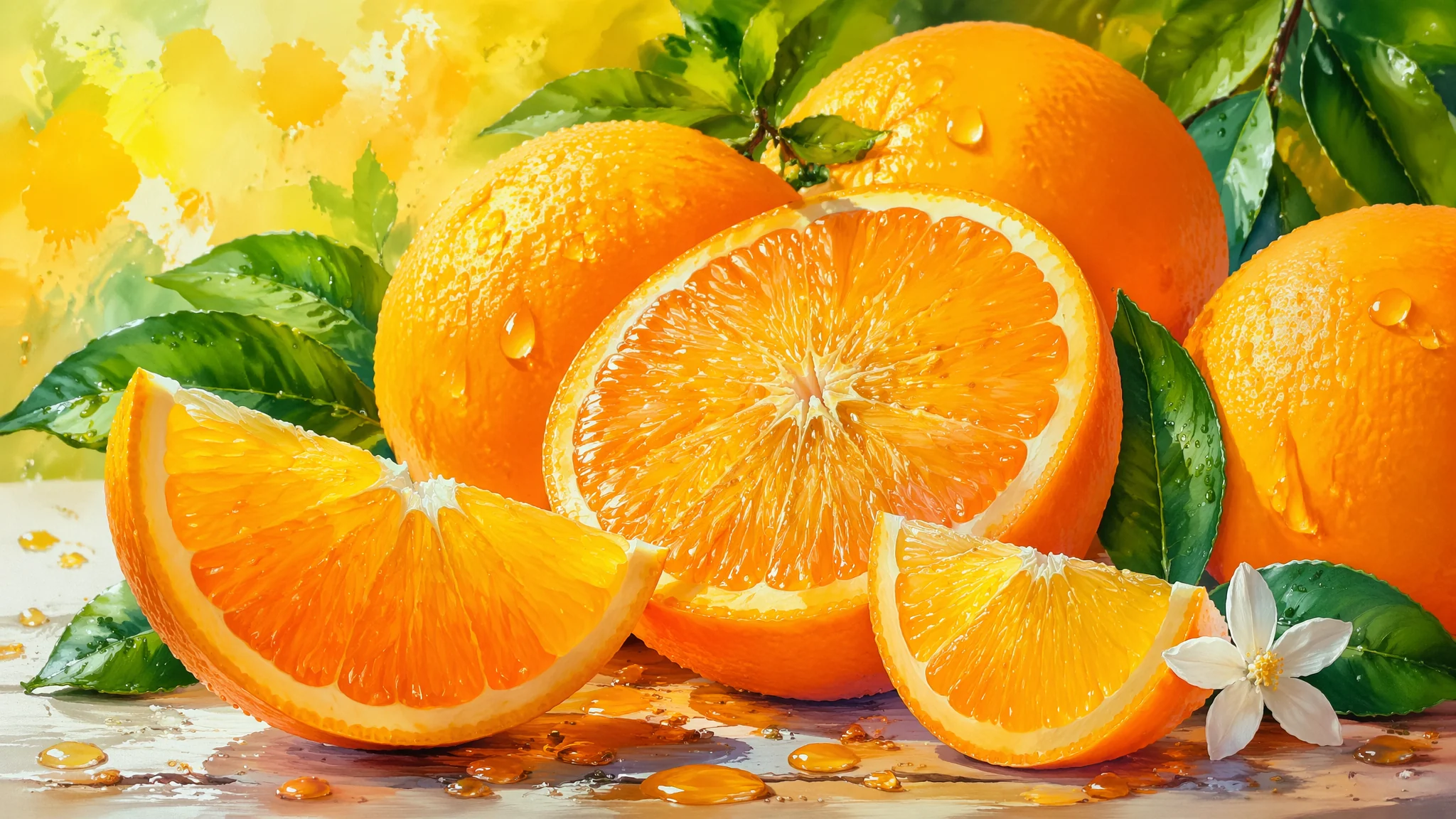
我奶奶是四川人,每年冬天都会寄一大箱"不知火"丑橘来北京。那些橘子皮皱皱的、形状歪歪的、头上还顶着一个鼓包——但剥开之后那股香气能充满整个厨房。有一次我想用AI画一张以丑橘为主题的静物画,结果出来的东西让我哭笑不得——AI把所有"丑"的特征都过滤掉了,给了我一个光滑完美、闪着塑料光泽的"标准橙球"。那一刻我意识到:AI对"橘子"的理解是非常粗糙的——它的训练数据里"orange"这个词关联的图大多经过了商业修图处理,所有不完美的表皮纹理都被磨平了。如果真的想用AI画出让人"闻得到橘子味"的画面,需要你像一个植物学家+食品摄影师+光影师一样去写Prompt。这篇从我过去一年研究"AI水果绘画"的笔记中提炼——专门聚焦柑橘类。
柑橘表皮的科学——为什么"橘子皮"比你想的复杂一万倍
橘子皮(专业术语叫"果皮/flavedo")不是一层均匀的橙色油漆——它是一个具有复杂微观结构的功能性器官。组成橘子皮视觉特征的核心元素有三个:油胞(oil glands)、气孔(stomata)和蜡质层(cuticle wax)。油胞——橘子皮上那些肉眼可见的微小凹坑,每个凹坑下面是一个含有精油的腺体。用手指掐一下橘子皮喷出来的那股"雾"就是这些油胞破裂释放的精油。在Prompt里正确描述油胞:"the surface of the orange is covered in a fine stippled texture——thousands of tiny oil glands dot the entire peel, each gland is a slight depression approximately 0.3-0.8mm in diameter, the rim of each depression catches the light creating a micro-ring of highlight, while the center of the depression sits in micro-shadow——this is what gives orange peel its characteristic matte-sparkle texture, not smooth and not rough but somewhere in between"。
蜡质层是第二个关键——橘子皮表面有一层天然的蜡质,它不是镜面反光而是"柔光反射":"the orange peel has a natural waxy cuticle that creates a soft satin-like sheen——the reflection is diffuse and broad, not sharp and mirror-like, when side-lit the peel shows a gentle gradient of light that wraps around the curvature, the wax also slightly desaturates the orange color in the highlight areas giving a pastel-like quality"。品种间的油胞密度差异也很大:脐橙油胞细密(约每平方厘米80-120个),丑橘油胞粗大稀疏(约40-60个/平方厘米),柠檬油胞几乎不可见(皮太光滑)。这些差异是区分品种的关键视觉线索——比颜色更重要。更多关于水果表皮的材质分析见AI水果材质绘画。
从橙子到金橘——六种柑橘的独特Prompt
脐橙(Navel Orange):"a whole navel orange and one cut in half side by side——the whole orange has a bright vivid orange peel with the characteristic navel at the blossom end——a small secondary fruit embedded like a belly button, the peel has a fine dimpled texture with visible oil glands, the cut half reveals the interior structure——11 to 13 segments arranged radially around a hollow central core, each segment is filled with tightly packed elongated juice vesicles that glisten with moisture, the segment walls are thin translucent membranes, the white pith (albedo) forms a 3mm band between the outer peel and the flesh and extends inward along the segment walls"。
红肉西柚(Ruby Red Grapefruit):"a ruby red grapefruit cut in half showing the stunning interior——the flesh is a deep ruby pink that graduates to a lighter pinkish-white near the center, the segments are large and clearly defined, each juice vesicle is visible as an individual elongated sac, the rind is thick——about 8-12mm——with a yellow outer flavedo and a thick spongy white pith, a few drops of pink juice are beading on the cut surface, the color contrast between the pale rind and the vivid ruby flesh creates a dramatic visual effect"。西柚颜色参考可查阅FDA食品颜色标准中的柑橘类色素分类。
柠檬(Lemon):"a bright yellow lemon with a smooth thin peel——the surface is almost glossy with a natural wax coating, tiny oil glands are barely visible as pinprick indentations, the shape is oval with pointed ends, when cut the flesh is a pale translucent yellow-green with 8-10 segments, the rind is thin——about 2-3mm——with very little pith, juice droplets catching the light like tiny glass beads"。青柠(Lime)的着色要点在AI水果色彩指南中有对比分析。
丑橘/不知火(Dekopon/Shiranui):"a dekopon mandarin——characterized by its intentionally ugly appearance, the peel is loose and wrinkled with a rough bumpy texture, the shape is squat and irregular with a distinctive protruding knob at the top, the peel color is a warm deep orange with some greenish patches near the stem, the skin comes away from the flesh easily showing visible air gaps, when partially peeled the segments are plump and tender, the peel has large distinct oil glands that are more widely spaced than common oranges"。
金橘(Kumquat):"a handful of kumquats——tiny oval citrus fruits about the size of a large olive, the peel is thin smooth and glossy in a bright golden-orange, the unique feature of kumquats is that the peel is sweet and edible while the flesh is tart——a whole kumquat and one cut in half showing the tiny segmented interior, the skin is so thin that the flesh color is visible through it"。其他柑橘品种的视觉参考可以在美国农业部柑橘品种图鉴中找到详细的形态描述。
光与柑橘——让橘子"发光"的核心技术
柑橘类水果最迷人的视觉特征——也是AI最难自动做到的——是"透光感"。橘子果肉是半透明的——当你把一瓣橘子对着光看时,光线会穿透果肉,让汁囊在逆光下像千万颗微小的琥珀珠子一样发光。这个效果的Prompt写法:"backlit orange segment——the segment is held up against a soft light source, the light passes through the translucent flesh illuminating each individual juice vesicle from within, the vesicles glow with a warm amber luminosity, the thin membrane walls appear as delicate dark lines tracing the architecture of the segment, the edge of the segment is rimmed with a thin bright line of light where the surface curves away from the viewer, tiny droplets of juice on the surface act as micro-lenses focusing the light into bright specks"。
侧光下的表皮纹理——"side lighting rakes across the orange peel at a shallow angle——the low directional light emphasizes every bump and dimple on the surface, the raised areas between oil glands catch the light as tiny bright spots while the depressions remain in shadow, the texture becomes the dominant visual element——the orange is not defined by its color or shape but by the topography of its skin"。对于商业食品摄影风格的光线设置,可以参考食品摄影布光的经典教材——AI食品摄影光影中有系统分析。配合水滴效果——"a few water droplets on the surface of the fruit——each droplet acts as a tiny lens magnifying the peel texture beneath it, the droplets have crisp specular highlights on their top surface and a soft shadow underneath where they sit on the peel"——这是食品摄影中让水果"看起来新鲜"的经典手法。
场景构图——从"证件照橘子"到"有故事感的柑橘画面"
单颗橘子孤零零放在画面正中央——这是最无聊的柑橘静物。有魅力的柑橘画面通常包含这些场景元素:剥开的动态瞬间——"hands in the middle of peeling an orange——one hand holds the orange while the other pulls back a strip of peel, a fine spray of aromatic oil mist is visible in the air catching the sunlight, the peel curls away from the flesh revealing the white pith underneath, the gesture is casual and natural——not posed"。装满柑橘的篮子/木箱——"a rustic wooden crate overflowing with mixed citrus——oranges lemons and a few grapefruits nestle against each other in casual abundance, some fruits have leaves still attached on short stems, the wood grain of the crate contrasts with the smooth waxy surface of the fruit, some fruits are in sharp focus in the foreground while others softly blur toward the back"。
厨房料理台场景——"a marble kitchen counter with a cutting board——one orange is sliced into rounds arranged in a slightly overlapping row, another orange is half-peeled with the peel spiraling off in one continuous ribbon, a small puddle of juice has pooled on the cutting board reflecting the overhead light, a knife with orange juice residue on its blade lies nearby"。早餐/饮品场景——"a glass of fresh orange juice on a sunny breakfast table——the juice is a rich opaque orange with a fine layer of pulp visible, condensation beads on the outside of the glass, a halved orange and a vintage juicer are in the soft-focus background, morning sunlight streams through a nearby window creating warm golden highlights"。场景构图的更多思路见AI静物构图。
常见问题
橘子切面为什么AI总是画成"像披萨一样均匀的三角形分割"而不是真正的橘子瓣?
因为AI的"切面"模式是把圆形切割成等角扇形——这是几何逻辑,不是生物学逻辑。真正的橘子瓣不是均匀的三角形——每个瓣的大小和形状略有差异,瓣的顶端不是尖的(是圆钝的),瓣与瓣之间的白色薄膜(中隔)有时薄有时厚。修正Prompt:"the orange cross-section shows 10-13 segments of slightly varying sizes——not perfectly uniform, each segment has a rounded teardrop shape (not a sharp triangle), the thin translucent membrane walls between segments are visible——some are slightly separated showing a gap between segments, the center of the orange has a small hollow core (not a solid point where all segments meet), the pith extends from the outer peel inward along the segment walls in irregular wavy lines"。
商业食品摄影风格的橘子Prompt和写实绘画风格的有什么区别?
商业食品摄影追求"虚假的真实"——比真的看起来更好吃。核心差异:一,颜色饱和度——摄影风加10-15%饱和度让橘子看起来"更橙",绘画风保持自然饱和度。二,表面处理——摄影风会把所有瑕疵修掉(斑点、疤痕、不完美着色),加人工水滴增加"新鲜感";绘画风保留瑕疵作为"真实感"的来源。三,布光——摄影风用大柔光箱制造无影的均匀光照,绘画风用方向性强的侧光或逆光制造戏剧性和体积感。Prompt区别——摄影风:"commercial food photography, studio lighting with large softboxes, the orange is flawless and perfectly ripe, a fine mist of water droplets sprayed on the surface for freshness, high resolution, shallow depth of field, vibrant colors"。绘画风:"still life oil painting style, directional warm light from a window creating chiaroscuro, the orange has natural imperfections——a small blemish near the stem, slightly uneven coloration, the peel texture is rendered with visible brushstrokes, the mood is quiet and contemplative"。
柑橘叶子和枝条怎么画——AI总是把叶子画成"绿色椭圆片"?
柑橘叶片的关键特征:椭圆形但尖端微凹(emarginate tip),叶缘有细锯齿,叶柄处有窄小的翼叶(winged petiole——柑橘属的特征)——"the citrus leaf is ovate-lanceolate with a slightly notched tip, the margins have fine serrations visible upon close inspection, the leaf has a leathery glossy surface with visible pinnate veins, the petiole has a narrow wing——a small leaf-like extension along the leaf stalk that is characteristic of citrus species, the leaf color is a rich dark green on the upper surface and a lighter matte green on the underside"。枝干——"the branch has a smooth grayish-brown bark with occasional sharp thorns (characteristic of many citrus varieties), where the leaf attaches to the branch there is a slightly swollen node"。