AI绘画摄影角度技巧:镜头视角与构图取景的视觉表现方法
我大学学的不是摄影,但我爸玩了一辈子摄影——从胶片机到数码单反到微单,家里防潮箱里的镜头比我的鞋子还多。小时候他带我去拍风景,总是让我先站在原地用眼睛看,然后蹲下来再看,再站到旁边一块石头上再看——"同一个东西,你看它的角度变了,它就不是同一个东西了。"这句话后来成了我理解AI绘画构图的核心信条。很多AI绘画新手把所有精力放在Prompt里的"内容"上——画什么角色、穿什么衣服、什么背景——但忽略了"角度"这个隐形的最强杠杆。同一个角色同一个场景,平拍和仰拍传达的气质完全不同——前者是"日常的",后者是"英雄的"。摄影角度的选择本质上是在定义"观众和画面主体的权力关系"——你站得比它高,你在俯视它(轻视/怜悯/上帝视角);你蹲得比它低,你在仰视它(崇拜/敬畏/渺小感)。这篇把摄影语言完整翻译成AI能理解的Prompt。
六大角度——平拍、仰拍、俯拍、鸟瞰、蚂蚁视角、Dutch angle的Prompt配方
摄影中"角度"不是"相机摆了多高"——它是"镜头光轴和水平面的夹角"。这个夹角决定了观众看到画面时的潜意识感受。AI对角度标签"low angle""high angle"的理解很模糊——你需要把角度翻译成具体的"空间关系"。
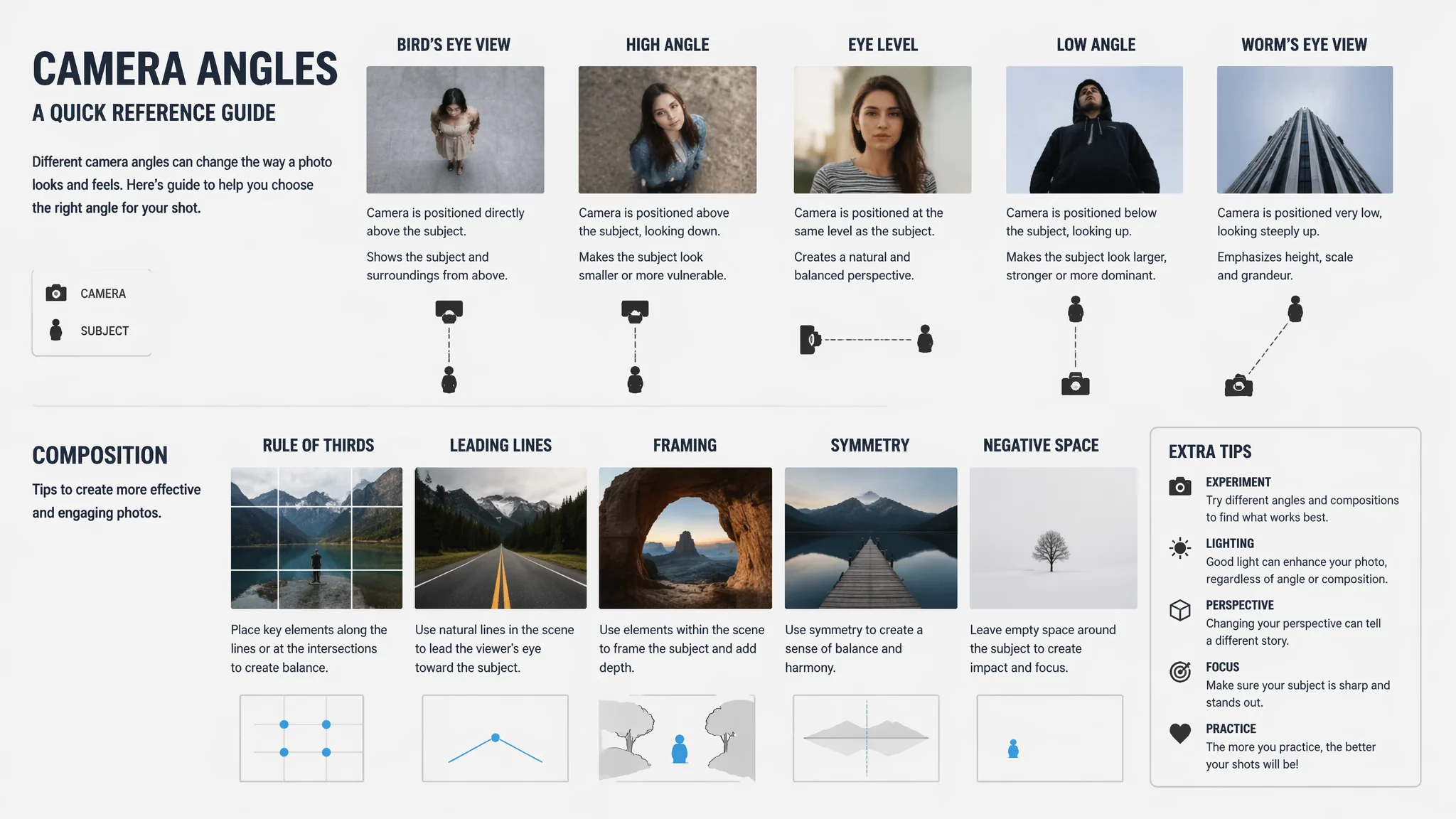
平拍(Eye Level)——中立/日常/平视:"the camera is at eye level with the subject, the lens is positioned at the same height as the subject's eyes, there is no upward or downward tilt, the horizon line is approximately at the center of the frame, the perspective is neutral and natural——this is how a person standing in front of you would see you, the feeling is intimate and equal"。仰拍(Low Angle)——英雄感/威严/压迫/崇拜:"the camera is positioned low——at knee level or ground level, the lens is tilted upward toward the subject, the subject appears larger than life towering over the viewer, the horizon line is low in the frame, the perspective lines converge dramatically upward, the feeling created is awe intimidation grandeur or heroism"。仰拍角度变化范围:"slight low angle at chest level——the subject looks confident and capable, extreme low angle at ground level——the subject looks godlike and overpowering"。俯拍(High Angle)——脆弱/渺小/审视/怜悯:"the camera is positioned above the subject and tilted downward, the subject looks smaller and more vulnerable from this elevated perspective, the horizon is high in the frame or absent, the ground or floor fills most of the background, the feeling is detached or observational or pitying"。鸟瞰(Bird's Eye/Overhead)——全面/平面/上帝视角:"the camera looks straight down from directly overhead——90 degrees to the ground, the subject is seen as a flat shape on the ground plane, the perspective is plan view with minimal depth, the feeling is omniscient and analytical——seeing the big picture, commonly used for food photography desk setups and urban scenes"。蚂蚁视角(Worm's Eye)——极端仰望/震撼:"the camera is placed on the ground looking straight up, the subject is seen from the most extreme low angle, objects near the camera appear enormous, the sky or ceiling is the background, the feeling is of being tiny and insignificant before something immense"。Dutch Angle/倾斜构图——不安/混乱/紧张/梦境:"the camera is tilted so the horizon is diagonal, the entire frame is rotated 10-20 degrees off-axis, vertical lines in the scene are no longer vertical, the feeling is unease disorientation tension or psychological disturbance, commonly used in thriller and horror films"。更多角度与构图技巧在AI漫威超级英雄绘画中有大量超级英雄电影级别的角度运用范例。
镜头的"视觉语言"——焦距、光圈、景深如何在Prompt里表达
镜头不只是"画面清楚不清楚"的问题——不同的镜头参数从根本上改变了画面的空间感、主体和背景的关系、以及观众的注意力分配。AI摄影绘画的进阶,就是学会"用镜头参数思考"而不是"用绘画参数思考"。
焦距与空间压缩——广角(16-35mm)→空间扩张:"shot at 24mm, the wide angle stretches space——things near the camera look larger and far things look further away, the perspective is exaggerated and dramatic, the depth of field is naturally deep, everything is in focus from a few feet to infinity, the wide angle creates a sense of being inside the scene rather than observing from outside"。标准(50mm)→人眼视角:"shot at 50mm, the perspective is natural——this is close to how the human eye perceives space, no distortion no compression, the subject and background have a natural spatial relationship, the rendering is honest and unmanipulated"。人像长焦(85-135mm)→空间压缩+背景虚化:"shot at 85mm with a wide aperture f/1.4, the background melts into creamy bokeh——circles of confusion from distant light sources are soft and round, the subject is sharply isolated from the environment, the compressed perspective flattens the subject's features in a flattering way"。超长焦(200mm+)→强烈压缩+偷窥感:"shot at 200mm, the perspective is extremely compressed——distant buildings look like they are stacked right behind the subject, the viewer feels like a distant observer or a paparazzo, the subject may be unaware of the camera"。光圈与景深——f/1.2-f/2.0(超大光圈)→极浅景深:只有眼睛对焦清楚,鼻尖和耳朵已经开始虚化。f/8-f/11(中等光圈)→适中景深:主体和部分背景都在焦内。f/16-f/22(小光圈)→全景深:从最近的花到最远的山全是清晰的。镜头参数的详细参考可以在DPReview的镜头数据库和Canon的镜头产品页面中查阅。
构图法则的"描述式翻译"——把抽象法则变成AI能执行的场景描述
我最开始翻车的方式是直接在Prompt里写美术术语:"use golden ratio composition""apply rule of thirds"。AI完全不理我——因为它不认识这些抽象法则。后来我换了一种方法:不写法则名称,写"如果这张照片遵守了某某法则,它会看起来是什么样的"——效果立刻上来了。
三分法(Rule of Thirds)——"the subject is placed at the intersection of the left vertical third and the upper horizontal third of the frame, her eyes are aligned with the upper third gridline, she is looking toward the right side of the frame which has more negative space, the horizon sits on the lower third line, the composition feels balanced and natural"。对称构图(Symmetry)——"the composition is perfectly symmetrical along the central vertical axis, the subject is centered, the left and right sides of the frame are mirror images of each other, the symmetry creates a sense of order formality and stillness, examples include a reflection in still water a grand building facade seen head-on a character standing in the center of a doorway"。引导线(Leading Lines)——"a winding path or road starts from the bottom center of the frame and curves toward a small figure in the distance, the path narrows as it recedes creating a strong sense of depth, the viewer's eye follows the path naturally from foreground to background, the leading line is emphasized by its contrast with the surrounding——a bright path through dark forest a straight road across flat desert"。框架中的框架(Frame within Frame)——"the main subject is viewed through a natural frame——the opening of a cave looking out to sea, the arch of a bridge framing the city beyond, or overhanging tree branches creating a dark vignette around a sunlit figure, the frame element is silhouetted or darker than the subject creating depth"。这些构图技巧在角色创作中的实际应用见AI腹肌帅哥绘画中的人物构图方法论和AI宫廷风格绘画中的空间构图策略。
角度选择与情绪的对应表——根据你想要的情绪反向选择镜头
这是我做了几百张摄影风格AI图之后总结出来的"情绪-角度对照表"——不是先选角度再决定情绪,而是先确定"我想让观众感受到什么",再反推应该用什么角度和镜头。
权威/力量——低角度仰拍+广角24mm:"shoot from below with a 24mm lens, the low angle makes the subject look dominant and powerful, the wide angle exaggerates their size relative to the environment, the subject commands the frame"。亲密/温柔——平拍+85mm f/1.4:"eye level shot with an 85mm portrait lens wide open, the shallow depth of field creates intimacy by removing distracting background, the natural perspective makes the viewer feel like they are in a private conversation with the subject"。孤独/渺小——高角度俯拍+50mm:"shot from a high vantage point with a 50mm lens, a lone figure is small in the vast landscape, the high angle emphasizes their vulnerability and insignificance, the composition includes a lot of empty space around the figure"。紧迫/紧张——Dutch angle+35mm:"a tilted Dutch angle shot with a 35mm lens, the skewed horizon creates unease, the wider lens makes the space feel claustrophobic even though more is visible, the combination suggests something is wrong"。梦幻/超现实——鸟瞰+超广角16mm:"top-down bird's eye view with an ultra-wide 16mm lens, the extreme perspective makes ordinary scenes look abstract and unreal, shapes and patterns become more important than recognizable objects"。怀旧/回忆——平拍+50mm+略微过曝:"eye level shot with a 50mm lens, the image is slightly overexposed with a soft haze that recalls old photographs, the colors are slightly desaturated and warm, the overall feeling is of a fond memory seen through time"。摄影情绪对照的更多分析可以查阅StudioBinder的镜头语言教程。
常见问题
AI画出来的"镜头虚化"效果不自然——bokeh像均匀模糊而不是光学虚化?
AI默认的"模糊"是高斯模糊——均匀地把所有像素糊掉。真正的光学虚化(bokeh)有清晰的结构——"the background blur is not a uniform Gaussian blur but true optical bokeh, point light sources in the background render as soft circular discs with brighter edges——this is the characteristic 'donut' shape of specular highlights through a wide aperture lens, the bokeh circles are larger and softer the further they are from the focal plane, the transition from in-focus to out-of-focus is gradual and natural not a sharp cutoff"。把bokeh描述为"带亮边的圆形光斑"可以引导AI产生更接近真实光学虚化的效果。
同一个场景想出一组"不同角度"的系列图——怎么保持风格一致?
系列图的一致性控制:一,固定所有参数只改变角度描述——相同的风格词、相同的角色描述、相同的镜头型号、相同的色彩词。二,把"固定的内容块"放在Prompt前面,"可变的角度块"放在最后——每次微调只改最后一部分。三,使用相同的seed值(如果平台支持)——seed锁定了AI的"随机起点",在不同角度间保持相似性。四,写一个"摄像机绕场景旋转"的描述——"a series of shots as the camera circles around the stationary subject, starting from the front at eye level, moving to a three-quarter view, then to the side profile, each shot maintains the same lighting and the subject's pose"。这套方法在AI绘画描述权重技巧中的系列图一致性控制有更技术性的展开。
手机摄影的"人像模式"效果能用AI模拟吗?
可以,而且效果很好。手机人像模式的视觉特征:模拟大光圈虚化+中心锐利+边缘过渡自然+小传感器带来的深景深基础。"shot with smartphone portrait mode, the subject is sharp with a simulated shallow depth of field——the background is softly blurred like an f/2.8 lens on a larger sensor, the transition from sharp to blurred has a slight artificial quality that is characteristic of computational bokeh, there is a subtle edge detection artifact around the subject's hair where the software struggled to separate fine strands from the background, the overall look is a high-quality smartphone photo not a DSLR image"。这个描述能让AI理解"我要的不是85mm f/1.2的专业虚化,而是手机计算摄影那种略有瑕疵但总体好看的虚化"。