AI小狗绘画详细教程:从头部结构到全身毛发的系统化创作教学
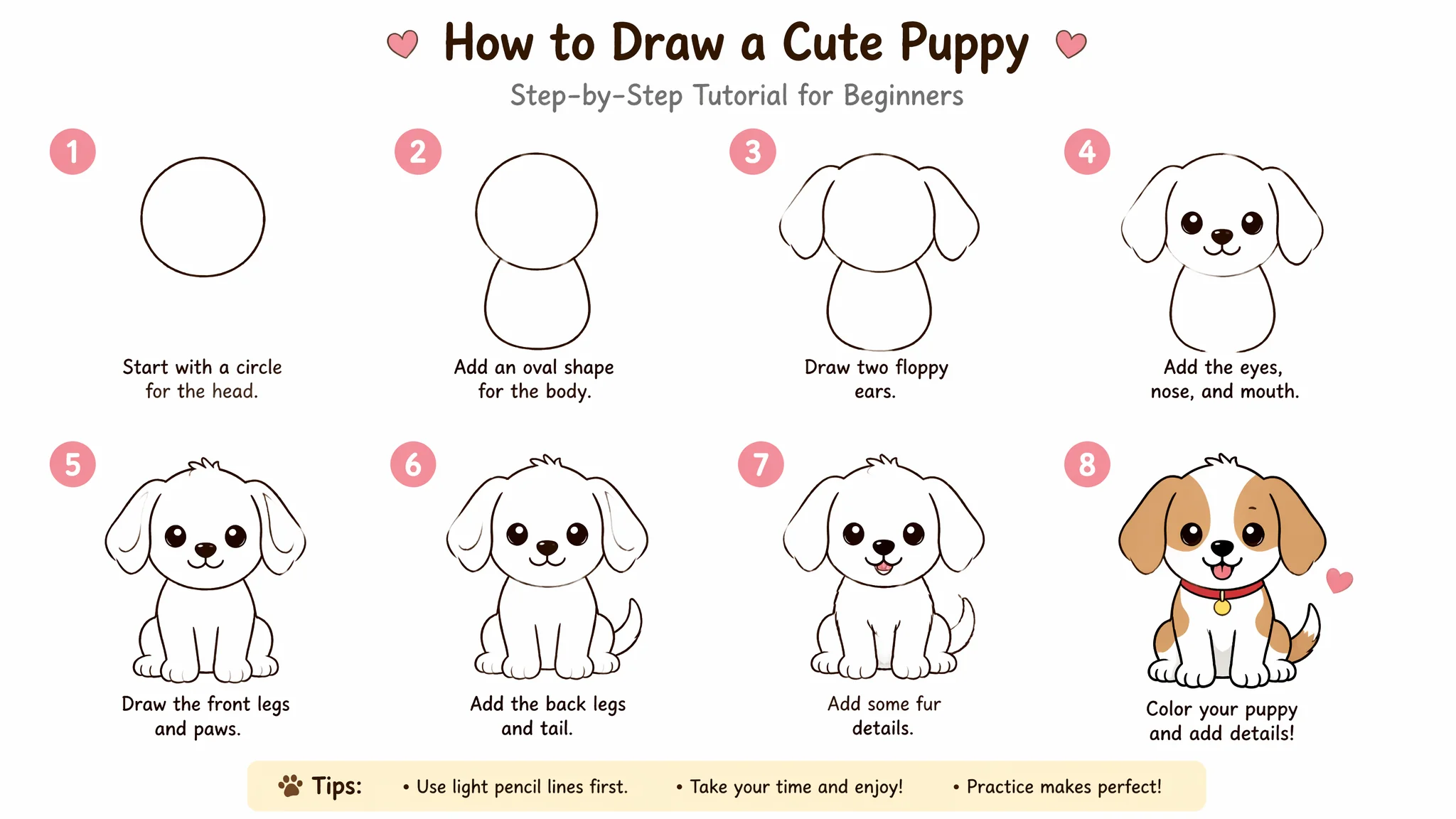
我女朋友去年生日的时候我犯了一个错误——想用AI画一张她家那只柯基"土豆"的肖像画送给她。结果AI出来的东西怎么说呢——像一只被压扁的狐狸和一只短腿金毛的混合体,腿有五条,眼睛长在头顶上。她看了笑了整整五分钟。从那以后我开始系统研究"怎么用AI画狗"这件事——不是那种"可爱小动物"的泛泛画法,而是能精准还原特定品种特征、甚至能让人认出来"这是土豆"的方法。经过差不多一年断断续续的折腾,我摸索出了一套从头部结构、品种特征、毛发质感到动态姿势的完整工作流。
狗的头部结构——AI最容易翻车的地方
狗的头部是AI画狗时出错率最高的区域——80%的"不像狗"的问题出在头部的比例和特征上。狗的头部最关键的结构参数是"止部"(stop)——即额头和鼻梁之间的那个转折角。不同品种的止部角度差异巨大:金毛的止部是缓和但明确的钝角,约120度——"a gentle but clearly defined stop, the forehead slopes smoothly into the muzzle at about 120 degrees";柯利的止部几乎不存在——"a very shallow almost nonexistent stop, the forehead flows into the muzzle in a nearly straight line";而斗牛犬的止部是一个接近90度的深沟——"a deep abrupt stop forming nearly a right angle between the forehead and muzzle"。
止部写对了,狗的面部"品种感"就能出来一半。剩下的一半靠耳朵位置和形状:立耳(柴犬、柯基、哈士奇)——"the ears are triangular and erect, set high on the head, the inner edge of each ear faces forward, the outer edge is slightly rounded";垂耳(金毛、拉布拉多、比格)——"the ears hang close to the head, set at eye level or slightly below, the ear leather is soft and the tips reach to about the corner of the mouth";玫瑰耳(灵缇、惠比特)——"the ears fold backward and outward like a rose petal"。关于更多动物头部解剖的参考可以查阅美国犬业俱乐部AKC品种标准——每个品种的官方标准都详细描述了头部结构和耳朵形态。
品种特征Prompt模板——六大热门犬种逐个写
与其给你一个"万能Prompt"(万能的东西往往万不能),不如给你六个具体品种的详细Prompt模板——你拿去改改就能用。萨摩耶幼犬:"Samoyed puppy——pure white double coat with a thick stand-off texture, the fur is not flat against the body but stands out creating a cloud-like silhouette, the face has the characteristic Samoyed smile——upturned mouth corners with dark lip lines that create a gentle smiling expression, dark almond-shaped eyes set deep with an intelligent sparkle, small thick triangular ears set wide apart and erect, the tail curls over the back"。比熊犬:"Bichon Frise puppy——pure white coat with a soft corkscrew curl texture, the coat is not flat——it has a plush cloud-like volume, round dark eyes with a curious lively expression, the muzzle is of medium length and the stop is moderate, the ears are dropped and covered with long flowing hair"。
博美犬:"Pomeranian puppy——profuse double coat with a harsh outer coat and soft undercoat, the coat stands off the body creating a puffball silhouette, small fox-like face with erect ears set close together, dark bright almond-shaped eyes with an alert and inquisitive expression, the tail is plumed and lies flat over the back"。边境牧羊犬:"Border Collie puppy——medium-length double coat that is dense and weather-resistant, classic black and white markings or other color combinations, the face has a distinctive white blaze running from forehead to muzzle, oval brown or blue eyes with an intense intelligent stare that is characteristic of the breed, semi-erect ears with the tips dropping forward or to the side"。每只狗的更多姿势参考可以从Unsplash的犬类摄影中找到高质量的品种参考图。
毛发质感的四层描述法——从"一团毛"到"一根一根"
AI画狗毛发的默认行为是生成一团模糊的"毛感纹理"——看起来像毛但又不像任何真实犬种的毛。要打破这个默认行为,你需要用"四层描述法"来控制毛发的视觉表现。第一层——整体质感:"the dog's coat is [length: short/medium/long] and [texture: smooth/wiry/curly/fluffy], with [density: a single coat/a dense double coat]"。第二层——光泽和反光:"the guard hairs have a [healthy sheen/silky luster/matte texture], the light catches the tips of the outer coat creating a subtle halo of scattered highlights"。第三层——毛流方向:"the fur flows in natural directional patterns——[具体部位的毛流方向描述]"。
第四层——毛发边缘处理(这是最关键的一层):"individual strands of fur are visible along the silhouette edge where backlighting catches them——these edge hairs are semi-translucent and soft, not sharp plastic-like lines"。这四层写完,AI生成的毛发质感会有质的飞跃。一个我反复验证过的规律:AI对"soft"和"fluffy"这两个词的理解非常浅——它只会给你加模糊。如果你想要真正的"软"——必须描述"为什么看起来软":因为细(fine texture)、因为松散(loose structure)、因为半透明边缘(translucent edges)。把"它很软"换成"它为什么看起来软"——这是所有材质描述的最核心方法论。类似材质技巧在AI布料材质绘画中有扩展分析。
动态姿势——让小狗"活"起来而不是"站"在那里
站着的狗是最无聊的狗——这是我在出了几十张"证件照风格"的小狗图之后悟出来的。狗最有魅力的瞬间是那些展示性格的动态:柯基奔跑时因为腿短导致的"身体跟不上腿"的笨拙感、金毛叼着东西时尾巴摇成螺旋桨的兴奋状态、柴犬趴在地上用前爪捂脸的那个傲娇姿势。捕捉这些动态的关键不是描述"动作"本身——而是描述"身体各部位在这个动作中的相对位置和状态"。
柯基飞奔:"a corgi running at full speed——the body is stretched long and low to the ground, the short legs are a blur of motion barely touching the ground, the large ears are pinned back by the wind, the mouth is open in a happy pant, the tail if present is wagging furiously, the whole body language says pure uncontainable joy"。金毛叼玩具:"a golden retriever puppy trotting proudly with a stuffed toy in its mouth——the toy is held gently but securely, the head is held high with pride, the tail is wagging in wide sweeping arcs, the eyes are looking up at the viewer as if seeking approval, the gait is bouncy and light"。
柴犬趴地捂脸:"a Shiba Inu lying flat on the floor with both front paws covering its face——the gesture is dramatic and almost theatrical, the body is pressed low against the ground in a 'sploot' position with the hind legs stretched straight back, one eye peeks between the paws, the curled tail is relaxed and slightly wagging"。关于更多动物动态姿势的参考见AI动物动态绘画和AI猫咪绘画教程——猫的动态逻辑和狗互补参照很好用。
写实与卡通风的切换——同一只狗的两个世界
同一条Prompt从写实切换到卡通模式不是加一个"cartoon style"就完事的——那会给你一个"不知道是哪国动画片风格"的四不像。写实到卡通的切换涉及渲染方式、比例系统、线条处理和色彩逻辑的四重变化。写实模式的核心词:"photorealistic, natural lighting, shallow depth of field, detailed fur texture, anatomically accurate proportions"——这是"动物摄影"的逻辑。卡通模式的核心词则需要精确指定风格来源:"in the style of Disney animal animation——expressive large eyes with visible sclera, softened anatomical proportions with slightly enlarged head and paws, smooth gradient shading rather than detailed fur texturing, clean readable silhouette with simplified shapes"。
日系治愈风——"in the style of Japanese character illustration, soft watercolor-like coloring, the dog has simplified rounded features with exaggerated puppy proportions——large head, oversized paws, big sparkling eyes with multiple highlight points, the fur is rendered as soft color blocks with minimal line work, the background is a simple pastel gradient"。皮克斯3D风——"in the style of Pixar animation, the dog has stylized proportions with expressive facial features, subsurface scattering on the ears and nose giving a soft translucent glow, the fur is rendered as textured volumes not individual strands, the overall feel is warm and cinematic"。更多风格切换技法见AI风格迁移教程。
常见问题
AI画的小狗总是有"恐怖谷效应"——明明是狗但看着很诡异怎么办?
恐怖谷效应在AI画狗中的来源通常是三个点:眼睛太像人类(有眼白、瞳孔正圆且正对镜头)、嘴巴弧度不对(AI学人类微笑的弧度套在狗脸上)、头部和身体的比例关系的诡异(小狗头+成年狗身体)。逐个修正:眼睛——"dark eyes with no visible white sclera, the iris fills most of the visible eye";嘴巴——"the mouth is slightly open in a natural canine pant, the lips are relaxed not stretched into a humanlike smile, the tongue is visible and has a natural pink color with a slightly textured surface";比例——"the head to body ratio is approximately 1:3 for a puppy, the paws are disproportionately large compared to the legs——a key puppy characteristic"。这三个点修正好之后,诡异感会明显消退。
想画一只特定的小狗——比如我家那只——需要训练LoRA吗?
不一定。如果你的目标是"画同品种、同花色、相近气质的小狗"——用详细的品种Prompt+毛色描述就可以达到80%相似度。如果你追求"让人一眼认出是我家那只"的相似度——那需要LoRA。训练LoRA的最低门槛:10-15张不同角度、不同光线、高清晰度的目标狗照片,用kohya_ss训练,约30-60分钟。训练时要注意:照片背景要尽量干净(杂乱背景会被AI当作"狗的特征"一起学进去),要包含正面侧面和45度角(缺某个角度的话AI在该角度时容易崩)。具体训练流程参考AI宠物LoRA训练专题。
为什么AI画的狗常常腿的数量不对或者腿长得很奇怪?
因为AI的训练数据里狗的腿经常被遮挡——站在草丛里遮住了腿、趴在沙发上腿压在身体下面、照片裁切只拍了上半身。AI学到的不是"狗有四条腿"这个事实,而是"狗照片里有大约2.7条可见腿"的统计规律。解决方法:在Prompt里加"all four legs are clearly visible and planted on the ground, each leg is anatomically complete from shoulder/hip to paw"——明确要求四条腿完整可见。如果还不行,试负面Prompt:"extra limbs, fused legs, missing legs, legs growing from abdomen, asymmetrical limb count"。