AI简单场景绘画:初学者友好的快速环境背景创建方法与技巧
去年我表妹想用AI给她的网文做封面——她完全零基础,打开Midjourney第一件事就是写"a fantasy kingdom with dragons flying over a castle surrounded by mountains with a river of lava and a glowing crystal tower"。AI给她返回了一团五彩斑斓的灾难——画面里什么都有但什么都看不清。我跟她说了一个原则:场景画得烂不是因为AI不行,是因为你一次给了它十个任务。简单场景的核心心法:一个场景只讲一件事——一间咖啡馆(而不是"一整条商业街")、一片树荫下的草地(而不是"整座森林")、一扇洒满阳光的窗户(而不是"整栋房子")。这篇写给场景苦手的新手朋友——咱们从"三句话画一个能用的场景"开始。
最简单的场景公式——"一个地方+一个时间+一种光线"
新手最常见的毛病是场景Prompt写得像小说——大段大段的形容词堆上去反而让AI迷失方向。经过数百次翻车,我总结出了一个绝对不会翻车的三要素公式:地点(where)+时间(when)+光线(how it's lit)。这三个要素每一个只用一句话,三句话就能生成一个完整且可用的场景。
三句话场景Prompt模板——第一句:具体地点。"a small neighborhood coffee shop on a quiet street corner——the shop has a wooden storefront with large windows and a chalkboard sign on the sidewalk"。第二句:时间与季节。"late autumn afternoon around 4pm——the sun is low in the sky and the light has a warm golden quality, fallen leaves scatter across the sidewalk"。第三句:光线氛围。"the sunlight streams diagonally through the cafe windows creating pools of warm light on the wooden floor inside while the street remains in cool blue shadow"。三句话,没有一句废话。AI在理解这个场景时不会迷路——因为它有一个清晰的"地方+时间+光"的三角框架。
为什么这个三要素公式特别管用?因为AI生成场景时本质上是在回答三个问题:我在画什么(地点)?这个画面发生在什么时候(时间)?画面里什么东西是亮的、什么东西是暗的(光线)?你把这三个问题回答清楚了,AI就拥有了构建画面的全部基本信息。反过来看,那些翻车的长Prompt往往回答了"画面里应该有什么"(列举了二十种物体)却忘了回答"光线从哪里来"——这就等于让AI蒙着眼画画。更多关于Prompt精简的技巧见AI初学者绘画。
日常场景——最容易上手也最实用的场景类型
新手最喜欢画奇幻和科幻场景——但新手最容易画好的其实是日常场景。理由是AI对"咖啡店""书房""公园长椅""浴室""厨房""教室"这些日常场景的训练数据最丰富——你不需要用复杂的描述去构建一个它没见过的东西。
几个几乎100%不会翻车的日常场景模板。书房——"a cozy home study with floor-to-ceiling bookshelves along two walls——the shelves are filled with books of varying sizes and colors, a heavy wooden desk sits by a window, a green reading lamp casts a warm circle of light on an open book, the room has the quiet stillness of a Sunday afternoon, dust motes float in the shaft of sunlight coming through the window"。清晨厨房——"a sunlit kitchen in the early morning——the light is soft and milky white coming through a window above the sink, a kettle is on the stove with steam rising gently, a half-eaten breakfast sits on the counter——a plate with toast and a mug of coffee, the room has a quiet domestic warmth, the tiles on the backsplash catch the morning light"。
日常场景的另一个好处是"错误不致命"——如果你画的是奇幻城堡,AI把一个塔楼位置画错了,整张图废了。但画咖啡馆的时候——台灯的光圈偏了五度、窗外街景模糊了一点点,这些"错误"反而增加了画面的自然感。关于日常氛围的营造技巧在AI场景生成绘画中有更系统的展开。
自然场景的简化法则——天空和地面是最便宜的"填充物"
自然场景的复杂度可以无限膨胀——从一棵树到一片森林、从一条小溪到整个峡谷。学会用"天空"和"地面"这两个元素作为场景的主要构成——它们是最便宜(Prompt开销最小)但效果最好(视觉占比较大)的场景元素。
大面积天空Prompt——"a vast open landscape under an enormous sky——the sky occupies the upper two-thirds of the composition, it is a late summer sky with scattered cumulus clouds that catch the warm light of the setting sun, the clouds range from bright white at their tops to soft grey-purple at their bases, the land below is reduced to a simple silhouette——a dark strip of grassland with a single tree on the horizon line, the composition is about the sky——the land is merely a frame for the cloudscape"。天空+水面——"a lake at twilight——the water is glass-smooth and reflects the sky perfectly, the horizon line is a thin dark band of pine forest, the upper sky is deep blue fading to a band of orange at the horizon, the reflection in the water mirrors these colors exactly——the scene is essentially just sky and its mirror image, the simplicity is what makes it beautiful"。
自然场景简化的核心智慧:让一个元素占据画面的绝大部分面积。天空占70%、地面占30%,或者水面占60%、天空占40%。大面积单一元素自带视觉平静感——这是"简单场景"美学的基础逻辑。参考国家地理摄影中的风光构图——最好的风景照经常把80%的画面留给天空。
场景"留白"的艺术——空场景≠无聊场景
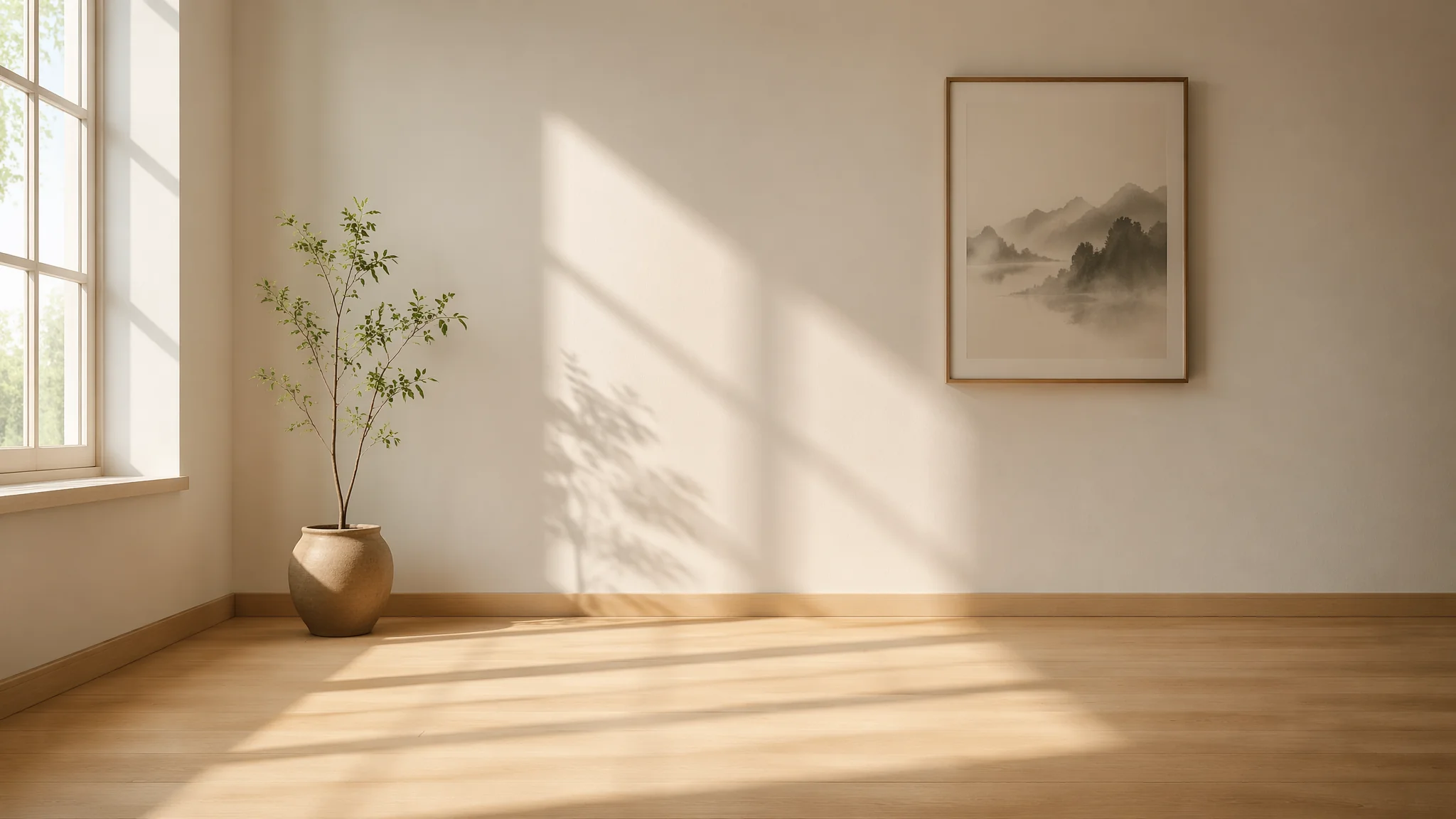
新手最容易犯的错是"场景填充焦虑"——总觉得画面里必须有足够多的物体才叫"完成"。一个只有一面墙、一扇窗、一道光的空房间可以是世界上最动人的画面——如果那道光的位置和角度对了。
极简室内Prompt——"an empty room with a single window——the room has white walls and old wooden floorboards with a warm honey patina, the window is tall and narrow with divided panes, the afternoon sun projects the window's cross-shaped shadow onto the wooden floor, the shadow is sharp and elongated——the only graphic element in the room besides the window itself, there is a sense of peaceful solitude, the room is empty but not abandoned——clean and waiting"。空场景的"不空"来源于光线在空表面上的行为——光在地板上画出的几何形阴影、光在墙上造成的明暗渐变、光穿过玻璃时投下的色散。这些"光的痕迹"就是空场景的内容。
一个很有用的练习方法——画十张"只有一个窗户的房间",每张改变时间(清晨、正午、黄昏)和天气(晴天、阴天、雨天)。通过这十张画你会深刻理解"空场景的力量来自光而不是物体"这个道理。这个练习思路在AI绘画进阶学习的训练方法中也有提及。
常见问题
场景画出来总是"空荡荡"的——怎么判断该加东西还是该留白?
判断标准只有一个:你的场景想传达什么情绪?如果情绪是"宁静""孤独""冥想"——空是对的,东西越少越好。如果情绪是"热闹""生活感""故事性"——需要加物体但没有必要加很多,三四个精心选择的物体就够了。安静场景留白Prompt:"an almost empty room——the emptiness is intentional, the negative space is the subject"。热闹场景轻量填充:"a few meaningful objects scattered naturally——not clutter but signs of life, a half-drunk cup of tea, a book left open face-down, a sweater draped over the back of a chair, each object suggests a person who just stepped away"。
怎么用最少的词描述"时间"——让场景一眼看出是清晨还是黄昏?
时间感的传达不靠说"这是早上7点",靠光线质量。清晨的光是"冷白中带一丝暖"——"the light is pale and slightly blue but has a golden tint near the horizon"。正午的光是"硬、白、垂直"——"the light is harsh and white, shadows fall straight down and are short and sharp"。黄昏的光是"暖、低、拉长"——"the light is warm and golden, shadows are long and stretch horizontally across surfaces"。把光线质量写对了,时间就自动传达了——不需要提具体钟点。
简单场景会不会让画面看起来很"廉价"——怎么让简单的场景仍然有高级感?
高级感不来自复杂度——来自"光线的质量"和"色彩的克制"。一张画面里只有一张桌子、一把椅子、一盏灯——但如果灯光在墙上的投影形状完美,搭配了有质感的木纹和柔和的色温——这张画就是高级的。提升简单场景高级感的三要素:"the lighting has cinematic quality——motivated from a single source with carefully controlled falloff, the color palette is restrained——no more than three dominant colors that harmonize, the textures are visible and tactile——wood grain, fabric weave, the subtle grain of the wall plaster"。关于场景用色见Adobe色彩理论的配色指导。