AI哭泣女性绘画:泪光闪烁与悲伤情感的女性角色深度视觉表达
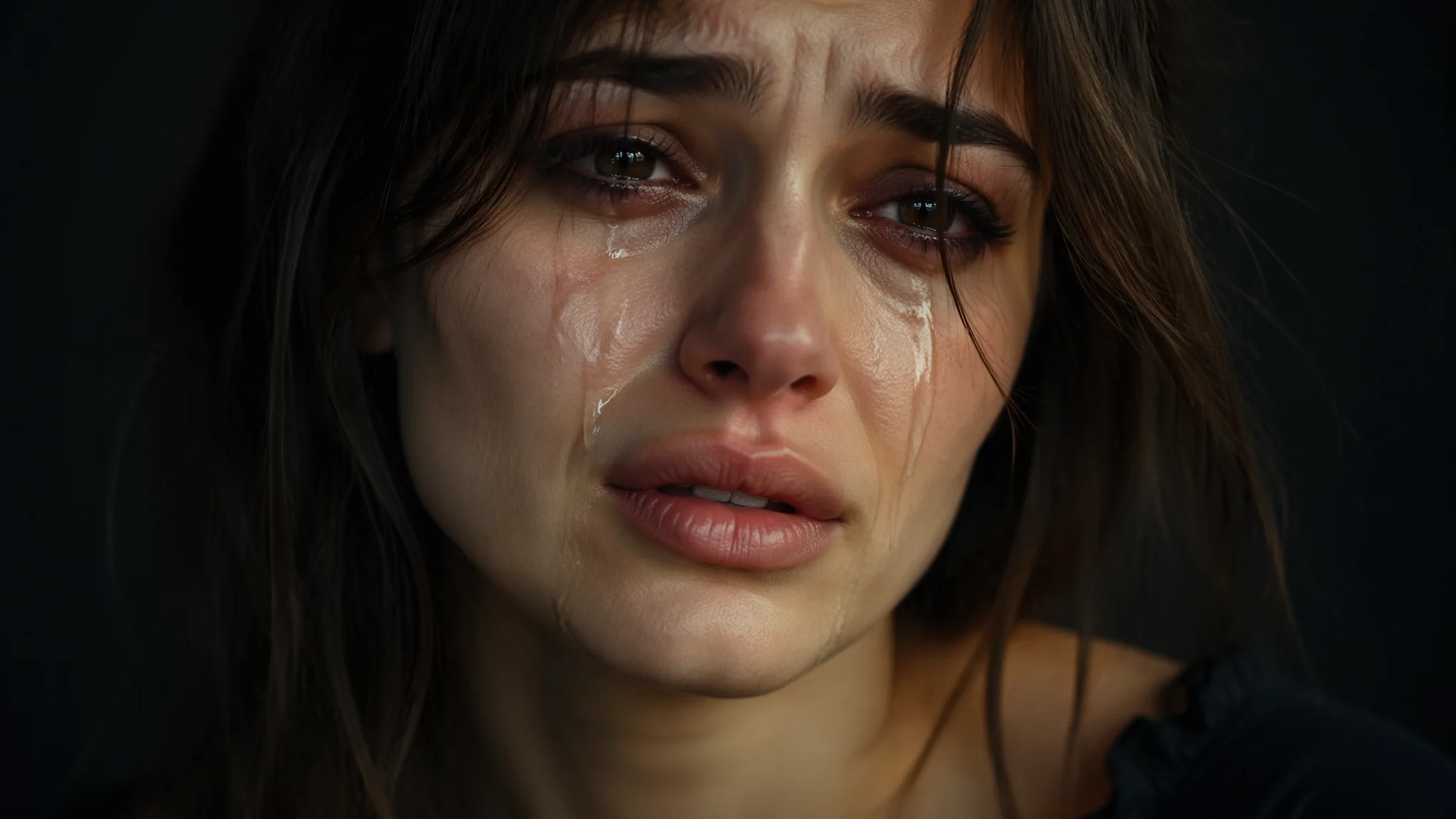
去年冬天有一次跟女朋友吵架——不是大吵,就是那种两个人坐在沙发上各自沉默、气氛很僵的冷战。后来她自己回了卧室,我没跟进去。过了一阵我推开门,看到她坐在床沿,脸上没表情,但眼泪就那么一颗一颗往下掉——没有抽泣声,没有擤鼻子,就是安安静静地流泪。那个画面比任何嚎啕大哭都让我难受。之后我用AI尝试画"哭泣的女性"的时候,发现AI对哭的理解极其粗暴——不是嚎啕大哭嘴张到下巴脱臼,就是两行白色液体粘在脸颊上像修正液涂的。完全画不出那种"安静地心碎"的感觉。所以这篇把泪水解剖、面部肌肉、气氛控制全部拆开来讲。
眼泪不是白色液体——泪水的物理光学三要素
AI对眼泪最大的误解:它以为眼泪是一种白色的、不透明的液体——类似于牛奶或者白色丙烯颜料——涂在脸上就是两条白道。但真实的眼泪是透明的——和清水一样——它在画面中的可见性完全来自于三个物理光学现象:高光反射、液体折射、以及湿润表面的反射率变化。泪水体积感的Prompt——"each tear is a three-dimensional bead of clear fluid with physical mass——it is not a flat white line, it bulges slightly from the surface of the skin, the top edge catches a bright specular highlight from the light source——a tiny sharp white point of reflection, the body of the tear is transparent——you can see the skin color and texture through it"。
泪水的折射效果——"the tear acts as a tiny liquid lens——the skin pores beneath the tear are slightly magnified and distorted, the edge of the tear has a subtle dark outline where the light bends, this refractive edge is what makes the tear visible when there is no direct highlight on it"。泪痕——"the trail left behind a falling tear is a thin film of moisture——it darkens the skin slightly, reduces the skin's natural texture and matte quality, catches a faint glisten when the viewing angle aligns with the light source"。这三个光学现象写全了,眼泪才会看起来是"挂在上面的液体"而不是"画上去的颜料"。关于面部细节的光学表现可以参考AI写实帅哥绘画中皮肤渲染的物理逻辑。
哭泣的脸——一组特定肌肉的协同运动
AI画"哭泣表情"的通病:把"frowning"和"crying"搞混。皱眉+嘴角下垂=愤怒或厌恶,不是悲伤。真正的人类哭泣表情涉及一组非常特定的面部肌肉群——这些肌肉的协同运动产生了"悲伤脸"独有的视觉特征。眉毛——"the inner ends of the eyebrows are pulled upward and toward each other by the corrugator supercilii and the medial portion of the frontalis——this creates an inverted V or a 'grief muscle' triangle between the brows, vertical wrinkles form between the eyebrows, the outer ends of the eyebrows may droop slightly"。
眼睛——"the orbicularis oculi muscles around the eyes are contracted——the lower eyelids tighten and push upward causing the eyes to appear narrowed and squeezed from below, crow's feet wrinkles radiate from the outer corners, the upper eyelids may appear heavier or droop from fatigue"。嘴巴——"the mentalis muscle in the chin is contracted——the chin dimples and the lower lip pushes upward and trembles, the depressor anguli oris pulls the corners of the mouth downward——this is active pulling down not passive drooping, the levator labii superioris lifts the upper lip in a grimace exposing the upper teeth, the nasolabial folds deepen into prominent grooves"。嘴唇——"the lips are parted, the lower lip is slightly everted and trembling, the mouth is not stretched wide like in a scream——the opening is vertical rather than horizontal"。
把这些解剖学词汇写进Prompt——"corrugator contraction""orbicularis oculi tightening""mentalis dimpling"——比写一百遍"sad expression"有效。对角色表情的系统控制方法见AI成熟男性绘画中的表情解剖分析。
四个哭泣强度级别——从眼眶湿润到情绪崩溃
很多AI绘画写手把所有"哭泣"都写成一个强度——要么泪水过多淹没了表情,要么表情夸张但一滴泪都没有。实际上哭泣是一组强度渐变的状态——从情绪即将失控的前一刻到彻底释放后的虚脱,每个阶段都有不同的视觉重点。含泪(强度1:眼眶蓄满但未溢出)——"the eyes are glassy and over-bright, a thin film of moisture coats the surface of the eye making it more reflective, the lower lash line is wet and clumped together in small spikes, the tears are trembling on the edge of the lower lid——held there by surface tension, the expression is one of holding back——the jaw is clenched, the lips are pressed together, the emotion is contained but visible"。
落泪(强度2:安静地流)——"a single tear or a few tears are falling, each tear rolls down the cheek following the contour of the cheekbone, the trails are thin and glistening, the expression is one of quiet sorrow——the crying is silent, the face is not contorted, the sadness is deep but not explosive, the posture may be still and withdrawn"。抽泣(强度3:控制开始破裂)——"the crying has become audible and physical——the mouth is open in a sob, the breathing is visible in the heaving of the shoulders and the expansion of the nostrils, tears flow freely down both cheeks in multiple tracks, the nose has begun to run, the face is flushing and becoming blotchy——real crying is messy and unphotogenic"。崩溃(强度4:完全释放)——"complete emotional collapse——the face is swollen and puffy from prolonged crying, the eyes are red-rimmed and the eyelids are thickened, tears and nasal mucus mix on the face, the mouth is contorted in a wail, the posture has given way——the body is slumped or curled, the crying has exhausted the person"。每个强度级别对应的情绪状态和身体反应都不一样——不要用"strong crying"一个词覆盖全部。相关的情感表达技法在AI明媚少女绘画中有反向对照——笑的肌肉群和哭的肌肉群是同一套系统的不同配置。
氛围与光源——悲伤的情绪不是靠"脸"一个人扛的
一张哭泣画面的情绪感染力,光源和色调至少占50%。同样的哭脸在不同的光线下完全是不同的故事。冷色侧窗光(孤独与内省)——"a single source of cold window light from the side, the light is overcast and gray——no direct sun, the half of the face turned toward the window is illuminated in cool pale tones while the other half falls into soft shadow, the tears on the lit side catch the diffuse gray light as tiny bright points, the mood is one of solitary reflection"。暖色低角度光(脆弱与亲密)——"a warm dim light from a bedside lamp or a candle, the light is low and intimate, the face is lit from below which is unusual and slightly unsettling——shadows fall upward, the tears glow amber in the warm light, the mood is fragile and intensely personal"。
雨与窗(隐喻性场景)——"seen through a rain-streaked window, the woman is indoors looking out, the rain on the glass distorts her face——the tears on her cheek and the rain on the window become visually continuous, the interior is dark and the exterior is gray, the reflection of her face is visible in the glass doubling the image"。镜中(自我审视)——"she is looking at herself in a mirror, her reflection shows her crying face, her hand is pressed against the mirror surface, the condensation from her breath fogs the glass around her hand, the mirror creates a dialogue between the self that cries and the self that watches"。这些场景设计的意义在于让你不需要在Prompt里写"she is sad"——场景自己会说话。可以看看MoMA摄影馆藏中Nan Goldin和Sally Mann的情绪肖像,以及英国国家美术馆中古典绘画的哭泣主题——从宗教画的圣母哀悼到浪漫主义的情感表达。
妆容与哭泣——眼泪对妆容的物理破坏是真实感的关键
一个化了妆的女性哭过之后,脸上的妆容会发生一系列特定的物理变化——这些变化是区分"AI假哭"和"像真的哭过"的重要视觉线索。睫毛膏——"mascara has smudged from the lower lashes creating dark gray smears under the eyes, the smudging follows the path of the tears——drawn downward and outward, the upper lashes are still intact but the lower ones are clumped and spiky from the moisture"。眼线——"eyeliner has blurred and migrated from the lash line——the sharp line is now a soft smudge, the inner corner of the eye has collected a small dark deposit of dissolved makeup"。底妆——"foundation has separated where the tears flowed——creating visible streaks of lighter skin tone through the makeup, the texture of the skin is exposed in these tracks while the rest of the face remains covered"。唇妆——"lipstick has bled slightly beyond the lip line, the center of the lips has been wiped or bitten leaving a ring of color around the edges"。
这些妆容破坏的细节比任何"crying expression"描述都更能说服观众"这个人是真的哭过"。不过也要注意——有些创作意图需要"唯美地哭"(妆容保持完整),有些需要"真实地哭"(妆容花了)。这是两条完全不同的审美路线,从Prompt的一开始就要选定。相关的面部细节技法可以参考AI古装美女绘画中对妆容与表情互动的处理。
常见问题
AI画的眼泪为什么总像"脸上画了两条白线"——怎么让眼泪看起来有体积感和折射?
因为AI把"tears"理解成白色的条纹。真实泪水是透明的三维液体。体积感——"each tear has physical mass——a bead of clear liquid, the top edge catches a specular highlight"。折射——"the tear magnifies the skin beneath it, the edge has a dark refractive outline"。湿痕——"the trail is a thin film of moisture that darkens the skin slightly and catches a faint glisten"。把"白色线条"替换为"透明液体+高光+湿痕"三重信息。
哭泣时面部肌肉的具体变化是什么——怎么避免AI把"哭"画成"皱眉+张嘴"?
"皱眉+张嘴"其实是愤怒或喊叫。真正的哭泣:降眉肌——"inner eyebrows pulled upward and together, vertical wrinkles between brows"。眼轮匝肌——"lower eyelids tighten and rise, crow's feet"。提上唇肌——"upper lip pulled upward, nasolabial folds deepen"。颏肌——"chin dimples, lower lip trembles"。降口角肌——"corners of mouth actively pulled downward"。把这些肌肉术语写进Prompt。
不同哭泣强度的Prompt怎么写——含泪、落泪、抽泣、崩溃四个级别?
含泪——"eyes glassy, tears trembling on lower lid edge, jaw clenched holding back"。落泪——"single tear rolling down, quiet sorrow, expression not contorted"。抽泣——"mouth open sobbing, shoulders heaving, tears flowing freely, nose running"。崩溃——"face swollen, eyes puffy, tears and mucus mix, posture collapsed, completely exhausted"。每个级别对应不同的肌肉参与度和身体姿态。
怎么让"哭泣"的画面有故事感而不是单纯的"一张哭脸"——场景和叙事的Prompt策略?
加入叙事锚点让观众脑补故事:一封信——"crumpled letter in hand, tear has fallen on the ink"。雨中的街道——"rain and tears mix, clothes soaked, not seeking shelter"。破碎的相框——"shattered photo frame on floor, reflection visible in glass shard"。这些物件提供"为什么哭"的线索——比直接写"she is sad because..."有效得多。