AI古风师徒绘画:仙侠武侠中的师门传承与江湖情深视觉创作
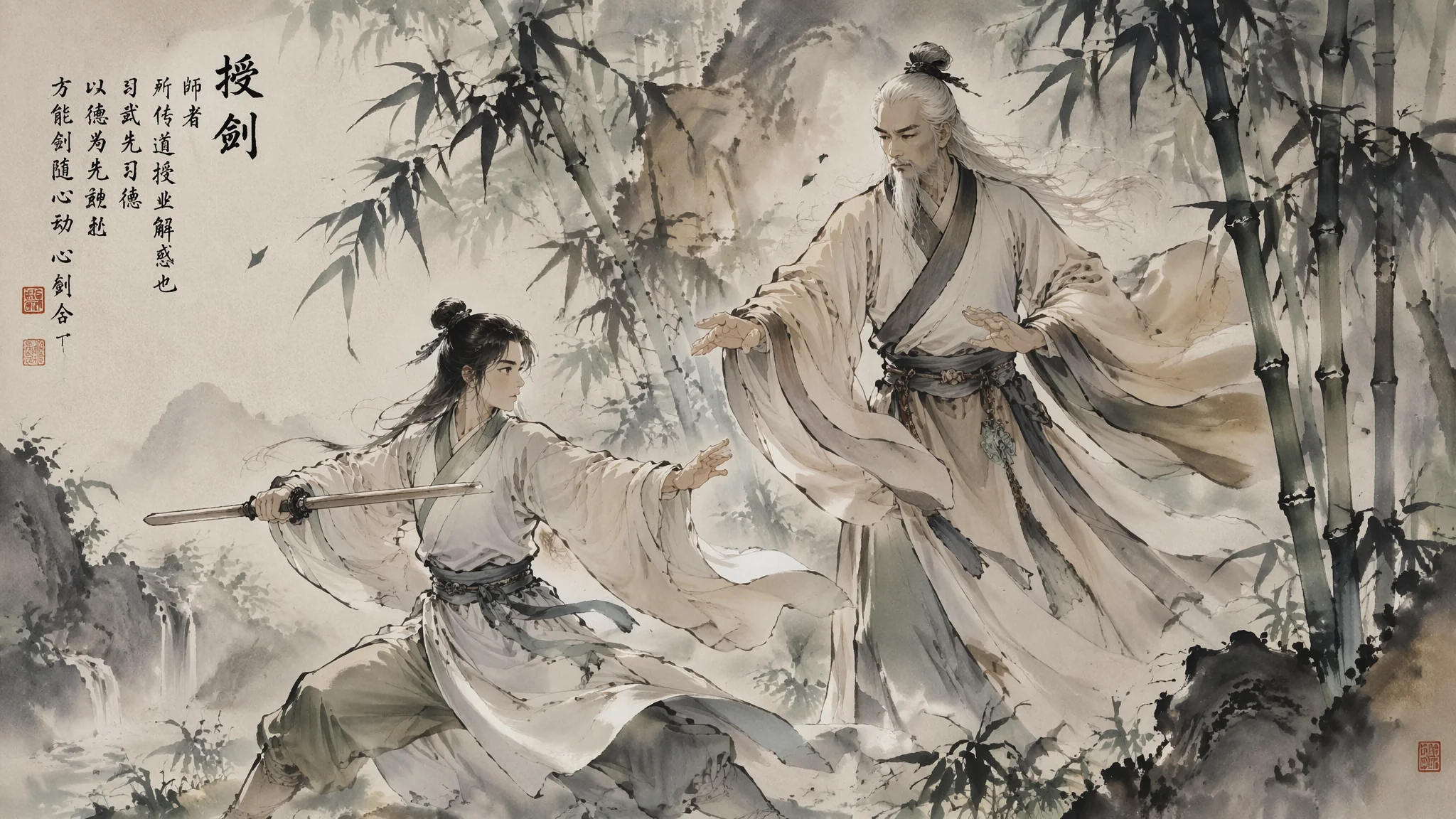
我小时候看《射雕英雄传》,洪七公教郭靖降龙十八掌那一段翻来覆去看了不下二十遍。一个白发老叫花子教一个愣头青练掌法——没有血缘关系、没有利益交换、就是"我看你小子顺眼"。这种师徒情谊在中国武侠和仙侠里有一个专门的词叫"传承"。但用AI画"师徒"这个题材,有一个非常搞笑的Bug:AI经常把师父画成三十岁的帅哥。你明明写了"an old master with white beard",它出来的是一个白发但面如冠玉的韩式美男。这背后是一个深层的训练数据偏见——AI对"东方古装男性"的默认模板是仙侠偶像剧男主。怎么打破这个模板、画出真正有沧桑感和传承感的师徒关系,就是这篇要聊的全部。
师徒关系在视觉上有几个固定的叙事母题:传艺(师父教徒弟剑法/心法/手艺)、守护(师父挡在徒弟前面面对危险)、别离(徒弟下山或师父仙逝)、重逢(多年后徒弟带着一身本事回来看师父)、背叛(师徒反目——最戏剧化的母题)。每个母题对应不同的构图、姿态、距离、光线和情绪。你不能写"a master and disciple"然后指望AI自己挑一个母题来画——你必须明确故事发生的瞬间。在AI古风场景绘画里有古风场景的完整环境构建方案,和师徒题材的场景需求高度互补。关于古风人物的更多画法,AI中国古代风格绘画有系统的人物造型方法论。
师尊形象的Prompt拆解——白发不是老人,道骨不是瘦弱
一个让人信服的师尊形象需要在三个维度上成立:年龄感(不是只加白头发)、修为感(内功深厚的外在表现)、距离感(师徒之间的尊卑界限)。年龄感的正确描述:"an elderly Daoist master in his 70s or beyond, the white hair is not the artificial white of a young cosplayer but the natural white of advanced age with thinning at the crown, the face bears the marks of decades —— deep lines around the mouth and eyes, weathered skin from years of training on mountain peaks, but the eyes are sharp and clear like polished jade, the gaze of someone who has seen through the illusions of the world"。修为感的关键词:"the master exudes an effortless authority that does not need to be demonstrated, the posture is perfectly upright from decades of meditation and martial practice, the hands are gnarled but steady, the presence commands respect without demanding it, there is a subtle glow or aura suggesting profound internal energy cultivation"。服装的道骨仙风:"wearing a simple but impeccably crafted Daoist robe in muted grey or deep indigo, the fabric is rough linen or cotton —— not silk, the master has transcended material luxury, the robe is held by a simple cloth sash, a fly whisk or a wooden sword rests nearby, the hair is pinned up with a single wooden hairpin"。三个维度的对照让师尊形象"立"起来——不是一个贴了"白头发"标签的年轻人,而是一个真正有岁月重量和修为深度的老者。关于古代服饰与道家审美的视觉研究,可以参考中国丝绸博物馆的在线馆藏——他们对历代服饰面料与道教服饰的考据非常详实。在AI成年男性绘画中有成熟男性面部结构的完整Prompt方案。
弟子形象的年龄梯度——从懵懂少年到独当一面的侠客
弟子的视觉形象应该随着"师徒故事线"的时间推进而变化——入门时是怯生生的孩子,学艺中是专注的青年,出师时是自信的侠客,重逢时是成熟的大人。入门期(12-15岁):"a young disciple boy or girl in early teens, still with the softness of childhood in the cheeks, the robes are slightly too large —— hand-me-downs from senior disciples, the posture is eager but clumsy, the eyes are wide with wonder and a touch of fear, standing before the master with hands clasped in a bow, the moment of formal acceptance into the sect"。学艺期(16-20岁):"a teenage disciple in training, the body has grown into the robes, the posture shows the beginnings of martial discipline —— spine straight, shoulders set, the hands are calloused from sword practice, sweat on the brow, practicing a sword form under the watchful eye of the master in the background, the expression is focused and determined"。出师期(20-25岁):"a young swordsman or swordswoman at the moment of leaving the mountain, fully grown into their skill and confidence, the robes fit perfectly and are of better quality —— perhaps a gift from the master, a sword at the hip that was once the master's, kowtowing or bowing deeply before the master at the mountain gate, the eyes hold both gratitude and the determination to face the world below"。重逢期(25-35岁):"the disciple returns to the mountain years later, the youthful softness is gone replaced by the hard edges of real-world experience, there may be a scar or two, the robes are travel-worn, the master is even older now, the reunion carries the weight of all the years between"。这条年龄梯度线上每个阶段都有对应的外貌、体态和服装变化——你指定了阶段,AI就能给出相应的人物状态。关于年龄跨度的更多Prompt拆解,AI人物肖像绘画中有从少年到老年的完整年龄谱系。
师徒场景的经典构图——距离、高低和眼神决定关系
师徒关系的视觉核心是"不对称的亲密"——两人在物理距离上是接近的(因为师徒关系是一种亲密关系),但在姿态上是高低不等的(因为师徒之间存在着尊卑和知识梯度)。传艺场景——侧面并立构图:"the master and disciple standing side by side in a bamboo forest clearing, the master's hand guides the disciple's wrist adjusting the angle of the sword, the master is slightly taller or positioned slightly uphill, the two figures form a diagonal line suggesting the transfer of knowledge from high to low, dappled sunlight filters through the bamboo leaves"。对坐论道——面对面坐构图:"master and disciple seated facing each other on meditation cushions in a simple Daoist temple, a small incense burner between them trailing a thin line of smoke, the master speaks while the disciple listens with head slightly bowed, the scene is intimate and quiet, paper windows diffuse the afternoon light"。守护场景——前后站位构图:"the master stands in front of the disciple facing an unseen threat off-frame, one arm extended protectively behind to shield the disciple, the disciple stands behind the master, the dynamic is clear —— the master will not let harm reach the disciple, the wind whips their robes creating tension"。别离场景——远距离构图:"the disciple kneels in a deep bow at the mountain gate, the master stands on the steps above watching, the physical distance between them has grown large —— symbolizing the imminent separation, falling cherry blossoms or autumn leaves mark the passage of time, the master's expression is stoic but a single detail betrays emotion"。关于双人构图的更多技巧,AI绘画构图技巧与视觉引导中有多人场景的空间关系处理方法。
古风师徒的情感暗线——用细节而非表情来传达情感
中国古典师徒文学的情感表达是极其含蓄的——师父不会抱着徒弟哭,徒弟也不会对师父说"我爱你"。情感是通过物、动作和克制来传达的——一把传承的剑、一碗师父亲手熬的汤药、一次沉默的目送。物的传承(最经典的师徒情感载体):"the master's old sword, its scabbard worn smooth by decades of handling, now placed in the disciple's hands, the exchange is formal —— both hands offering, both hands receiving —— but the sword carries the master's entire lifetime of martial understanding"。无声的关怀:"the disciple is injured, sitting against a tree with a bandaged shoulder, the master is brewing herbal medicine over a small fire, not looking at the disciple, not speaking, the care is in the action not the words, the scene is lit by firelight"。沉默的目送:"the master stands at the mountain peak at dawn watching a tiny figure descend the winding mountain path below, the master's face is unreadable, the hands are clasped behind the back but the knuckles are white, the wind tugs at the robes, the figure below does not look back —— if they did, they might not be able to leave"。情感传递的API不是面部表情——是物件、距离、光线、动作的克制程度。关于通过细节传递情感的更多方法论,在AI氛围情绪绘画中有完整的"情感暗线"Prompt策略。
仙侠与武侠的师徒风格差异——两套视觉体系
仙侠师徒和武侠师徒在视觉上应该能用眼睛区分——仙侠偏"超凡脱俗的飘逸感",武侠偏"筋骨血肉的真实感"。仙侠师徒视觉体系:"the master is an immortal cultivator, the robes float as if moved by spiritual energy rather than wind, the setting is a misty mountain peak above the clouds or a celestial realm with floating islands, the master may appear ageless —— white hair but a youthful face suggesting immortality, spiritual beasts like cranes or qilin may be present, the color palette leans towards white, pale blue, silver, and ethereal gold, the overall mood is transcendent and otherworldly"。武侠师徒视觉体系:"the master is a martial arts grandmaster, the robes are practical cloth with worn edges, the setting is grounded —— a remote mountain temple, a winter training ground with packed snow, a simple courtyard with a plum tree, the master shows clear signs of age, the training is physical —— calloused hands, sweat, visible exertion, the color palette is earthy and muted, the mood is grounded and human"。仙侠师徒的情感冲突往往是"凡心与仙道的矛盾"(动了凡心的仙人该不该继续修无情道),武侠师徒的情感冲突是"忠义与生存的矛盾"(师父让我杀的人原来是我的恩人)。两种不同的世界观对应两套不同的视觉语法——写Prompt的时候要明确走哪条路线。关于各风格体系的更深入讨论,可以参考WuxiaWorld武侠世界——虽然是个小说翻译网站,但社区里有大量东西方读者对武侠/仙侠视觉想象的讨论,对理解两种风格的视觉区别很有帮助。
常见问题
AI古风师徒绘画的核心难点集中在年龄真实感、双人场景关系和情感含蓄度上。AI画的师父总是太年轻,怎么画出真正的"老人家"感?
AI对"东方老人"的理解不足——因为在训练数据里东方老年男性的图像远少于白胡子西方面孔的老年巫师。解法:①在年龄描述上使用非常具体的年龄范围——"a man in his 70s""an elderly master in his 80s"而非模糊的"old master";②同时描述"年轻化特征的反面"——不写"handsome old man"(这会触发AI的"鹤发童颜"模式),写"an aged face marked by time, not handsome in the conventional sense but dignified, the beauty of a life fully lived";③使用"反偶像剧"关键词——"no idol drama styling, no K-drama aesthetic, realistic elderly proportions, the body of an old person not a young model"。三个步骤叠加使用效果最好。
师徒双人场景中AI经常把两人画成一个人或者搞混两人的特征?
双人场景中AI混淆人物身份是常见Bug。解法:①在Prompt中明确区分两人的段落——用两个独立的描述段来分别定义师父和弟子(中间用BREAK关键词在SD中,MJ中用分号或句号分隔);②给两人配置明显不同的视觉特征——师父穿深灰,弟子穿浅蓝;师父白发长须,弟子黑发束马尾;③利用身高差和体态差——师父比弟子矮(年老者身体萎缩)或比弟子高(看具体设定),明确的身高差异帮助AI区分两个人物。关于双人场景的更多技术细节,AI绘画软件人物功能对比中有各平台的多人场景能力测评。
古风师徒的画面经常缺少"情感",看起来很僵硬?
你写的情感可能太"直白"了。AI对"love""affection""caring"的理解来自西方数据——师徒抱在一起哭天喊地。但这完全不是中国古典师徒文学的情感表达方式。改用"行动代替情感形容词"策略:不写"the master loves his disciple",写"the master adjusts the disciple's collar before the long journey, a gesture so brief it could be mistaken for checking the fit";不写"the disciple is grateful",写"the disciple kowtows three times, each kowtow slower than the last, as if reluctant to rise";不写"a sad farewell",写"the master turns away first, because someone has to"。让动作和细节来承载情感——读者自然会补全那个情感的缺口。
画师徒题材这一年多,我逐渐明白了为什么中国人对这个题材有如此深的情感共鸣——不是因为我们喜欢"教"和"学"这件事本身,而是因为师徒关系是中国文化里少数几种"非血缘的深度亲密关系"之一。父母是血缘的,爱人是选择的,师徒介乎两者之间——没有血缘但有一种近乎神圣的纽带。AI可以把衣袂飘飘和剑光闪闪画得很漂亮,但它画不出"师父嘴上骂你笨手里却在给你缝补衣服"那种拧巴的深情。那些需要你写的不是Prompt里的形容词——是藏在动作后面的、你从自己生命经历里挖出来的东西。那些东西AI画不出来,但会因为你写了出来而让画面里的人物多一点温度。