AI荷花绘画教程:从含苞待放到盛开莲池的系统化创作教学指南
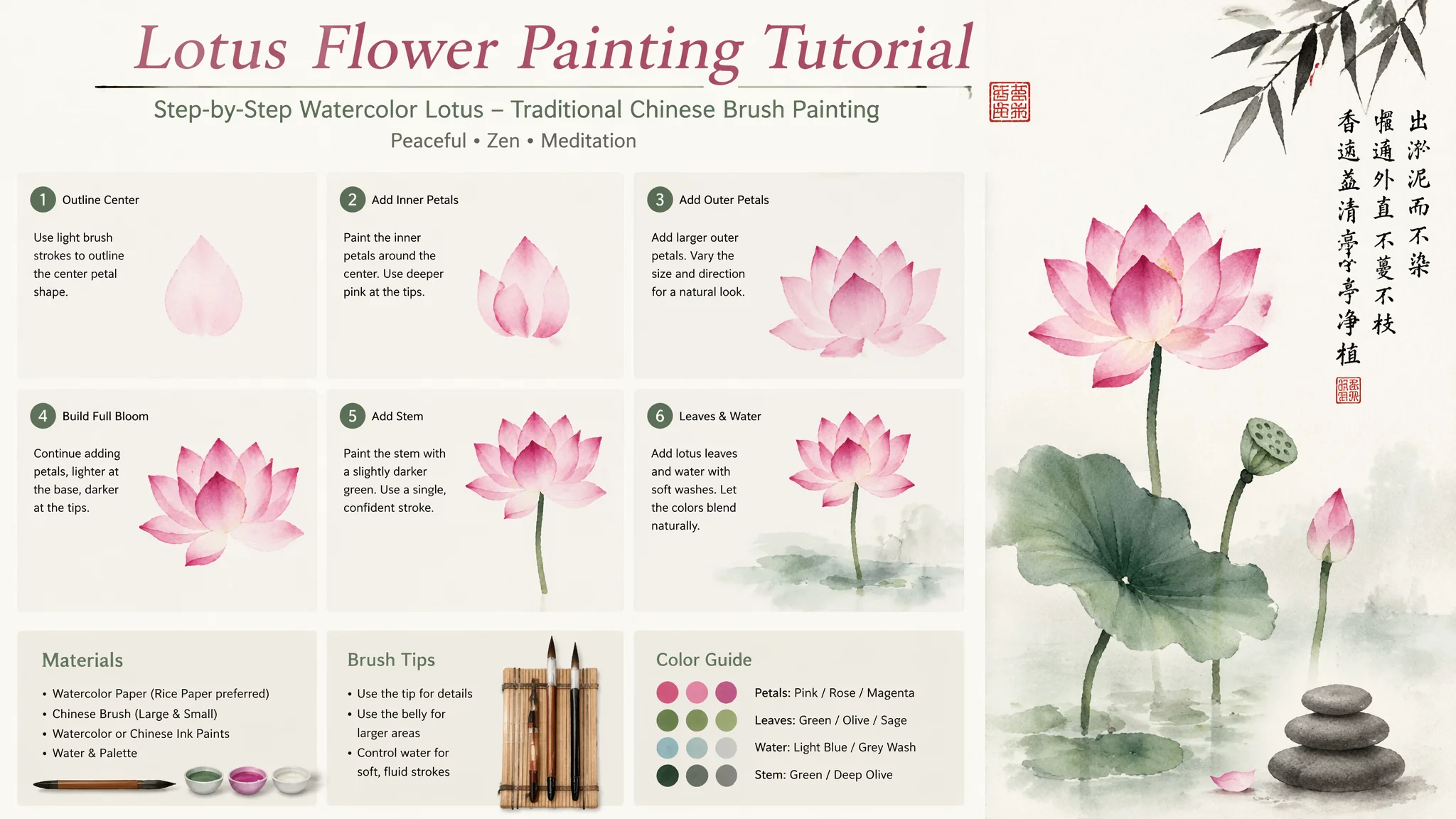
去年夏天我回老家看外婆,她院子后面有一小片荷塘。七月的傍晚我坐在塘边,看着一朵荷花从含苞到完全盛开——那个过程大概三个小时,我一直用手机拍延时。回家之后我把延时视频喂给AI做风格转绘,出来的图让我很失望——荷花像塑料假花、荷叶像绿色的飞盘、水面像蓝色的塑料布。我意识到一个问题:AI知道"荷花长什么样"——但它不理解"荷花是怎么长的"。你让它画一朵荷花,它调用的是"荷花"这个标签对应的图像平均值——一片粉色花瓣堆叠在绿色圆片上方。那种平均值里没有"生命"。这篇把你需要告诉AI的那些"超过平均值"的知识写出来。
荷花的生长阶段——从花苞到莲蓬的完整叙事线
画好一朵荷花的前提是你理解它的生长过程。AI不懂植物学——它只懂"这个标签对应什么像素分布"。你要在Prompt里把生长阶段变成视觉描述。含苞阶段(花蕾)——"a tightly closed lotus bud rising above the water on a slender green stem, the bud is a pointed teardrop shape, the outermost green sepals are still partially wrapped around the pink petals within, the tip of the bud shows a tiny opening where the first pink is beginning to show, the entire bud has a sense of compressed potential——tomorrow it will open"。
初开阶段(半开)——"the lotus flower is halfway open, the outer petals have unfurled and lie flat against the water surface while the inner petals are still upright and cupped around the center, the petals are arranged in a spiral——each layer offset from the one beneath, the golden center with the developing seed pod is just becoming visible through the inner petals"。盛开阶段(全开)——"the lotus is in full bloom, all petals are open and spread in a symmetrical bowl shape, the central seed pod is fully exposed——a flat yellow-green disk with small holes where the seeds will develop, the petals have a slight wave to their edges not a perfect curve, some petals show subtle signs of the beginning of wilting——a slight browning at the very tips"。谢落阶段(花瓣飘落)——"a lotus at the end of its bloom, most petals have fallen, only a few remain attached——they are translucent and fragile, the seed pod is now the dominant feature——large and turning brown, fallen petals float on the water surface around the stem like pink boats"。四个阶段四个画面——或者放在一起做"荷花的一生"系列,视觉叙事力极强。
花瓣的透光感——AI最不会画的东西之一
我做过一个实验:用AI画"逆光下的荷花"——一百张图里大概只有三四张有正确的花瓣透光效果。其他图都是"正常的粉色花瓣放在一个明亮的背景上"——花瓣本身没有透光,只是背景很亮。真正透光的花瓣是这样的:顺光面是正常的粉色,背光面(我们看不到的那面)被阳光穿过花瓣,所以我们看到的是"被粉红色滤镜柔化了的阳光"——比顺光面亮很多、颜色更淡、边缘几乎是白的。
透光Prompt的高阶写法:"the lotus petals are backlit by the morning sun, the thin petal tissue acts as a natural diffuser——light passes through the petals revealing their internal structure, the areas where petals overlap are darker because the light must pass through two layers, the single-layer edges glow with a luminous pink-white translucency like stained glass, the veins within each petal become visible as slightly darker lines where the tissue is thicker and transmits less light, the overall effect is that the flower appears to emit its own light rather than merely reflect it"。关键在"双层花瓣重叠处更暗"——这个细节是判断AI到底有没有真正模拟透光的试金石。
荷叶——不只是一片绿色的圆形背景
荷叶在荷花题材中常常被当作"背景元素"——画个绿色的圆片放在花下面就完事了。但荷叶在视觉上极其复杂:它的表面有蜡质光泽、叶脉从中心向边缘放射、边缘有波浪形起伏、有时会卷边、水面接触处有明显的浮力感。当荷花是主角时,荷叶不用画得太细。当荷叶本身就是主角时——比如画"雨打荷叶"或"枯荷"——荷叶的纹理和质感就变成了画面的全部内容。
新鲜荷叶Prompt:"a large healthy lotus leaf floating on the water surface, the leaf is a near-perfect circle with a radial notch at one edge where the stem attaches at the center, the surface is a cool bluish-green with a matte waxy texture——water beads up into perfect spheres on its surface, the radial veins are visible as fine raised lines spreading from the central point, the edge of the leaf has a subtle undulating ruffle not a smooth line, where the leaf meets the water there is a visible meniscus——the surface tension of the water curves up to meet the hydrophobic leaf"。枯荷Prompt:"a withered lotus leaf in late autumn, the leaf has collapsed and folded in on itself, the color has faded to brown and ochre with patches of dark decay, the veins are now more prominent than the flesh of the leaf——they create a skeletal framework, the leaf hangs low over the water, barely above the surface, the mood is not sad but meditative——this is the natural end of a cycle"。枯荷的美不在"花"——在"结构被时间剥离后剩下的骨架"。
水面倒影——荷塘的灵魂在倒影不在实景
拍过荷塘的人都知道——最好看的荷塘照片,往往水面占了画面三分之二以上。因为水面不是一个"实体"——它是一个"复制+扭曲+染色"了天空和荷花的镜子。倒影中的荷花比真实的荷花更柔、更模糊、颜色被水面染了一层绿灰色——这种"被水处理过的美"是AI很难自然生成的。
水面倒影Prompt:"the still pond water reflects the lotus and the sky above like a dark mirror, the reflection is a softer slightly blurred version of the real flower——the colors are muted by the water's green-brown tint, the reflection is not a perfect mirror——the water surface has a very subtle texture of microscopic ripples that breaks the reflection into tiny fragmented pieces that the eye reads as a continuous image, fallen petals and pollen dust float on the water surface between the reflection and the viewer——creating a bridge between the real world and the reflected world"。关于水面光影的更多技法可以参考AI湖水绘画教程中关于水面反射和折射的Prompt技巧。
水墨荷花——中国画传统的AI翻译
用AI画中国水墨荷花,最大的误区是在Prompt里写"Chinese ink painting"然后期待AI理解"留白"和"写意"。AI的"Chinese ink painting"是一个被西方视角污染过的标签——它理解成"模糊的黑白图像加一些汉字印章"。真正的水墨荷花美学核心是:一,留白——画面中没画的部分和你画了的部分一样重要;二,笔触的不可重复性——每一笔都是瞬间决定,没有修改;三,"形"服务于"神"——荷花的"像"不重要,荷花给你的"感觉"重要。
水墨荷花Prompt模板:"ink wash painting of a lotus, executed in the style of traditional Chinese literati painting——xieyi freehand brushwork rather than gongbi fine brushwork, the lotus is rendered with just a few decisive brushstrokes——the petals are suggested by the negative space between two sweeps of wet ink, the stem is a single confident vertical stroke, the composition embraces empty space——the unpainted areas are as intentional as the painted ones, monochrome ink with a single touch of pale pink on the flower tip, the xuan paper texture is visible, the ink has bled slightly into the fibers creating soft undefined edges, the overall feeling is more poetry than illustration"。关于更多中国风绘画的技法在AI中国古风绘画中有完整的审美框架。
外部学习资源:大都会博物馆的亚洲艺术展厅有高清宋代花鸟画扫描——那些一千年前的荷花是中国水墨荷花美学的源头。日本琳派(Rimpa school)的荷花屏风也可以参考——在京都国立博物馆的数字档案里能看到俵屋宗达和尾形光琳的荷花金屏风。
常见问题
AI画荷花时颜色总是"死亡芭比粉"——怎么调出有质感的荷花色?
荷花粉不是粉色——是一组复合色。花瓣尖是偏冷的玫瑰粉(带紫调)、花瓣中部是暖调的珊瑚粉(带橘调)、花瓣基部是乳白带淡黄绿。在Prompt里分段描述颜色:"the lotus petal color transitions from a cool rose-magenta at the very tip through a warm coral-pink at the mid-petal to a creamy ivory-white with subtle yellow-green undertones at the base where it meets the receptacle, avoid uniform pink across the entire petal"。给AI一个"颜色渐变地图"比给一个颜色标签有效得多。
荷花和莲花的Prompt可以混用吗——它们有什么视觉区别?
在中文里"荷花"和"莲花"常混用——但在AI(尤其是英文Prompt)中,lotus(荷花)和water lily(睡莲)是两种不同的植物。AI对lotus的理解:花瓣更宽大、花心有明显莲蓬、叶子出水很高、花瓣掉落后莲蓬留在原处。AI对water lily的理解:花瓣更窄更尖、花心不明显、叶子贴在水面上、整体更像莫奈画里的那种睡莲。搞清楚你要的是lotus还是water lily——这两个词在AI里画出来的植物是不同的。
想在荷花图里加昆虫(蜻蜓/蜜蜂)——怎么避免AI画成巨型变异昆虫?
AI很容易把昆虫画得过大——因为它在构图时会把"有昆虫"理解成"昆虫是画面的重要元素"然后放大。解法:明确写昆虫在画面中的比例——"a single tiny dragonfly perched on the tip of an unopened bud, the dragonfly is only a few centimeters long——dwarfed by the lotus flower, it occupies less than 5% of the frame, it is a delicate detail you notice second, not the main subject"。加上"less than 5% of the frame"这种明确的面积描述能让AI控制好比例。