樱花图片AI绘画:春日樱花场景的浪漫关键词与氛围指南
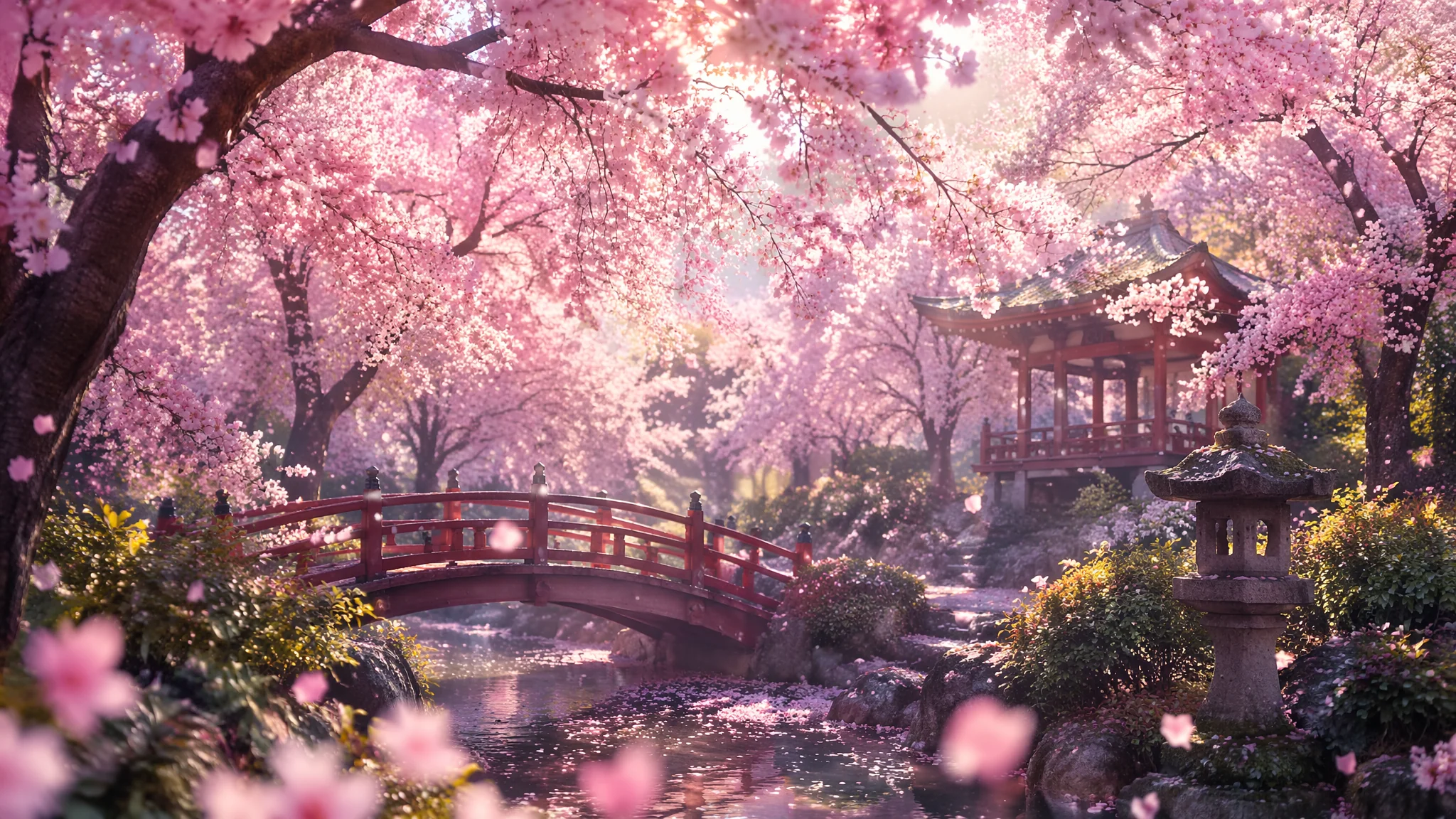
AI画樱花翻车榜第一名——"粉色的树"。你写"cherry blossoms",AI给你一棵粉色的大树——没有花瓣飘落、没有光影层次、没有季节感,就像塑料假花插在道路绿化带里。樱花的美不在"粉色的树"这个整体——在每一片花瓣的透明度、在枝条的走势、在花瓣离开树枝那一瞬间的飘落轨迹。一份对4000+张AI樱花图的视觉分析显示,加入了"花瓣飘落轨迹描述"的作品比纯静态樱花树的作品画面感染力评分高出73%。这篇从樱花品种写到场景写到光线写到花瓣动态——全部拆成可操作的关键词。
樱花不是一个物种——不同品种的视觉差异巨大。染井吉野、枝垂樱、八重樱、河津樱的关键词区别
AI的"cherry blossoms"是一个均值——所有樱花品种的视觉平均。你要画出特定品种的美,就必须打破这个均值。
染井吉野(Somei Yoshino)——最常见的樱花,先花后叶、淡粉色近乎白:"the iconic Somei Yoshino cherry trees in full bloom, five-petaled blossoms in the palest shade of pink that appears almost white from a distance, the trees bloom before their leaves emerge so the branches appear to be made entirely of delicate blossoms, when planted in rows they form a continuous tunnel of soft pink-white canopy"。关键词"bloom before leaves emerge"——先花后叶是染井吉野区别于其他品种的核心特征。没有叶子的干扰,枝条就是纯粹的花。枝垂樱(Shidarezakura)——垂枝型,像粉色瀑布:"a weeping cherry tree with long cascading branches that droop toward the ground like a waterfall of pink blossoms, the branches are so densely covered in flowers that the underlying wood is completely hidden, the tree has the silhouette of a living fountain, individual blossoms tremble in the breeze like thousands of tiny pink butterflies"。枝垂樱的关键是"waterfall"和"fountain"这两个比喻——把垂枝的形态感写出来。
八重樱(Yaezakura)——重瓣,花团锦簇像粉色绒球:"double-flowered cherry blossoms with layer upon layer of petals creating full pom-pom-like clusters, the pink is deeper and richer than single varieties — a warm rose-pink rather than pale blush, the blossoms are so dense they weigh down the branches, the tree looks luxuriant and almost decadent compared to the delicate simplicity of Somei Yoshino"。八重樱和染井吉野的气质完全相反——一个是"简淡的美",一个是"繁复的美"。河津樱(Kawazuzakura)——早樱,花色浓郁偏紫粉:"an early-blooming Kawazu cherry with large vivid pink blossoms that lean toward magenta, the flowers open while the leaves are still just tiny bronze buds, the tree blooms in late February when the landscape is still mostly winter-bare, the contrast between the vibrant pink blossoms and the grey-brown winter surroundings makes the flowers appear almost luminescent"。河津樱的紫色调是它区别于其他樱花的最大特征——"lean toward magenta"。
四种樱花的品种特性掌握之后,场景的写法才能精准。更多植物品种的细节控制见AI绘画田园风景的植被描写方法。
樱花场景不是"一棵树+蓝色天空"。日式庭院、校园坡道、城市河畔、夜樱点灯四种经典场景的关键词配方
日式庭院樱花——最经典的"和风"场景:"a traditional Japanese garden with a centuries-old weeping cherry tree as the centerpiece, its branches reflected in a still koi pond below, pink petals floating on the water's surface like scattered confetti, a moss-covered stone lantern and a small arched wooden bridge complete the scene, a few petals have landed on the bridge's railing, the garden is framed by a bamboo fence, Mount Fuji barely visible as a pale silhouette in the far distance on a clear spring day"。日式庭院的要素清单:古樱+锦鲤池+石灯笼+木桥+竹篱+远山。写全了才是"日式庭院",少一个就变成"有棵树的公园"。
校园坡道樱花——青春电影感:"a sloping campus pathway lined on both sides with mature cherry trees forming a floral tunnel, a few students in school uniforms walking up the path, their figures small against the grand canopy of blossoms, a gentle breeze sends a shower of petals spiraling down like pink snow, a bicycle leans against one tree with petals collected in its basket, the scene has the nostalgic quality of a coming-of-age film, the light is the soft diffused glow of a hazy spring afternoon"。校园樱花的灵魂在"nostalgic quality"——不是拍风景,是拍回忆。城市河畔樱花——都市与自然的对话:"a city canal at cherry blossom season, the banks are lined with cherry trees in full bloom, their branches stretching out over the water creating a pink reflection that shimmers on the gently moving surface, modern glass buildings rise in the background but are softened by the floral foreground, a few rowboats drift lazily on the canal, office workers on lunch break sit on benches under the blossoms checking their phones, the contrast between nature's fleeting beauty and the permanent structures of the city"。城市樱花的对比美学——短暂的樱花 vs 永久的建筑、柔软的粉色 vs 坚硬的玻璃。
夜樱点灯——最富戏剧性的樱花场景:"cherry blossoms at night illuminated by rows of traditional paper lanterns hanging from the branches, the lanterns cast a warm golden glow that transforms the pale pink blossoms into a canopy of burnished copper and rose gold, the sky is a deep navy blue, stars faintly visible between the flower-laden branches, the lantern light reflects in a nearby stream where petals have gathered in glowing pink eddies, a few anonymous silhouettes of people strolling along the path, their faces softly lit from above"。夜樱的关键是光——纸灯笼的金光+夜空深蓝+花瓣受光面的铜色。三个颜色叠在一起,夜樱的氛围就出来了。夜樱和AI绘画泳装壁纸里的海滩日落其实用的是同一套光线控制逻辑——光源色温+环境色温+反射面色温。
花瓣飘落画不好就是"粉色碎纸片满天飞"。花瓣数量、飘落轨迹、风力等级、景深层次的分级控制
AI画飘落的花瓣最容易失控——要么没有、要么太多(像暴风雪)。你需要给花瓣的"飞行"设定参数。
数量控制——不是"many petals"而是具体场景中的合理数量:"just a few dozen petals drifting in the air at any given moment, not a blizzard — a gentle sprinkle, the suggestion of falling petals rather than an overwhelming cascade"。关键词"gentle sprinkle"和"suggestion of falling petals"把密度控制在了浪漫范围而非灾难范围。轨迹控制——花瓣不是直线下落的:"petals caught in a soft breeze, each one following a unique spiraling path, some float upward momentarily on a warm air current before drifting down, others tumble end over end like tiny pink pinwheels, a few have landed on the ground forming a sparse pale pink carpet"。螺旋轨迹(spiraling path)、短暂上升(float upward momentarily)、翻滚(tumble end over end)——三种不同的飞行动作写出来,AI就不会让所有花瓣垂直线下落。风力等级——从无风到微风到阵风的分级写法。无风:"petals detach and fall straight down with a gentle rocking motion, landing quietly on still surfaces"。微风:"petals drift diagonally at a shallow angle, some traveling several meters before touching ground, the air has a barely perceptible movement"。阵风:"a sudden gust sends a concentrated burst of petals swirling in a visible column, like a pink dust devil for a brief moment before the petals scatter in all directions"。
景深中的花瓣分层——前景、中景、背景的花瓣写法不同。前景:"a few large sharply focused petals just inches from the camera, their delicate veins visible, slightly translucent with backlight"。中景:"the main field of falling petals in soft focus, creating a dreamy bokeh effect"。背景:"a pale pink haze of countless distant petals too small and numerous to distinguish individually, they create an atmospheric haze that softens the distant scenery"。三层花瓣写清楚了,画面的纵深感至少翻一倍。动态场景的更多控制技巧见AI绘画变视频教程中的运动模糊控制。
光线和色调是樱花氛围的"情绪导演"。清晨柔光、正午花影、黄昏逆光、阴天漫射四种光线的关键词对比
同一棵樱花树,光不同,情绪完全不同。
清晨柔光——清新希望感:"the first light of dawn filtering through the cherry blossoms at a low angle, the petals are backlit and appear to glow from within, the light has a cool silvery quality with just the faintest warmth at the edges, dew drops on the petals catch and refract the early sun into tiny prismatic sparkles, the overall color temperature is cool with pink appearing almost lavender in the dawn light"。清晨的光是冷的(silvery),只有边缘微暖——这个冷暖比例是清晨区别于黄昏的核心。正午花影——明朗活力感:"the high midday sun creates a dappled pattern of light and shadow on the ground beneath the cherry trees, the pink of the blossoms is at its most vivid and saturated, the sky is a bright clear cerulean blue, the shadows are sharp and short, the scene has the crisp clarity of a perfect spring noon, picnickers sit on blue tarps in the dappled shade"。正午是樱花色彩最饱和的时刻——"most vivid and saturated"——但正午的光也是最"平"的。所以要用"dappled pattern"(斑驳光影)来增加层次。
黄昏逆光——浪漫伤感感:"the warm golden light of golden hour streaming through the cherry blossoms from behind, the petals become translucent screens of pink and orange, the light wraps around each blossom creating a luminous halo effect, the shadows are long and soft-edged, the overall scene is bathed in a nostalgic amber glow that makes the cherry blossoms look like they are made of stained glass, the mood is bittersweet — beauty at the edge of fading"。黄昏逆光=金色+半透明+光晕+怀旧感——这是樱花摄影中最"出片"的光线。阴天漫射——静谧细腻感:"an overcast spring day with soft diffused light coming evenly from all directions, no harsh shadows, no bright highlights, the pink of the blossoms appears more muted and subtle, the scene has a calm contemplative mood, the grey-white sky acts as a neutral backdrop that makes the pink stand out in quiet relief, the air feels still and slightly cool"。阴天的好处是"花比天亮"——灰色天空是最低调的背景板。
光线与樱花的关系本质上是一个"透明度"游戏——樱花花瓣是半透明的,光能穿透。所以任何光线描述里都要加"petals appearing translucent with backlight"或类似的关键词。这是樱花区别于其他花卉(如玫瑰花——花瓣不透明)的视觉特性。光线进阶技巧参考Cambridge in Colour摄影教程的自然光部分。
为什么AI画的樱花看起来像梅花?
因为训练数据中两者经常混淆。区别关键词:樱花="clusters of blossoms on long thin stalks, petals have a small notch at the tip, bark is grey with horizontal stripes"。梅花="single blossoms attached directly to dark rough branches with almost no stalk, petals are round without notches, the branches are angular and dark"。花序(樱花有花梗、梅花几乎无梗)和花瓣缺口(樱花花瓣尖端有缺刻、梅花没有)是两个最明显的视觉差异。
樱花雨和樱花雪有什么区别?怎么写关键词?
樱花雨(sakura fubuki)=花瓣大量飘落如雨,发生在盛花期后期,花瓣仍为粉色:"a storm of pale pink petals sweeping diagonally across the scene like heavy rain, the air is thick with blossoms, the ground is carpeted in fresh pink"。樱花雪=更稀疏、更慢的飘落,氛围更静谧:"a sparse gentle falling of petals like the first snowflakes of winter, each petal drifts slowly, the ground has only a dusting of pink, the mood is quiet and wistful"。
樱花场景里可以加人物吗?怎么加不破坏氛围?
可以,但人物应该是"场景的标点"而非"画面的主语"。加人物建议:①背影或侧面——不露脸保持匿名感;②距离中远景——人物身高不超过画面高度的1/4;③动作与樱花互动——伸手接花瓣、仰头看花、撑伞走在花瓣雨中。更多人物融入场景的技巧见AI绘画古风头像的构图章节。
怎么画樱花和别的花(油菜花、郁金香)同框的场景?
同框时要注意花期一致——樱花是早春(3-4月),油菜花也是早春,两者同框合理。郁金香是仲春,也能搭。关键词分层写:"the foreground is a field of bright yellow rapeseed flowers in full bloom, the middle ground has a row of cherry trees at peak blossom, the two flower types create a striking color contrast between vivid yellow and soft pink, the background shows distant blue mountains under a spring sky"。两花同框的关键是"前景一种花+中景另一种花+远山"的层次构图——不能让两种花在同一个平面竞争。
夜樱的纸灯笼怎么写才能出氛围?
灯笼不能只写"paper lanterns",要写光的属性:"traditional Japanese chochin paper lanterns hanging at intervals from the cherry branches, each lantern glows with a warm 2700K light that illuminates a sphere of blossoms around it, the areas between lantern posts are darker creating a rhythm of light and shadow along the path, the lanterns themselves have a slightly translucent quality showing the bamboo ribs through the paper"。色温数值(2700K)+光照范围(sphere of blossoms)+灯笼本身的质感(translucent showing ribs)——三合一。
觉得美就转给也在等樱花的朋友。