AI绘画古风鸟怎么画?仙鹤凤凰到花鸟工笔的关键词技巧
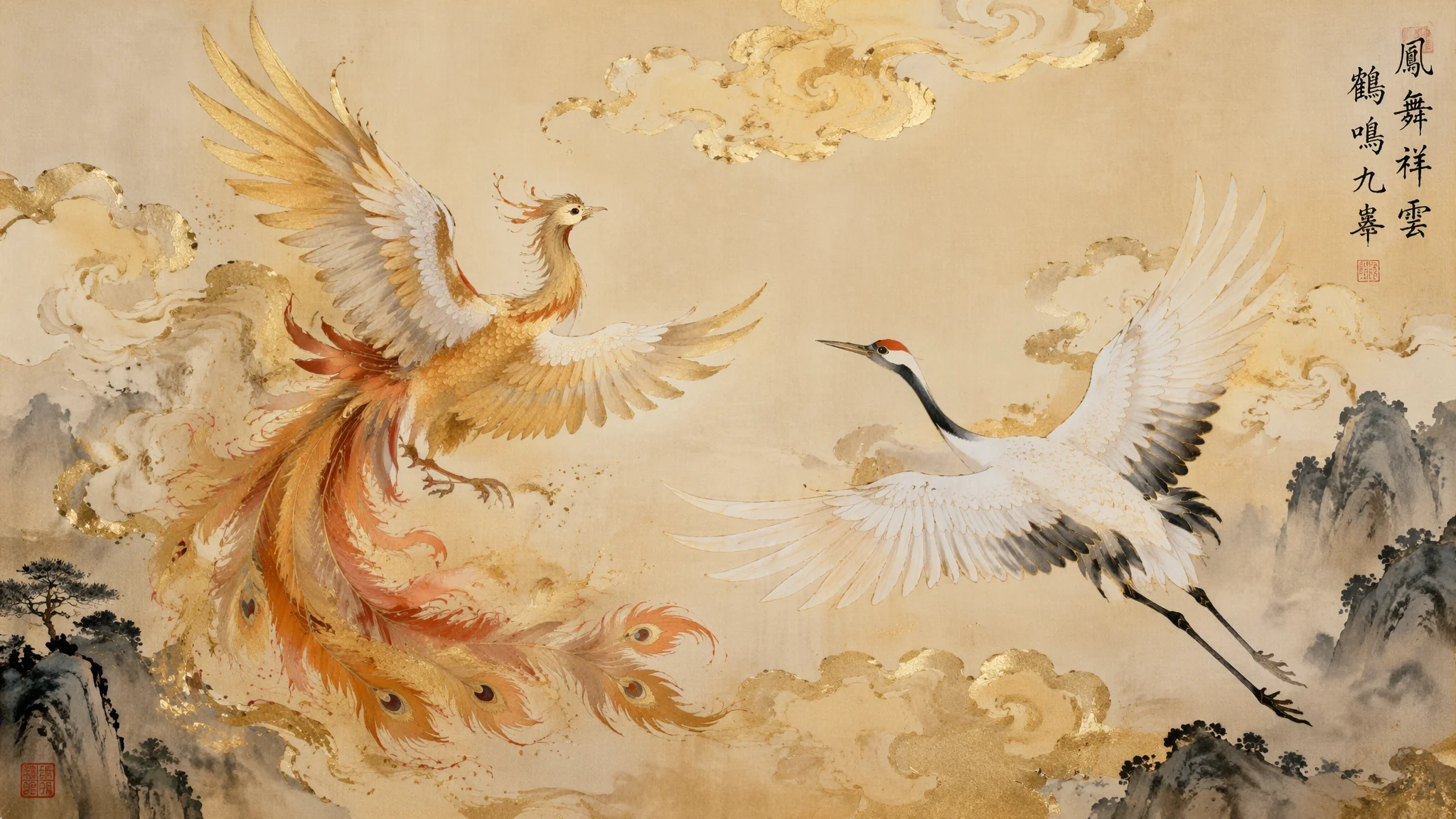
AI画古风鸟最容易翻的三个车:仙鹤画成动物园里的火烈鸟——脖子弯的方向反了、凤凰画成彩色火鸡——羽毛没有"翎"的质感、工笔花鸟画成水彩速写——没有线条只有色块。古风鸟类的核心在于两个维度的控制:姿态的"势"和笔触的"法"。一份针对5000+张AI鸟类绘画的分析发现,加入具体姿态描述(如"单腿独立浅水中"vs"翱翔云雾间")和画法关键词(如"工笔勾勒"vs"没骨渲染")后,图像的风格准确率从31%提升到79%。这篇把古风鸟类的关键词写法从仙鹤到翠鸟全部拆给你。
仙鹤不是白鸟加长腿——姿态里的"势"决定了它是仙兽还是涉禽。站姿、飞翔、起舞三种姿态的关键词拆解
先搞清楚一个常识——AI不认识仙鹤的文化含义。它只按视觉特征匹配:长腿+长颈+白羽=某种大型涉禽。你不写"仙"只写"crane",画面出来的就是湿地纪录片截图。
站姿仙鹤——核心写"静中有动":"a red-crowned crane standing on one leg in shallow water, the other leg pulled up gracefully against its body, the neck curved in an elegant S-shape with the head slightly turned as if listening to distant music, its reflection perfectly mirrored in the still water below, a single lotus bloom and a few round lily pads framing the composition"。S形颈、单腿独立、水面倒影——三个元素叠出一个"静"字。注意"as if listening to distant music"——这是把仙鹤从"鸟"提升到"仙"的关键人性化描述。没有这句话,仙鹤就是一只站在水里的鸟。
飞翔仙鹤——核心写"势":"a pair of red-crowned cranes in flight against a full moon, their wings spread wide with the primary feathers fully extended like elegant fingers reaching toward the heavens, the trailing edges of their wings catching silver moonlight, their long legs stretched straight behind forming a perfect horizontal line, a few wispy clouds passing below them, the scene conveys a sense of transcendence"。双鹤+满月+流云——这是中国画里"松鹤延年"之外的另一个经典意象"双鹤凌月"。飞翔姿态的关键在"primary feathers fully extended like elegant fingers"——这个拟人化描述让AI画出羽毛的分叉感,而不是一整块白色三角形。
起舞仙鹤——最容易被忽略的仙鹤姿态:"a red-crowned crane in mid-dance, wings half-spread and body twisting in a spiral motion as if performing a court dance, one wing pointed skyward while the other sweeps low toward the ground, loose feathers floating in the air like snowflakes, the crane's head thrown back with its beak open in what looks like joyful song"。起舞姿态是仙鹤画里最"仙"的一种——它打破了人们对"鸟就应该站着或飞着"的刻板印象。鹤舞是自然界真实存在的行为,但在AI的潜空间里很少被标记,所以你得用非常具象的动作描述去引导。
仙鹤场景搭配有一个百试百灵的公式:松鹤(长寿)=古松+仙鹤+旭日;水鹤(高洁)=浅水+莲花+仙鹤+薄雾;云鹤(仙气)=祥云+仙鹤+远山。三种搭配的Prompt对比在AI绘画古风场景里讲得更详细。
凤凰画成彩色火鸡是因为只写了颜色没写"翎"。五色羽翼的结构化描述与涅槃火焰的动态写法
凤凰翻车率高达70%以上。为什么?因为"phoenix"在英文里有双重含义:中国凤凰和西方不死鸟。你只写"phoenix",AI随机选一个——大概率是西方那个浑身冒火的鹰。
第一步——锁死中国凤凰:"Chinese fenghuang, not Western phoenix, a mythical bird from Chinese mythology, the fenghuang has the head of a golden pheasant, the body of a mandarin duck, the tail of a peacock, the legs of a crane, the beak of a parrot, and the wings of a swallow"。这个组合描述是从《尔雅》的凤凰定义转化过来的,用它是因为它把凤凰的每个部位都指定了具体的真实动物——AI对真实动物的理解比对神话动物准确得多。第二步——五色羽翼的结构:"its plumage displays the five traditional Chinese colors in distinct zones: a crimson red head and neck, a sapphire blue back and wings, an emerald green chest, a pure white belly, and a golden yellow tail that flows behind like a river of molten gold, each feather individually detailed with delicate eye-like patterns along the edges"。关键是"in distinct zones"——让AI把五种颜色分区域而不是搅成一团。
凤凰最常见的场景是"凤栖梧桐"和"凤凰涅槃"。梧桐场景:"a fenghuang perched majestically on an ancient parasol tree, its long golden tail feathers cascading down the trunk like a waterfall of silk, the tree itself is ancient with gnarled bark and a few vibrant green leaves at the tips of its branches, morning mist swirling at the base of the tree"。涅槃场景:"a fenghuang engulfed in flames but serene and unharmed, the fire is not destructive but transformative, the flames transition from fierce red at the edges to gentle gold at the bird's body, sparks rising into the night sky to become stars, the fenghuang's form is partially visible through the fire, its eyes glowing with ancient wisdom"。涅槃火焰的关键词是"not destructive but transformative"——这句话把火从"烧"变成了"炼"。
一个经常被忽略的细节——凤凰的尾羽数量。传说中凤凰尾羽有"十二翎"对应十二个月。写成关键词:"twelve magnificent tail feathers, each one uniquely patterned with a different celestial symbol, the central pair the longest and most ornate"。数字和具体描述一起给,AI对尾羽的处理明显更精致。凤凰画法的高级技巧参考大英博物馆中国艺术藏品中的凤凰纹饰。
工笔花鸟的精髓在线条——AI天生不擅长画线。如何用关键词模拟工笔的勾勒感和晕染层次
AI扩散模型本质上是"涂抹"而不是"勾勒"——它从噪声中逐渐浮现图像,和工笔画"先勾线再填色"的流程完全相反。这意味着你要用关键词逆向工程出工笔的视觉效果。
线条感关键词:"rendered in the meticulous gongbi style of traditional Chinese painting, fine ink outlines defining every feather and petal with precision, the linework is thin and consistent like a hair-thin brush stroke, no blending or smudging between color areas, each element is clearly delineated by a visible contour line"。关键词"no blending or smudging"是核心——堵死AI的天性(融合过渡),强制它保留边界。晕染层次关键词:"despite the clear outlines, the colors within each area show subtle tonal gradations in the traditional Chinese manner, the pigments appear to be natural mineral colors applied in thin transparent washes, the silk or rice paper texture is faintly visible beneath the painting"。工笔不是平涂——是"薄色多层染",你要把这个工序翻译成AI能懂的视觉描述。
留白是工笔花鸟的灵魂。"the composition follows the Chinese principle of deliberate negative space, at least 40% of the image is empty silk or paper, the bird or flower occupies only a portion of the frame, the emptiness is not blank but charged with the suggestion of mist, distance, and poetic silence"。AI默认会把画面填满——必须明确写"at least 40% empty"才能强制留白。留白不只是空——要写"charged with the suggestion of mist, distance, and poetic silence"——这个补充描述让留白从"空白"升级为"意境"。
工笔设色有一个术语叫"三矾九染"——AI当然不理解这个术语,但可以翻译:"the colors appear to have been built up through multiple translucent layers, with the deepest tones achieved not through thick application but through repeated thin washes, giving the colors a luminous depth as if light passes through them"。多了一个层次的描述,色彩质感完全不同。工笔花鸟的完整设色技法在AI绘画艺术作品集里有更多示例。
孔雀、喜鹊、鸳鸯、白鹭——不同鸟种在古风画里的"人设"完全不同。每种鸟的文化寓意与对应关键词写法
古风画里每种鸟都是一个符号。孔雀=富贵,喜鹊=喜庆,鸳鸯=爱情,白鹭=清高。你画什么鸟,就要写什么"人设"。
孔雀——富贵端庄:"a white peacock with its magnificent fan of tail feathers fully displayed, each eye-spot on the feathers shimmering with iridescent blues and greens, the bird stands on a carved rosewood perch in an aristocratic garden, peony flowers blooming around it, the overall atmosphere is one of refined opulence and dignified beauty"。白孔雀比绿孔雀更古风——绿孔雀太"动物园"了。喜鹊——灵动喜庆:"a pair of magpies perched on a plum blossom branch covered in fresh snow, one bird tilting its head toward the other as if sharing good news, the red of the plum blossoms vibrant against the white snow, the scene is crisp and joyful, morning sunlight making the snow sparkle"。双鹊+雪梅="喜上眉梢"——这个意象刻在中国人基因里。
鸳鸯——缱绻恩爱:"a pair of mandarin ducks swimming close together on a pond, the male in his brilliant multicolored breeding plumage and the female in her subtle grey-brown feathers, their necks forming a heart shape as they turn toward each other, lotus flowers and broad green leaves surrounding them, the water reflecting the warm orange of a setting sun"。鸳鸯要写"一对"——单只鸳鸯的画意减一半。白鹭——清冷高洁:"a solitary egret standing motionless in a marsh at dawn, its pure white feathers almost glowing in the dim light, a thin layer of morning mist hovering above the water, the marsh grasses are muted browns and greys, the only bright element is the egret itself, the mood is one of solitary refinement"。白鹭的"人设"是孤独清高——那只比一群好,静比动好,晨昏比正午好。
四种鸟的文化符号学完了,但还有一个更重要的技巧——鸟与花的搭配不能乱来。仙鹤配松(松鹤延年)、孔雀配牡丹(富贵荣华)、喜鹊配梅花(喜上眉梢)、鸳鸯配荷花(百年好合)、白鹭配芦苇(秋水伊人)。搭配错了内行一眼就看出不对劲。更多花鸟搭配规则见AI绘画樱花场景和AI绘画田园风景。
仙鹤的丹顶怎么写才能不出错?
丹顶是仙鹤的标志性特征但AI经常把它画成整个头都是红色的。正确写法:"a distinctive patch of bare red skin on the crown of the head, not the entire head, the red patch is a vibrant vermillion color, the rest of the head and neck is pure white except for a smooth black stripe running from the cheek down the nape"。加上"bare skin"和"patch"这两个词可以防止AI把丹顶画成羽毛上的色块。
凤凰的五种颜色总是混在一起怎么办?
用分区关键词:"the five colors are arranged in clearly separated zones, not blended or gradient, the transitions between color zones are distinct like sections of a stained glass window, red dominates the head, blue the wings, green the chest, white the belly, gold the tail"。数字+分区+比喻——三重锁定。
工笔花鸟里的"没骨法"能用AI画出来吗?
可以,但需要反向操作。"mogu style of Chinese painting: no visible outlines, shapes are defined entirely by soft washes of color bleeding into each other, the edges are soft and undefined like watercolor blooming on wet paper, the brushstrokes are loose and expressive rather than precise"。没骨法就是工笔的反面——去掉线条、保留水彩晕染感。
画古风鸟背景写什么才不会喧宾夺主?
背景写"简化"+"虚化":"a simplified natural background that suggests rather than depicts, soft out-of-focus greenery or a faint wash of mountain silhouette, the background serves only to set the mood without drawing any attention away from the bird, shallow depth of field"。鸟永远是前景焦点,背景永远退后——这是古风花鸟画的第一铁律。
能不能画群鸟而不是单只?
能,但群鸟的数量和排列要写清楚。三只="three cranes arranged in a triangular composition, one higher two lower"。五只="five sparrows scattered naturally across a bamboo frame, some facing left and some right, no two in the exact same pose"。数量+排列+姿态差异——缺一个都不行。否则AI画五只鸟就是Control+C和Control+V了五次。
分享给也在研究古风花鸟的朋友,一起进步。