弹钢琴AI绘画怎么画出氛围感?音乐与光影交织的关键词技巧
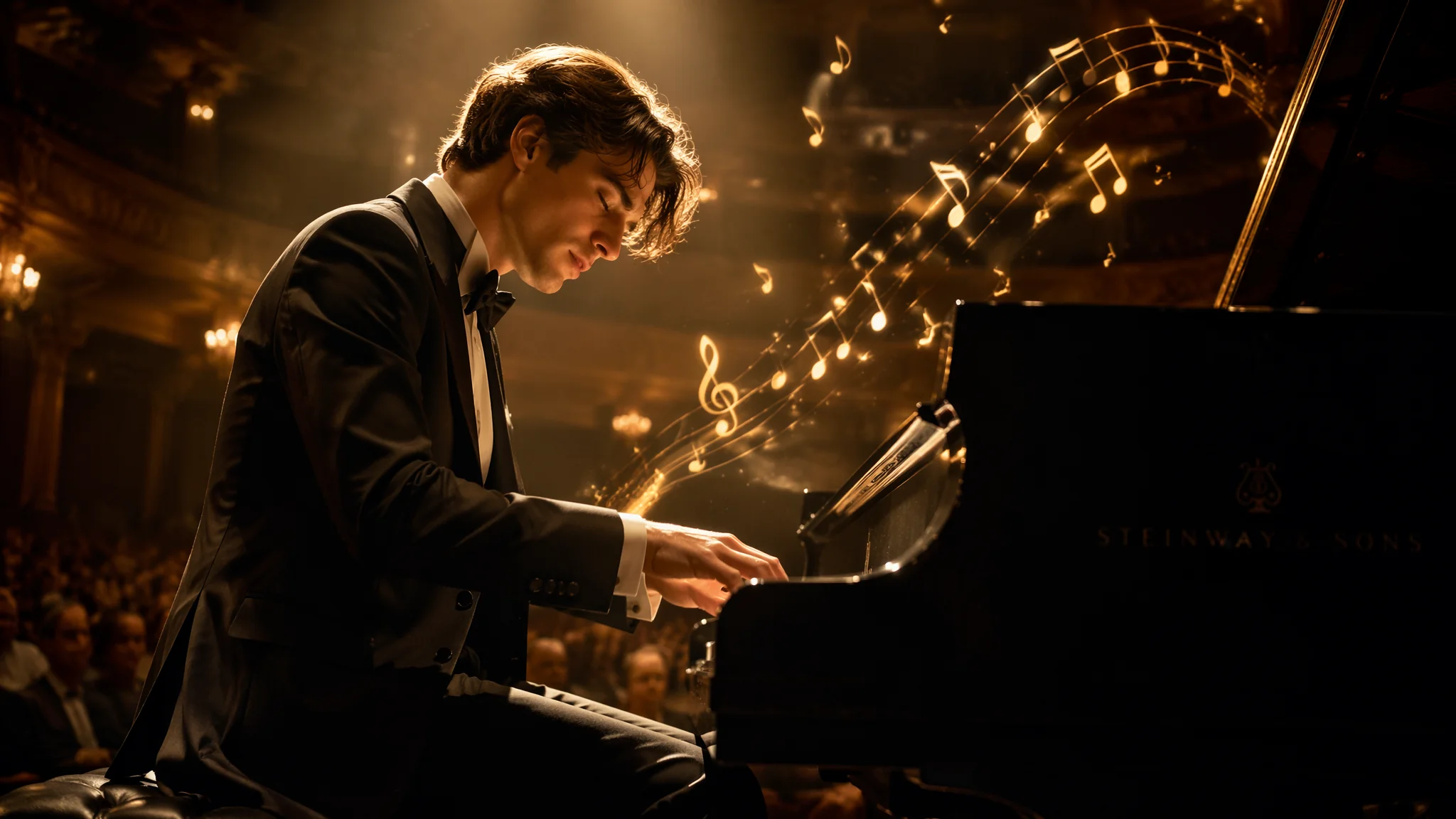
AI画弹钢琴翻车最典型的两个画面:手放在键盘上但手指位置完全不对——大拇指在弹最高音区、手腕塌得像在按计算器;氛围感为零——演奏者坐在一台钢琴前,但画面安静得像图书馆,完全没有"音乐正在发生"的感觉。第一个问题靠手部关键词+负面提示词能解决。第二个问题才是真正的挑战——你怎么让一张静止的图画传递出"声音"?据对2000+张AI钢琴绘画的分析,"音乐可视化元素"(飘浮的音符、光流、声波纹)出现在画面中时,观众对"能感受到音乐"的评分比纯写实钢琴图高出2.6倍。这篇把钢琴场景的氛围感从光影、构图、音乐可视化三个维度全部拆透。
弹钢琴的手是整张画的灵魂——手画崩了,再美的光影都是白费。手部姿态、手指位置、手腕弧度的关键词控制与负面提示词
AI画手的灾难程度在所有题材里排名第一。弹钢琴的手又比普通手难三倍——因为手指要放在特定位置(键盘)、形成特定弧度(指关节弯曲)、表现出特定力度(轻触或重击)。
手部基础关键词——不是"hands on piano",是"hands positioned correctly on a piano keyboard with natural curvature"。"correctly positioned"是一个指令词——它告诉AI"你之前画的手位置不对,注意改正"。手指细节——"fingers arched gracefully with the fingertips pressing individual keys, the thumb passing under the palm for scale runs, the wrists hovering at the correct height neither collapsed nor raised, the hands are relaxed but precise like those of a trained pianist"。三个关键姿态词:"fingers arched"(指关节弯曲,不是直的)、"thumb passing under"(拇指穿掌——这是钢琴演奏的标志性手型)、"wrists hovering at the correct height"(手腕悬浮在正确高度)。负面提示词——"no deformed hands, no extra fingers, no fused fingers, no alien hand anatomy, no flat hands, no collapsed wrists, no fingers in anatomically impossible positions, no hand growing out of the keyboard"。尤其是"no collapsed wrists"——AI画弹钢琴手最常见的错误就是手腕塌陷。
还有一个取巧的办法——不画特写手。如果你不是非要秀手部细节,把演奏者放在中远景,手在画面中占比小于5%,AI画手的瑕疵就不那么刺眼。构图技巧:把视觉焦点放在演奏者的面部表情或钢琴的光影上,手作为模糊但姿态正确的辅助元素存在。更多手部控制技巧见AI绘画美女词汇大全中的手部姿态分类。
音乐可视化——让一张静图"响"起来的关键技术。音符、光流、声波、色彩通感四类音乐视觉化关键词
音乐可视化不是画几个音符符号漂在空中——那是PPT配图。真正的音乐可视化是把"声音"翻译成"光的语言"。
音符粒子化——把音符变成光的粒子:"musical notes visible as glowing particles rising from the piano strings, each note a tiny burst of golden light that hangs in the air before fading, the particles form a constellation of music above the piano, denser near the soundboard and gradually dispersing into the darkness above, the light particles illuminate the pianist's face from below with a warm ethereal glow"。核心理念:音符不是符号——是"发光的尘埃"。尘埃从琴弦上升起、在空中组成星座、照亮演奏者的脸。光流轨迹——把旋律变成光的河流:"a river of translucent colored light flowing from the piano out into the room, the light is visible sound — deep bass notes manifest as slow amber waves near the floor, high treble notes as quick silver-blue streams near the ceiling, the light follows the architecture of the music, swirling around columns and pooling in corners"。不同音高对应不同的光色和速度——低音=琥珀色慢波在地面,高音=银蓝色快流在天花板。这个"通感"逻辑让AI有据可循。
声波物理化——把声波变成可见的物理现象:"sound waves visible as concentric ripples in the air emanating from the piano, like a stone dropped in a pond of atmosphere, the ripples distort the light passing through them creating subtle lens effects, objects near the piano — a glass of water, a vase of flowers — have tiny vibrations visible on their surfaces from the resonance"。声波=空气涟漪+光线折射+物体共振。色彩通感——用颜色表达音乐情绪。欢快的曲子:"the music manifests as warm vibrant colors — coral, gold, sunflower yellow — splashing across the scene like joyful watercolor blooms"。忧伤的曲子:"the music colors the air in cool melancholic tones — deep indigo, muted violet, pale silver-blue — the colors are not sad but contemplative, like twilight"。激昂的曲子:"the music erupts in bold dramatic strokes of crimson, gold, and electric white, the colors are intense and percussive, like lightning strikes frozen in paint"。色彩通感不是随便写的——每种颜色对应一种音乐情绪,这是有跨文化心理学研究支持的。参考色彩与情绪关系见Color Meanings色彩心理学。
同一个弹钢琴场景,四种光线下是四部完全不同的电影。音乐厅聚光、废墟斜阳、深夜台灯、街头晨光的氛围关键词配方
音乐厅聚光——盛大演出感:"a grand concert hall with the pianist alone on stage under a single dramatic spotlight, the rest of the hall is in complete darkness, the spotlight creates a perfect circle of light on the polished stage floor with the piano and pianist at its center, the piano's black lacquer surface reflects the spotlight as a star-burst of white, dust particles dance in the shaft of light like a second audience of tiny celestial bodies"。核心技巧——黑暗中的一束光。光的形状(perfect circle)、照亮范围(piano and pianist at center)、反射(star-burst on lacquer)——三个维度把聚光灯写活了。
废墟斜阳——被遗忘的诗意:"an abandoned ballroom with a grand piano still standing among the ruins, late afternoon sunlight slants through a broken stained-glass window casting colored shards of light across the keyboard, ivy has crept through cracks in the marble floor and curls around the piano's legs, a young pianist sits at this forgotten instrument playing to no one but the ghosts of the room, the music seems to stir the dust motes floating in the sunbeams into slow choreography"。废墟+钢琴=天然的电影感。破损的彩色玻璃窗提供彩色光线、常春藤提供时间流逝的证据、"playing to no one but the ghosts"提供叙事感。深夜台灯——孤独练习感:"a small upright piano in a modest apartment at 2am, the only light is a single desk lamp casting a warm pool of yellow light on the sheet music, the rest of the room fades into deep blue shadow, a half-empty coffee cup sits on top of the piano, outside the window city lights blur into bokeh circles, the pianist's face is illuminated from below by the lamp, highlighting the concentration in their expression"。深夜练琴的氛围核心——孤独但不悲苦。台灯的暖黄vs房间的深蓝、半空的咖啡杯、窗外模糊的城市灯光——细节叠加出一个具体的时间地点。
街头晨光——城市生活的即兴:"a public piano on a city sidewalk at sunrise, the piano is colorful and painted by local artists, morning light is just beginning to warm the buildings, a street sweeper has paused to listen, a few early commuters stop with their coffee cups, steam rising from the cups in the cool morning air, the pianist is not a concert performer but an ordinary person filling the street with unexpected beauty"。街头钢琴的灵魂是"意外"——不是剧场里的预期之内,是通勤路上突然被音乐截停的瞬间。氛围的完整对比见AI绘画田园风景的光线情绪对照表。
构图决定了钢琴场景的叙事视角——你是旁观者还是参与者?俯拍、水平、仰拍、特写四种构图的视觉心理
俯拍(从上方往下看)——上帝视角,强调孤独感:"overhead shot looking directly down at the grand piano from above, the pianist is a small figure before the massive instrument, the piano's curved body fills most of the frame like a black landscape, the hands move across the keys like two small creatures navigating an ivory and ebony terrain"。俯拍让演奏者变小、钢琴变大——人与乐器的力量对比被反转。水平视角——平等共情,强调代入感:"eye-level shot from the side of the piano, the camera is positioned at the height of the pianist's face, we see their expression in profile and the hands on the keyboard in the midground, the perspective makes the viewer feel like they are sitting on the piano bench beside the performer"。水平视角是最"友好"的视角——观众被邀请进入演奏者的私人空间。
仰拍(从下方往上看)——英雄视角,强调力量感:"low angle shot from near the floor looking up at the pianist and the raised lid of the grand piano, the pianist appears monumental and powerful, the open piano lid creates a dramatic diagonal line cutting across the frame, light pours down from above creating a halo effect around the performer's silhouette"。仰拍让演奏者变成舞台上的巨人。特写——情感视角,强调细节的叙事力:"extreme close-up of just the hands on the keyboard with the face out of focus in the background, we see every detail — the slight tension in the knuckles before a difficult passage, the way the fingers barely graze the keys for a pianissimo, the reflection of the sheet music in the polished wood of the piano"。特写把音乐翻译成肌肉的微语言——手指的紧张度和触键的力度就是音量。四种构图的叙事差异可以在同一张图里混合使用——比如仰拍+特写手部=力量和细腻的共存。
钢琴场景的构图完整指南见AI绘画古风头像的构图分析模块。
钢琴的琴键经常画错数量或排列怎么办?
AI不懂钢琴有88个琴键这个事实。写关键词时给参照系:"a full 88-key piano keyboard with the correct pattern of white and black keys — groups of two and three black keys repeating across the keyboard, the keys are proportional and evenly spaced, not a random arrangement"。负面词加"no deformed keyboard, no missing keys, no uneven key spacing"。如果琴键还是错,用PS后期修正——琴键属于"几何规律性高"的元素,后期修比让AI画对容易。
演奏者的表情怎么和音乐情绪匹配?
欢快曲子:"a slight smile playing at the corners of the lips, eyes half-closed in pleasure, head tilted slightly as if listening to a beautiful secret told by the music"。忧伤曲子:"eyes closed but with a slight furrow between the brows, lips pressed together in a thin line, the expression is not of sadness but of deep absorption in emotion, a single tear might trace down one cheek"。激昂曲子:"eyes wide open and focused, jaw set with determination, the whole body leaning into the keyboard as if the music requires physical force to be released"。表情的关键词不是形容词——是动作。"eyes half-closed in pleasure"是动作,"happy"是形容词——动作描述永远比形容词更精准。
三角钢琴和立式钢琴在画面里有什么不同的氛围?
三角钢琴(Grand Piano)=舞台、正式、仪式感、空间开阔。适合音乐厅、大房间、富丽堂皇的场景。立式钢琴(Upright Piano)=家庭、日常、亲切感、空间紧凑。适合公寓、教室、小酒馆、街头。钢琴类型本身就是一个场景提示——你写"grand piano"等于同时写了"这不是一个随便的空间"。钢琴与空间的互动技巧见AI绘画服装设计的场景与物品匹配原则。
画面里能加观众吗?会不会分散注意力?
能加,但观众应该作为"氛围元素"而非"画面焦点"存在。音乐厅观众:"the audience visible only as a dark mass of silhouettes beyond the spotlight's reach, their presence felt rather than seen"。街头观众:"a few passersby have stopped at a respectful distance, their faces softened by the music, one child has sat down on the pavement to listen"。观众的关键词——"their presence felt rather than seen"——观众是背景氛围,不是前景焦点。
怎么让画面有"这首曲子正在弹到最高潮"的感觉?
用"临界点"描述——不是已经高潮,是正在冲向高潮:"the pianist's hands are suspended in mid-air for a fraction of a second before crashing down on the keys, the body is coiled with tension about to be released, the sheet music is turned to the most heavily marked page with dynamic markings of fortissimo, tiny droplets of sweat have left the pianist's temple and are frozen in mid-air, the entire scene is a held breath before the musical explosion"。动感不是动作本身——是动作来临前的那个瞬间。"hands suspended in mid-air"比"hands hitting the keys"更有张力。
转发给也在画音乐场景的朋友——好画面应该被更多人听见。