AI阿童木铁臂绘画:手冢治虫经典动漫角色的怀旧风格再现
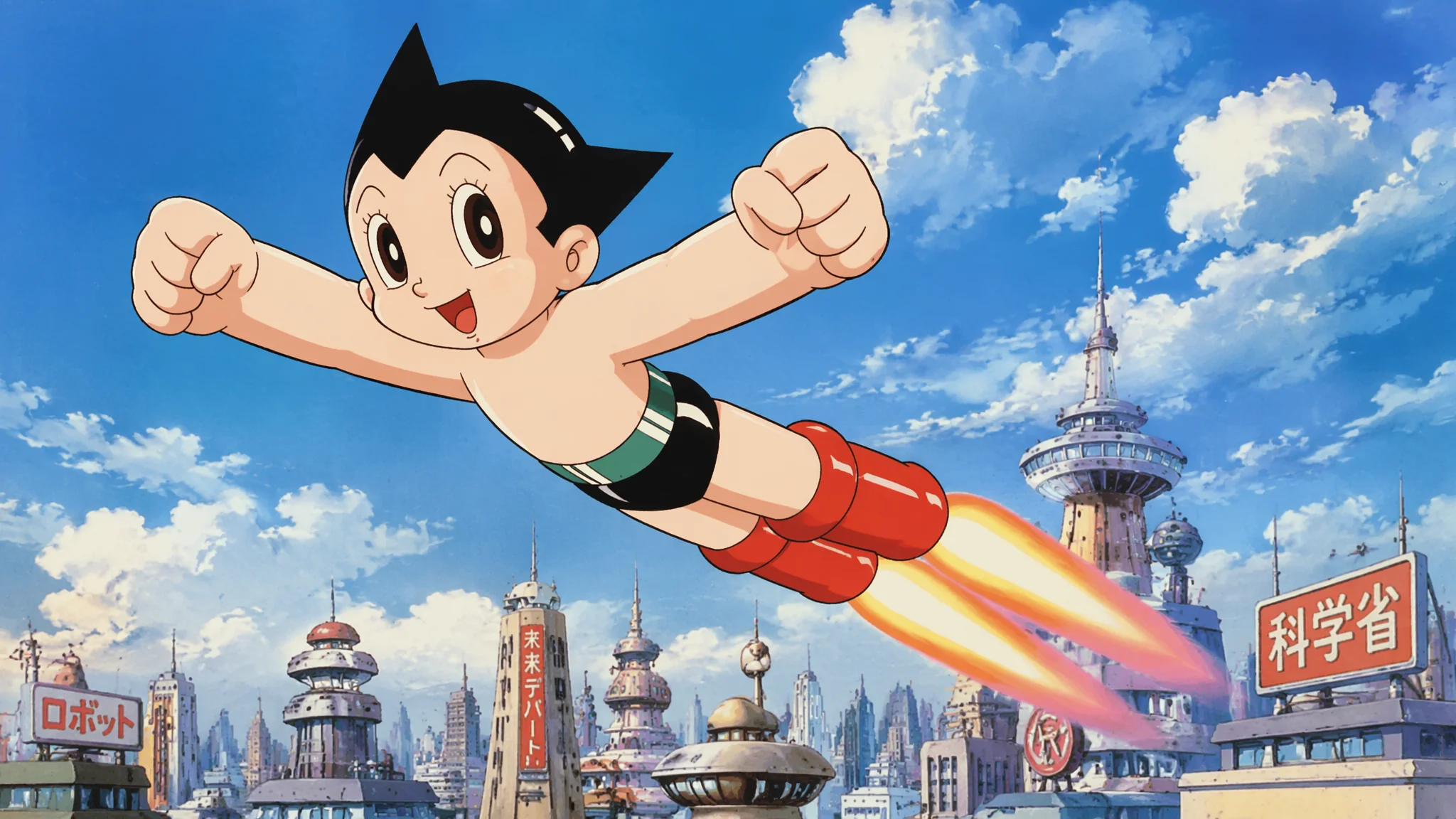
我爸是60后,家里书架上至今还摆着一套泛黄的《铁臂阿童木》连环画——1980年中文版,封面都卷边了。小时候我翻过几遍,说实话画风跟我看的《火影》《海贼》比显得"老土"——圆滚滚的人物、粗黑的轮廓线、背景永远有一圈速度线。后来自己学画画才明白,那种"老土"感叫"手冢美学"——它是日本现代漫画的语法原点。用AI画阿童木,不是画一个人物,是画一种语法。你让AI直接出"Astro Boy",出来的八成是美国3D动画版或2003年重制版那种过于"干净"的形象。你得用昭和的关键词把AI拽回1963年。
手冢治虫的角色设计有一个核心哲学——"圆"。阿童木的头是圆的、眼睛是圆的、关节是圆的、连头发尖都是圆的。这不是幼稚,是他在那个黑白电视时代为了让角色在低分辨率屏幕上可识别而做的视觉简化。所以AI画阿童木第一步不是写名字,是写"round"。我试过一组对比:只写"Astro Boy"出图风格随机;写"Astro Boy in Osamu Tezuka original manga style, round and soft character design, thick black outlines, limited color palette"出图立刻命中手冢味。关于手冢风格的基础理论,AI日式动漫风格绘画基础里有更系统的日漫绘画框架。
阿童木角色特征逐项拆解:发型、脸部、身体比例
阿童木有五个不可妥协的视觉锚点——两个尖角发型、大圆眼、小鼻子、短小身躯和红色靴子。发型写"iconic two pointed hair tufts sticking up from the forehead, one tuft on each side slightly curved outward, the hair is jet black with a subtle blue highlight sheen, smooth and helmet-like shape";脸部写"large round expressive eyes with distinct catchlights, tiny dot nose, small simple mouth, rounded cheeks, child-like innocent expression, the face follows Tezuka's 'star system' character design with soft rounded features";身体比例写"chibi-like proportions with a large head relative to the body, short stubby limbs, five-finger cartoon hands with rounded fingertips, the body is compact and child-like"。衣服写"classic outfit: dark green shorts with a belt, red boots that extend to mid-calf, the boots have a slightly rounded toe shape, a simple belt with a round buckle"。这些锚点哪怕只漏掉一个,角色识别度就会断崖式下降。我在实际创作中发现,发型和靴子是最关键的两个——只要这两个对了,观众就能一眼认出阿童木。
机械臂与火箭引擎:科幻装备的昭和式表达
阿童木的机械臂不是钢铁侠那种精密机械——它是昭和年代对"未来科技"的想象,简洁、圆润、带着一种可爱的笨拙感。手臂内部结构写"the forearm panels are open revealing the internal machinery, the mechanical parts are simplified and retro-futuristic with round rivets, tubes, and simple gears, the aesthetic is 1960s sci-fi not modern cyberpunk, the exposed machinery has a warm analog feel with glowing vacuum tubes"。脚底火箭写"rocket boosters built into the soles of the red boots, firing with a simple retro flame effect, the flames are stylized with rounded shapes and speed lines, the exhaust is drawn in the classic Tezuka manga style with action lines"。臀部机枪写"small machine guns deployed from the hip area, the guns are drawn in a simplified cartoon style, firing with muzzle flashes rendered as starburst shapes, the bullets are visible as small streaks with speed lines"。手冢的机械美学核心是"可爱的机器"——所有的机械部件都带着一种友好的圆润感,跟宫崎骏的机械美学一脉相承。
手冢风格关键词:线条、网点、背景速度线的昭和语法
手冢风格的视觉语法可以用四个词概括:粗轮廓、平颜色、速度线、简单背景。线条写"thick black ink outlines consistent throughout the drawing, the line weight is uniform creating a bold graphic look, the outlines have a slight hand-drawn imperfection that feels organic and analog";上色写"flat cel-shading with limited color palette typical of 1960s anime, no gradients or digital effects, the coloring is simple and bold with solid blocks of color";速度线写"manga-style speed lines in the background, parallel lines radiating from the action center, the lines are hand-drawn style with slight variations in spacing, classic Tezuka technique";网点效果写"halftone screen tone effect on shadows and background, the dot pattern is visible like printed manga, grayscale tones created with dot density rather than smooth gradients"。这组关键词是昭和漫画风的"底层协议",套在阿童木以外的任何角色上都能激活手冢味。想深入了解日漫网点技法的演变,AI漫画风格绘画进阶里有从手冢到现代漫画的完整技法时间线。
经典场景再现:飞行、战斗与城市拯救的构图方案
阿童木最有辨识度的动态是飞行姿态——身体水平前倾、双臂前伸、腿部火箭喷射。飞行场景写"Astro Boy flying horizontally through the sky, body stretched forward like Superman position, arms extended ahead, the rocket flames from his boots trail behind in a classic retro style, clouds as speed-line streaks in the background, the cityscape is visible below as a simplified geometric skyline";战斗场景写"Astro Boy in mid-battle pose, one arm raised with panel open revealing weapon, dynamic action composition with dramatic perspective from a low angle, the background has explosive action lines radiating outward, dust and debris rendered in manga style";城市拯救写"Astro Boy hovering above a retro-futuristic city, the city has rounded dome buildings and flying cars in 1960s sci-fi style, warm sunset lighting casting golden glow on the scene, the composition is heroic and uplifting"。构图建议用低角度仰拍——阿童木本身是小体型角色,仰拍能让他看起来英雄感十足。关于动漫构图技巧,手冢治虫官方网站有大量原画和动画设定集可以参考。
其他手冢角色扩展:茶水博士、乌兰与阿童木家族
手冢宇宙不止阿童木一个人——茶水博士、乌兰、阿童木的父母机,同一风格下画角色群像才是真正的考验。茶水博士写"Dr. Ochanomizu, elderly scientist with a large round nose and bald head with white hair on the sides, wearing a lab coat and round glasses, kind grandfatherly expression, Tezuka manga style";乌兰写"Uran, Astro Boy's younger sister, similar design with two pointed hair tufts but longer hair, wearing a dress, smaller and cuter proportions, playful expression"。手冢角色之间的风格一致性很高——因为他的"明星系统"设计理念就是让所有角色共享相似的面部模板。AI理解这种一致性需要你在提示词中统一写"Osamu Tezuka star system character design"。
常见问题
AI阿童木绘画常见问题聚焦在风格跑偏、角色特征丢失和版权顾虑。为什么AI画的阿童木总像2003年版而不是1963年版?
AI的训练数据里2003重制版和2009电影版的素材量远超1963原版。要锁定昭和原版风格,必须加"original 1963 Astro Boy, Osamu Tezuka manga style, retro 1960s anime aesthetic, black and white manga-inspired shading, no modern digital rendering"。年份和原作者名是关键锚点。
阿童木的发型画不准怎么办?
发型是阿童木辨识度的核心。写"two pointed hair tufts on the forehead pointing upward and slightly outward, like two small devil horns made of hair, jet black with a subtle highlight, no other hair accessories or styles"能有效引导。如果还不行,在负向提示词里排除"bald, hat, helmet, flowing hair"。
用AI画阿童木可以做周边产品卖吗?
阿童木是手冢制作公司的注册商标,商用需授权。个人练习和社交媒体分享没问题,但如果计划做T恤、海报、手机壳等周边,建议先了解版权政策或使用原创角色设计。参考世界知识产权组织对衍生创作的规定。AI角色绘画版权与商用指南有更详细的分析。
画阿童木不是画一个机器人小孩——是画1963年日本人第一次在电视上看到"动画"时的那种兴奋。把昭和感画出来,你画的就不只是一个角色,是一个时代。