AI敦煌飞天绘画:丝路壁画与佛教艺术之美的数字化再现创作
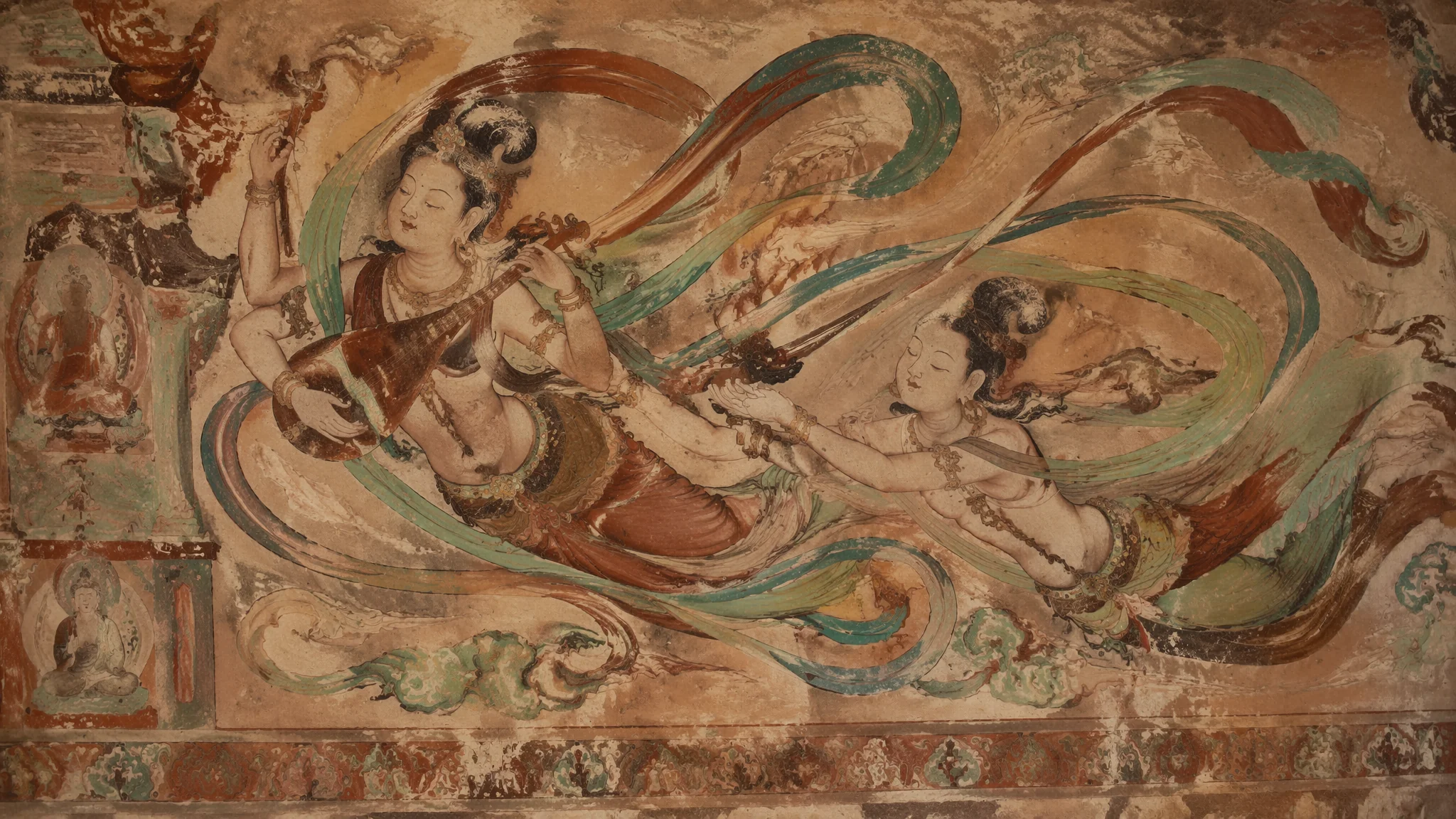
2019年我去过敦煌莫高窟——站在那个幽暗的洞窟里,手电筒的光扫过北壁的飞天壁画,一千多年前的画师用矿物颜料画出的飞天在黑暗里"活"了过来。那种震撼没法用语言描述——飞天不是"飞"在墙上的,是"飘"在墙上的。回来后我用AI尝试复现敦煌飞天的美学——第一版出来我就删了:AI画的飞天是"西方天使穿了中国衣服"——飘带的动态不对(西方天使的翅膀逻辑、不是东方飞天的飘带逻辑)、人物的体态不对(直立站姿、不是飞天的"S形三道弯")、壁画的质感完全缺失(光滑的数码表面、没有千年风化的龟裂纹理)。这篇把我后来研究的"AI画敦煌飞天"的系统方法论完整整理出来。
飞天的体态密码——"三道弯"与失重漂浮感
敦煌飞天的体态有一个千年前就定型的公式——"三道弯"(Tribhanga):头向右偏、上身向左倾、下身向右摆——整个人体形成一个优美的S形曲线。这个"S形"是飞天的骨骼结构——AI如果不理解这个结构,画出来的就是"一个直立的人在挥彩带"。
S形体态Prompt——"the flying Apsara (celestial being) is captured in a dynamic floating pose——her body forms a graceful S-curve (Tribhanga posture): the head tilts gently to one side, the torso curves in the opposite direction, and the legs trail behind in a flowing motion, the pose is weightless and ethereal——she does not stand or sit but floats through the air as if swimming through clouds, her spine describes an elegant asymmetrical curve, her arms extend gracefully——one arm reaches forward holding a lotus flower, the other trails behind releasing a swirl of flowing ribbons, the entire body language conveys lightness and divine freedom——gravity does not apply to celestial beings"。关键细节——飞天的腿不是"直直地垂着"的,而是"自然地弯曲并向后飘"——"her legs are bent at the knees with the feet relaxed and trailing behind, the lower body floats higher than the upper body creating a diagonal ascending line"。
飞天的"飞天感"来自一个视觉悖论——身体在移动但表情是安详的、飘带在狂舞但手势是柔和的。这种"动态的身体+静态的面部"的矛盾统一创造了佛国世界的超脱感。关于飞天姿态的更多细节参考敦煌研究院的数字壁画数据库——高清扫描的飞天壁画是最好的姿态参考。
飘带的流动美学——飞天不是"长了翅膀",是"披了彩带"
西方天使靠翅膀飞,东方飞天靠飘带飞。飘带(天衣/披帛)是飞天形象中最重要的视觉元素——它不是装饰品,它是"飞天之所以能飞"的视觉解释。飘带的动态决定了飞天的"飞行方向"和"飞行速度"。
飘带动态Prompt——"her flowing celestial ribbons and scarves are the visual engine of her flight——the ribbons are impossibly long, extending several body lengths behind and around her, the ribbons twist and spiral through the air in three-dimensional curves——they do not flutter randomly but follow aerodynamic arcs that describe the path she has flown, the ribbons have a weightless silk-like quality——they ripple and undulate like fabric underwater, the ribbon colors transition from deep red-orange at the body to pale pink and gold at the trailing ends, multiple layers of ribbons create visual depth——the foreground ribbons are sharp and detailed, the background ribbons are softer and more diffuse, the ribbons wrap around clouds and frame the composition"。飘带的"三度空间"运动——向上飘的(支撑)、向后飘的(速度)、环绕身体飘的(保护/装饰)——三种飘带各有各的运动逻辑,合在一起才构成"飞天"的完整飞行轨迹。
飘带与云气的关系——敦煌飞天的飘带经常与云气(彩云)交织在一起,飘带穿过云朵、云朵缠绕飘带——"the celestial ribbons weave through stylized auspicious clouds, the clouds and ribbons merge at their edges——it becomes ambiguous where the ribbon ends and the cloud begins, this visual ambiguity between textile and vapor is a hallmark of Dunhuang aesthetics"。关于云气画法的更多内容见AI古风场景绘画。
壁画肌理的做旧——千年风化的"时间层"
AI画敦煌飞天最致命的问题不是画得不像——是画得"太新了"。崭新的壁画看起来像商场里的装修墙绘,不是千年洞窟里的佛教艺术。敦煌美学的核心魅力之一是"时间的痕迹"——颜料的剥落、墙体的龟裂、烟熏的暗沉、以及矿物质颜料氧化后的微妙变色。
壁画肌理Prompt——"the image has the texture and patina of an ancient cave mural that has survived for over a thousand years——the surface has a network of fine crackles (craquelure) running through the pigment like the crackle pattern on aged ceramics, some areas of the painting have flaked off——revealing the earthen plaster underneath in patches, the edges of the flaked areas are irregular and organic, the colors are muted and earthy——the original mineral pigments have oxidized and mellowed over centuries, the once-bright vermillion has become a deep rust, the malachite green has darkened to a sage, the lapis lazuli blue has retained more of its original intensity, the overall surface has a warm ochre undertone from the clay ground, there is a subtle unevenness to the lighting——as if illuminated by a single beam of light in a dark cave, the image feels excavated and ancient rather than freshly painted"。参考大英博物馆收藏的敦煌壁画残片——可以看到真实的颜料剥落和龟裂状态。
矿物颜料特征——敦煌壁画使用的是天然矿物颜料:朱砂(红)、青金石(蓝)、孔雀石(绿)、赭石(棕)、金箔(金)。这些矿物颜料在现代AI绘画中需要用对应的色彩词汇来描述——"the red is not modern cadmium red but a warm earthy vermillion with a slight orange undertone——the pigment looks like ground cinnabar, the blue is deep ultramarine with the richness of crushed lapis lazuli——it has a slight purple undertone in the shadows"。关于矿物颜料色彩体系的更多内容见AI古风插画绘画。
唐代到元代——飞天造型的演变与各朝代的特征区分
敦煌飞天不是一成不变的——从北凉到元代,飞天造型经历了近千年的演变。唐代飞天最经典(丰腴圆润、雍容华贵、色彩绚丽),西魏飞天最飘逸(清瘦修长、西域风格浓重),元代飞天最神秘(密宗影响、装饰繁复)。不能混着写Prompt——"唐代的丰腴脸+西魏的细长身+元代的密宗手势"这锅乱炖出来的就是"AI缝合怪"。
唐代飞天(黄金时代)Prompt——"the Apsara is rendered in the High Tang dynasty style——her face is round and full with the plump beauty ideal of Tang aesthetics, her eyebrows are painted in the 'moth antenna' style——slightly curved and thick, her cheeks are flushed with a soft rouge, her expression is serene and benevolent with a subtle smile, her body is curvaceous and ample——reflecting the Tang appreciation for fuller figures, her garments are layered and sumptuous——a tight-fitting top with a long flowing skirt and multiple layers of translucent silk ribbons, the color palette is warm and opulent——vermilion, gold, emerald green, and ultramarine blue"。西魏飞天——"the flying figure has the slender elongated proportions of the Western Wei period——the body is thin and ethereal with exaggeratedly long limbs, the facial features show Central Asian influence——a high-bridged nose and deep-set eyes, the style is more linear and less volumetric than Tang depictions"。
不同朝代飞天造型的详细对比是一个非常庞大的知识体系——从发型(唐代的高髻vs西魏的宝冠vs元代的璎珞冠)、服饰(唐代的齐胸襦裙vs北周的袒右肩袈裟)、到手持法器(唐代的莲花vs元代的嘎巴拉碗)——每个细节的历史准确性决定了AI敦煌飞天的专业水准。更多古风各朝代特征的详细考据见AI古风男性风格绘画中关于历代服饰的对比分析。
常见问题
AI画的飞天飘带总是"僵硬"——像纸片而不是流动的丝绸,怎么解决?
飘带僵硬的根因是AI没有理解飘带的"受力"——在真实物理中,飘带的每一个弯曲都是在对抗重力和空气阻力。解决方法——在Prompt里描述飘带的"力学状态"而不仅是"视觉状态"。"the ribbons are caught in an invisible celestial wind——they billow and ripple with the fluid dynamics of silk in a breeze, the ribbons do not hang limply or fly in straight lines——they curve in complex S and C shapes as they interact with air currents, the edges of the ribbons flutter rapidly——creating a sense of motion blur at the trailing ends, the thicker parts of the ribbon near the body move more slowly, the thinner trailing ends whip and snap with greater velocity"。加上"motion blur at the edges"——这是让飘带"动起来"的终极技巧,微小的拖影暗示了运动速度。
怎么在保持敦煌风格的同时让画面有"现代感"——而不是纯粹的仿古?
现代敦煌风的融合策略——保留敦煌的核心视觉元素(飞天体态、飘带、云气、矿物色板),但在构图、光影和细节精度上使用现代数字绘画语言。现代敦煌Prompt:"a contemporary digital art interpretation of the Dunhuang flying Apsara——the traditional elements are preserved: the S-curve posture, the flowing celestial ribbons, the mineral pigment color palette, and the ancient mural texture, but the rendering is crisp and high-definition with cinematic lighting——a dramatic shaft of light illuminates the figure as if by a spotlight in a dark museum gallery, the level of detail is photorealistic——individual threads in the silk ribbons are visible, the gold leaf accents gleam with metallic realism, the background fades to a deep atmospheric black, the composition blends the ancient iconography with modern aesthetic sensibilities——like a masterpiece in a contemporary art exhibition"。核心公式:传统题材+现代渲染质感+高级光影="新中式敦煌风"。
AI经常把飞天画成"天使"——加了翅膀,怎么强制去除西化元素?
飞天被西化为天使是因为AI训练数据中"会飞的宗教人物"被"天使"的图像主导了。去西化需要在Prompt里明确几个差异点。第一,否定翅膀——负向Prompt:"no wings, no feathered wings, no angel wings, no western angel iconography"。第二,强调飘带飞行——正向Prompt:"she flies not with wings but with the power of her celestial ribbons——the flowing scarves are her means of flight, she is an Eastern Apsara not a Western angel"。第三,强调东方面部和服饰特征——"East Asian facial features, Chinese-style costume, Buddhist iconography, Dunhuang mural art style"。三管齐下,基本能覆盖住AI"画天使"的冲动。如果仍然不行——可以尝试在Prompt里加"pre-10th century Chinese Buddhist art"这个时期限定——10世纪以前的中国佛教艺术是天使图像还没有进入训练数据关联的时间段。