AI游戏怪物角色绘画:从概念草图到次世代3D的完整设计流程
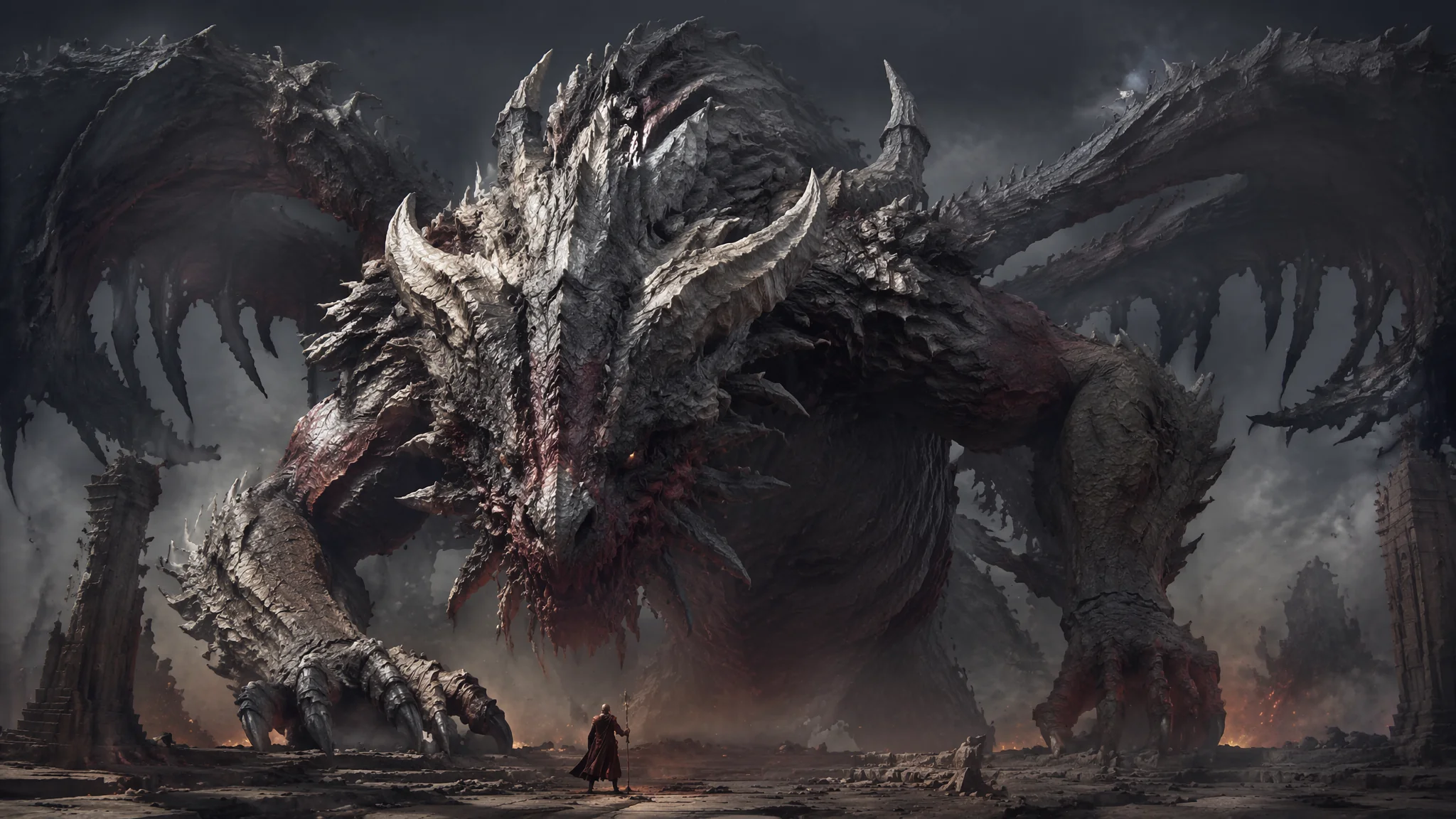
我有个朋友在成都一家游戏公司做怪物原画——干了六年。去年他跟我说现在公司要求每个原画师必须学会用AI辅助设计,产能要求从一个月三只怪物提到了一个月八只。他一开始很抗拒——觉得AI画的怪物"没有灵魂",就是各种动物的零件拼在一起。后来他琢磨出了一套自己的工作流:AI负责快速出剪影和材质变体,他负责做"生物逻辑"的判断和筛选——结果产能不仅翻倍了,他反而觉得自己的创作更自由了:"以前一周时间有三天在抠鳞片的排列,现在AI十秒钟给我二十种鳞片方案,我选最对的那一种继续优化"。这篇就是从他那里学来的"AI怪物设计管线的正确打开方式"。
怪物的"剪影识别度"——游戏行业中一条铁律:好怪物的剪影让你一眼认出它
游戏怪物设计有一条金科玉律:把怪物填成纯黑色——如果只看剪影你还能认出这是什么怪物,设计就成功了;如果剪影是一团模糊的轮廓,回去重做。因为玩家在战斗中看到的怪物通常只有零点几秒——而且是远景、逆光、或者屏幕边缘的一小块——剪影是第一时间传递"这是什么怪物"的信息通道。AI画怪物最大的毛病就是"剪影不独特"——因为它被训练成"画一个看起来像怪物的东西",而"看起来像怪物"的剪影往往就是一个人形加一些刺和尾巴。
怎么在Prompt里解决剪影问题?分两步。第一步——先不给AI任何生物描述,只给剪影方向:"the creature has an unmistakable silhouette——the shape reads clearly as a single distinctive form: the head and shoulders form a massive triangular wedge like an axe blade, the torso tapers dramatically to a narrow waist, four long thin legs extend from the torso at sharp angles like a crane fly, two additional limbs rise from the shoulder area curving upward and inward like a mantis, the tail is a long segmented whip that extends beyond the frame——every element contributes to an asymmetrical but instantly recognizable profile"。第二步——在剪影清晰的基础上再填充细节。这个"先剪影后细节"的顺序在AI绘画中同样适用——如果你一上来就写"dragon-like creature with scales and horns and spikes and wings"——AI会给你一团"细节很多但形状模糊"的东西。
生物融合的逻辑——好的怪物不是"缝合怪",是"生态位推导"
顶级怪物设计(比如《血源诅咒》《怪物猎人》)的创作逻辑不是"我们把鳄鱼和螳螂拼在一起酷不酷"——而是"在这个虚构的生态系统中,什么顶级掠食者会进化出这样的特征"。这个思维方式的转变是AI怪物设计从"业余"到"专业"的分水岭。
生态位推导Prompt模板:环境定义→适应特征→视觉表现。示例——沼泽伏击型掠食者:"this creature has evolved as an ambush predator in a toxic swamp where the water is waist-deep and visibility is near zero due to thick fog, its body is low and flat like a crocodile but with amphibian skin that can change color and texture to match the murky water, its mouth is disproportionately wide and lined with needle-thin transparent teeth that are nearly invisible until it strikes——prey does not see the teeth, the mouth opens upward from below like a trapdoor, its nostrils and eyes are mounted on small periscope-like stalks that barely break the water surface, its limbs are short and paddle-like for silent propulsion through thick water, its skin is covered in symbiotic algae and moss that provide camouflage and absorb toxins from the water)。这比写"swamp monster with big mouth"精确一百倍——而且3D建模师看了这个描述会非常清楚每一个设计的"为什么"。关于更广泛的角色设计系统见AI外星人绘画——异星生物的设计逻辑和怪物设计是相通的。
材质系统——鳞片、甲壳、黏液、皮毛的Prompt精确控制
怪物设计的另一个核心难点是材质——AI对"怪物皮肤"的默认理解是一层灰色的粗糙纹理,和水泥墙差不多。但不同生态位的怪物需要完全不同的材质系统:爬行类的鳞甲、节肢动物的几丁质外壳、两栖类的湿润表皮、深海生物的半透明凝胶状组织——每种材质的光学行为完全不同。
爬行类鳞甲:"the creature's body is covered in overlapping keratin scales arranged in a diamond pattern like a viper, each scale is slightly raised at the trailing edge——catching the light on the raised ridges, the scales are not uniform in color——they transition from dark charcoal on the back to pale gray on the belly, the scales have a slight iridescence like oil on water——a structural color effect from microscopic ridges on the scale surface, between the scales a darker flexible skin is visible allowing the body to expand and contract"。节肢动物甲壳:"the creature's exoskeleton is made of chitin——it has the smooth matte finish of a beetle's carapace, the segments are divided by thin flexible membranes that appear darker and slightly recessed, the chitin surface is not uniform——it has subtle ridges and bumps that follow the growth pattern of the exoskeleton, at the joints the chitin plates overlap like articulated armor with visible hinge structures"。黏液与湿润表面:"the creature's amphibian skin glistens with a thin layer of natural mucus——not dripping or excessive but creating a subtle wet sheen across the surface, the mucus catches specular highlights in thin streaks that follow the contours of the underlying muscles, in the crevices and folds of the skin the moisture pools slightly——creating darker lines that define the creature's anatomical structure"。
每一种材质描述都要包含三个要素:表面几何(scale shape/exoskeleton segment/skin fold)、光学行为(iridescence/matte/specular)、颜色分布(dorsal to ventral gradient/growth pattern/age variation)。只写材质名字("scales""chitin""slime")的Prompt产出的是"有鳞片的灰色物体"——不是活物。关于材质表现的更多技巧参考AI腹肌帅哥绘画——人类皮肤的材质描述逻辑在解剖学层面和怪物皮肤是相通的。专业游戏美术参考可查阅ArtStation Learning的生物设计课程和80 Level的次世代角色管线。
从概念到3D——AI在游戏管线中的正确定位
很多原画师担心AI会取代他们——但实际的情况是:AI替代的是"重复劳动",而不是"创作判断"。在一条标准的游戏怪物制作管线中:概念发散阶段(AI做80%你选20%)→ 剪影筛选(AI做70%你评判30%)→ 细节刻画(AI做40%你做60%)→ 三视图制作(你做100%——AI目前无法胜任)→ 3D建模(你做100%——AI只能提供材质参考)。AI的价值在前两个阶段是巨大的——它可以在十分钟内给你三十个概念方向,而你从中选出最有潜力的三个继续深化。
具体的"AI概念辅助→人工深化"工作流:一,用AI(Midjourney或Flux)以"silhouette exploration"模式生成大量黑白剪影变体——不做细节不写材质,只看形状。二,选中2到3个剪影后,用AI的"variation/remix"功能给同一个剪影叠加不同的材质方案(鳞片vs毛发vs甲壳)。三,选定最终方向后,不再用AI"画"——而是把AI的图导入Procreate/Photoshop作为底图参考,自己动手画精确的线稿和结构标注。四,把人工画好的线稿和AI参考图一并交给3D建模师。这个流程的关键是:AI负责"可能性空间"的探索,人负责"设计判断"和"精确执行"。关于AI在完整创作管线中的定位,在AI草图绘画软件推荐中有更系统的分析。
常见问题
怎么让AI画"可爱的怪物"——比如宝可梦风格而不是恐怖游戏风格?
关键在比例和眼睛。可爱怪物的比例规则:头身比1:2或1:1.5(头占身体的40%到50%),眼睛占脸部面积的25%以上,四肢短而圆润没有尖锐棱角,整体轮廓接近圆形或椭圆形。"a creature designed in a cute monster style, the proportions are chibi-like——the head is nearly half the total body height, the eyes are large and round taking up much of the face with large bright catchlights that give a friendly innocent expression, the body is round and soft with stubby limbs, any claws or teeth are small and rounded——clearly present but not threatening, the color palette is bright and saturated with warm tones, the overall design language is 'huggable' not 'dangerous'"。把"huggable"写进去——这是可爱怪物的核心审美。
AI画的怪物"尺度不够大"——想要那种比摩天大楼还大的巨型怪物?
AI的默认画面是"一个怪物站在中景距离"——没有尺度参照物就显示不出巨大。解决方法:在画面中放入人类尺度的参照物——"a colossal creature whose size is revealed by comparison——a tiny human figure in the foreground reaches only to the height of the creature's claw, the creature's eye alone is as tall as a person, the perspective is from a low angle looking up which exaggerates the creature's scale, atmospheric perspective creates haze around the creature's upper body making it fade into the clouds——this visual cue of 'so large it disappears into the sky' is essential for conveying kaiju-level scale"。关键词是"tiny human figure in the foreground"和"atmospheric perspective"——没有参照物就没有尺度感。
怪物设计中的"文化风格"怎么控制——中式妖怪和西方怪物的视觉区别?
中式妖怪——"inspired by Chinese mythology and Shan Hai Jing bestiary, the creature has flowing organic forms rather than bulky muscular anatomy, silk-like membranes and long flowing fur or feathers, the design emphasizes elegance and spirit over brute force, ink-wash textures and traditional Chinese pattern elements are integrated into the creature's natural markings, the color palette draws from Chinese five-color theory——vermillion red, jade green, imperial yellow, black, and white"。西方怪物——"Western dark fantasy monster design, the anatomy is heavy and muscular with emphasis on raw physical power, thick leathery skin with scars and weathered textures, horns and bone protrusions that grow in practical defensive patterns, the visual language is grounded in European medieval bestiary and Gothic horror traditions, earth tones and desaturated colors dominate"。两种风格的根本差异:中式=飘逸+灵动+留白,西方=厚重+写实+细节堆叠。更多神话题材风格在AI阿修罗神话绘画中有跨文化比较。