AI阿修罗神话绘画:印度教战神与佛教护法的神圣形象视觉创作
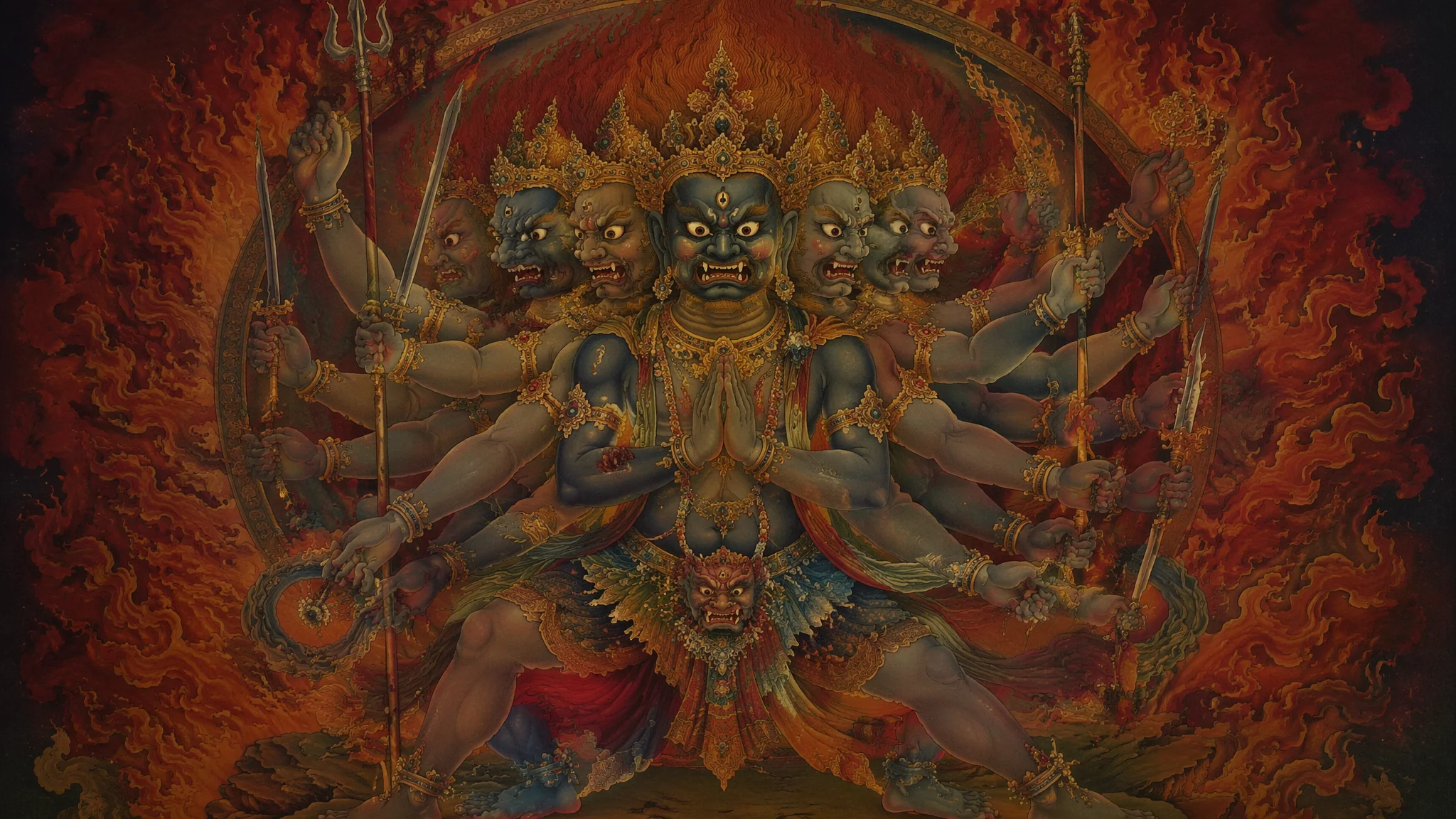
去年我在清迈一座小寺庙里看到一面壁画——画的是阿修罗与天神的战争。那些多臂战神踏着火焰云、手持各种法器、怒目圆睁的形象让我站在墙前看了整整二十分钟。回来以后我用AI试着复现那种感觉,结果第一张图六条手臂有三条从肋骨里长出来,火焰光环活像个轮胎着火了——惨不忍睹。后来我花了整整一个周末研究印度教与佛教造像的视觉语言,才发现画好神话人物的关键不是"多画几条胳膊"——而是理解每一件法器、每一种手势、每一层火焰背后的意义体系。这篇就是那次"惨败"之后系统整理的全部经验。
阿修罗不是"恶魔"——先搞清楚你要画的是哪一版的阿修罗
大多数人一听到"阿修罗"脑子里蹦出来的就是一个青面獠牙的怪物——这是被《天龙八部》和各类游戏带偏了。实际上阿修罗在印度教里是力量与战争之神,在佛教里是六道之一的修罗道众生,在日本动漫里又变成了另一种东西。你用AI画的时候如果脑子里的"阿修罗"是混在一起的——那出来的图也一定是混的。先搞清楚自己要画哪个体系:
印度教阿修罗——力量型战神,多臂持法器,深色皮肤(暗铜色或深蓝),身着华丽的金色盔甲和珠宝,表情是"愤怒但高贵"而非"狰狞",发型常为火焰状冲天发髻。角色参考:罗波那(Ravana)、摩醯舍阿修罗(Mahishasura)。Prompt核心词:"an Asura king from Hindu mythology, majestic and powerful, dark bronze skin gleaming under divine light, multiple arms holding celestial weapons, ornate gold armor with intricate Indian filigree patterns, a crown of gold and rubies, standing in a battle stance on a chariot pulled by mythical creatures, expression is fierce but dignified——a warrior-king not a monster"。关键词:"majestic, dignified, warrior-king"。
佛教阿修罗——六道众生,比天道低比人道高,特征是"嗔怒"和"好斗"但并非纯粹邪恶。视觉上比印度教版"瘦"一些,皮肤颜色偏红或偏绿,服饰更接近佛教护法风格。Prompt核心词:"an Asura being from the Buddhist six realms of existence, lean and wiry build, reddish or greenish skin tone, fierce expression showing the suffering of constant conflict, wearing armor made of leather and metal scales, multiple faces showing different expressions of anger and pain, standing in the Asura realm with the jewel-tree visible in the background"。
这两种阿修罗的审美完全不同——混在一起AI就会给你一个"红皮肤的多臂怪物站在莲花上"的奇怪组合。关于神话体系区分的方法在AI古埃及神话绘画中也有类似的跨文化辨析思路。
多臂造型的核心技术——让AI理解"手臂的结构层级"
AI画多臂角色时最常见的灾难是"手臂像树枝一样从躯干上随机分叉"。问题的根源在于AI不理解手臂的解剖连接关系——它看到training data里的多臂神像,学到了"身体周围有手臂"这个表象,但没学到"所有手臂都从肩膀长出来"这个结构逻辑。解决方法不是写更复杂的Prompt——而是用一个"结构映射"的写法:
结构映射写法分三层。第一层——肩部声明:"the deity has an exceptionally broad shoulder structure designed to accommodate multiple pairs of arms, all arms originate from the same shoulder complex in a symmetrical radial pattern, the shoulder muscles are naturally hypertrophied to support the additional limbs"。第二层——手臂排列:"the three pairs of arms are arranged in a graduated fan pattern——the uppermost pair angles upward at 45 degrees, the middle pair extends horizontally at shoulder level, the lowest pair angles downward at 30 degrees, each pair occupies a distinct vertical level without overlapping"。第三层——手部动作:"each pair of hands performs a specific mudra or holds a specific weapon——upper hands hold a trident and a chakra discus, middle hands form abhaya mudra (fear-not gesture) and varada mudra (boon-granting gesture), lower hands rest on the hips or hold a bow"。
我在Flux和Midjourney上都测试过这个三层写法——手臂长错位置的概率从原来的70%降到了大约20%。剩下的20%通过inpaint修复就行。关键是"all arms originate from the same shoulder complex"——这句话是纠正AI理解的核心。
法器的视觉正确性——AI不认识法器,但认识"你描述的形状"
别指望AI认识"trishula"或"vajra"——即使认识,画出来的也大概率是个形状不对的版本。正确的做法是把每件法器用"形状+材质+比例"三要素描述出来,而不是只说法器的名字。以三叉戟为例:"a trident (trishula) with three prongs——the central prong is longer and straight, the two side prongs curve outward slightly like flames, the shaft is made of dark iron with gold inlay in geometric patterns, a small damaru drum is tied to the shaft with red cloth, the overall length of the trident equals the deity's height"。
常见阿修罗/护法法器的形状描述速查:金刚杵(vajra)——"a ritual scepter with a central sphere and two lotus-shaped ends each splitting into four curved prongs that meet at the tips like a closed bud, made of gold or bronze"。法轮(dharma chakra)——"an eight-spoked wheel with an outer rim decorated with lotus petal motifs, the hub is a lotus flower with eight petals, golden in color"。嘎巴拉碗(kapala skull cup)——"a ritual cup made from the top of a human skull, lined with silver on the inside, the exterior of the skull is carved with intricate Tantric symbols"。把这些描述写在Prompt里而不是只写名字——AI画出来的法器准确率能翻倍。关于神话题材中器物描写的更多技巧见AI古风绘画——虽然体系不同但"器物形状描述"的逻辑是通用的。对于法器造型的参考,可以查阅大英博物馆亚洲馆藏和大都会博物馆亚洲艺术部的高清藏品图像。
神圣火焰与光环——让AI画出"唐卡级"的背光
神像背后的火焰/光环叫"prabhamandala"(光轮)或者"mandorla"(杏仁形光环)——这是区分"神"和"普通多臂人"的最核心视觉元素。没有光环的神像看起来就是一个穿着戏服的人。光环的Prompt写法要分三层:形状层、颜色层、光影层。
形状层:"a perfect almond-shaped mandorla behind the deity, the outer edge is composed of stylized flame tongues that curl inward at the tips, the flames are arranged in concentric layers like the petals of a fire lotus——the outermost layer has the largest flames, each inner layer has progressively smaller and more refined flames"。颜色层:"the flames are not ordinary fire——they are sacred fire in a gradient from deep gold at the base to pale white-gold at the tips, with hints of blue at the very edges where the fire is hottest, the mandorla glows from within like a sunrise"。光影层:"the sacred flames cast a warm golden rim-light on the deity's silhouette from behind, creating a separation between the dark figure and the glowing background, the deity's armor catches highlights from the surrounding fire"。
画神话题材的难度不在"画得像"——在"画得有神圣感"。而神圣感80%来自光环——不是什么神秘的"灵气",就是光。更多光影氛围的技巧在AI概念场景绘画中有系统的方法论。
常见问题
AI画出来的阿修罗怎么每次都像日本动漫角色而不是印度教壁画风格?
因为AI训练数据里"多臂角色"最大来源是日漫——不是印度壁画。解决方法是在Prompt头部加入风格锚定词:"in the style of traditional Indian miniature painting and Tibetan thangka art——flat perspective with intricate linework, gold leaf accents, saturated mineral pigments, the composition follows the hierarchical scale where the deity is largest, stylized rather than photorealistic, the aesthetic is devotional art not entertainment illustration"。加上"devotional art not entertainment illustration"这句话——AI会把风格从"动漫"切到"宗教艺术"。
三头六臂的阿修罗怎么让三个头的表情不重复?
AI默认会把所有头画成同一张脸复制粘贴。解决方法是为每个头指定不同表情:"the central face gazes forward with a fierce but controlled expression of a warrior-king assessing the battlefield, the left face shows wrath——brows furrowed, mouth open in a roar, fangs visible, the right face shows serene compassion——eyes half-closed in meditation, a faint smile, this tripartite expression represents the three aspects of the Asura nature"。三个头分别对应"王者之怒"、"战士之怒"、"慈悲之静"——这样AI就不会复制粘贴了。
AI怎么处理神像的"第三只眼"——经常画成普通的额头装饰?
第三只眼(智慧眼/天眼)不是额头上随便画一个竖着的眼睛就完事了。正确的Prompt写法:"a vertical third eye on the forehead positioned exactly between and slightly above the eyebrows, the eye is open and alert——not closed or merely decorative, it has its own eyelid and eyebrow, the iris is golden or flame-colored, a subtle glow emanates from the third eye, the skin around it shows slight tension as if the eye is actively perceiving, this is a functional spiritual eye not a tattoo or ornament"。关键在"functional spiritual eye not a tattoo"——这句话区分开了"真天眼"和"贴纸"。