AI埃及神话绘画:拉神荷鲁斯与古埃及众神的辉煌文明视觉再现
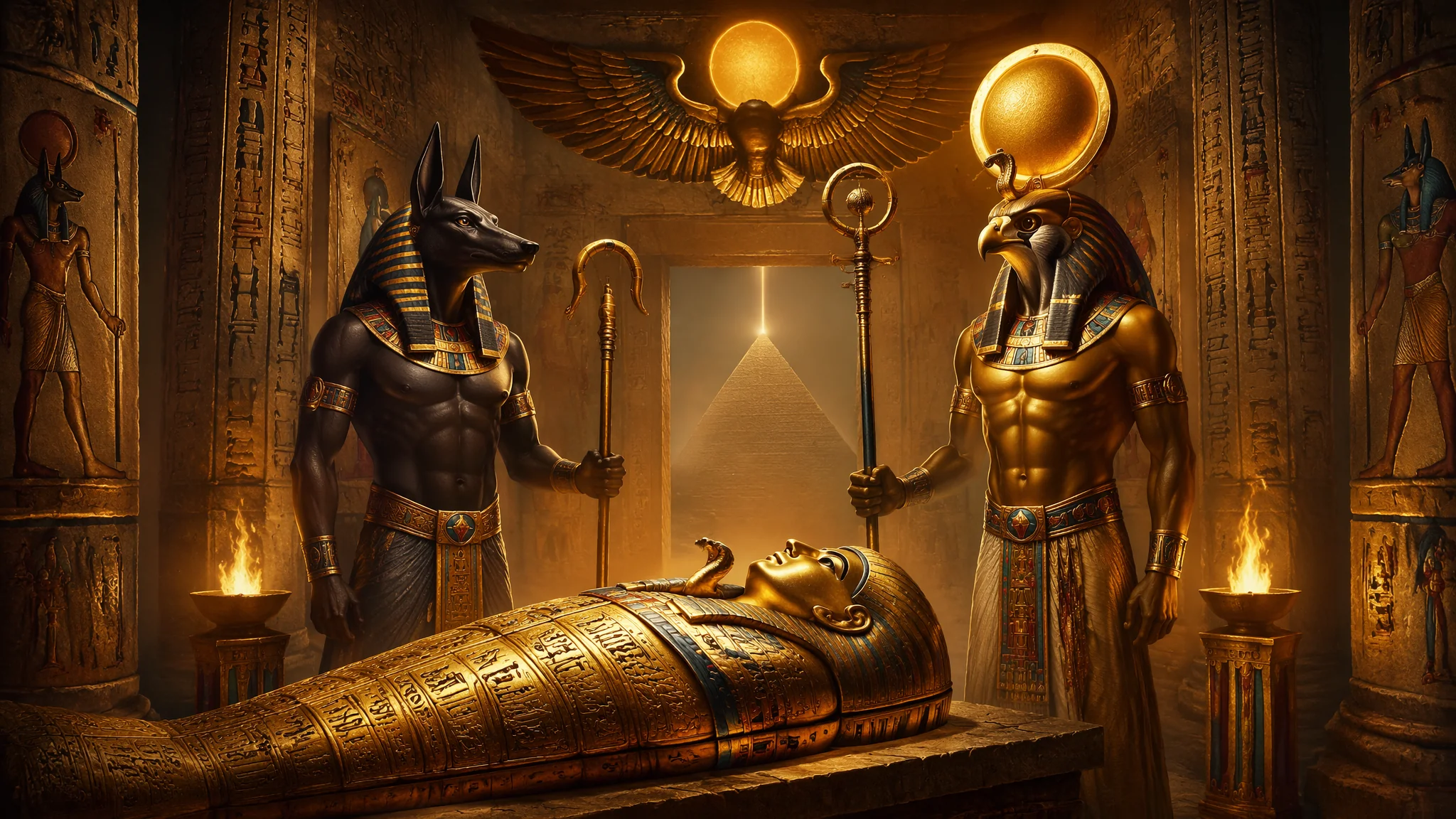
2018年我去了一趟埃及——不是跟团游,是自己背着包从开罗一路坐夜巴到卢克索再到阿斯旺。在帝王谷的一个墓道里,打着手电筒看墙上的壁画,那些三千多年前的颜色居然还留着——埃及蓝(Egyptian blue)那种介于蓝和绿之间的独特色调,在昏暗的墓道里闪闪发光。我站在那儿想:几千年前一个画师在完全人工照明的条件下画了这些——他大概想不到几千年后会有一个中国人站在这里用手机拍下来,然后回去用AI重新生成这些神的形象。回国之后我用AI画的第一张埃及神话图——荷鲁斯之眼画在了额头正中间而不是眼睛位置,阿努比斯的胡狼头变成了哈士奇,拉的太阳盘像个巨大的金色飞盘。这篇就是从那次"翻车"开始的埃及神话AI绘画系统整理。
众神图谱——不是"动物头+人身"那么简单
AI对埃及神祇的默认理解是"一个人戴着动物头套"——这是一个根本性的误解。埃及诸神的"动物头"不是面具、不是头套、不是cosplay——是神的本质以动物形态与人体融合。拉(Ra)的鹰头不是"他戴着一个鹰的头盔"——是"他就是鹰,鹰就是他,他的头部以鹰的形态显现"。这个区别在Prompt里必须明确,否则AI产出的永远是漫展上的埃及主题coser。
主要神祇的Prompt速查:拉(太阳神)——"Ra the sun god, his head is that of a great falcon crowned with a solar disk encircled by a sacred cobra (uraeus), the falcon's plumage is gold and white——the gold feathers at the crown radiate like the sun's rays, the transition from feathered neck to human shoulders is seamless and organic——golden skin with subtle patterns of feathers fading into smooth skin, he holds the was-scepter and the ankh, he radiates a warm golden light from within"。荷鲁斯(天空之神)——"Horus the sky god, the falcon-headed son of Osiris and Isis, his falcon head is that of a peregrine——sharper and more predatory than Ra's, his eyes are the sun and the moon——his right eye is golden and luminous (the sun), his left eye is silver and pale (the moon), the pschent double crown of Upper and Lower Egypt rests on his head, his body is athletic and youthful——a warrior god in his prime"。阿努比斯(丧葬之神)——"Anubis the god of embalming and the afterlife, his head is that of a black jackal——not a dog and not a wolf, the jackal's snout is pointed and elegant, the ears are tall and triangular always alert, his fur is the color of black obsidian——the black symbolizes the fertile Nile mud and the color of mummified flesh, he wears a golden collar and holds the ankh, his presence is solemn and protective not threatening"。托特(智慧之神)——"Thoth the god of writing and wisdom, his head is that of an ibis with a long curved beak, his ibis head is white with black markings at the eyes and beak tip, he holds a scribal palette and reed pen, his expression is thoughtful and serene, he wears the lunar crescent on his head"。
每个神的Prompt都包含三个要素:动物种类的精确描述(peregrine falcon/black jackal/ibis——不是一个泛泛的"bird"或"dog")、头身融合的方式(seamless/organic transition——不是"wearing a mask")、神的专属道具(was-scepter/ankh/pschent crown/scribal palette)。这三个要素都写清楚了——AI才不会把阿努比斯画成"一个穿黑衣服的人牵着一只狗"。更多神话角色的造型方法论见AI阿修罗神话绘画和AI古埃及神话绘画。
古埃及的色彩体系——神和人用的颜色不一样
埃及艺术有一套极其严格的色彩规则——不是"觉得好看就用",而是每种颜色都有神学含义。AI默认不会遵守这套规则——它看到"Egyptian"就会把画面变成一片沙黄色。你需要把色彩规则明确写在Prompt里。
埃及核心六色及其含义:Egyptian Blue(埃及蓝)——"a deep rich blue made from ground lapis lazuli or synthetic calcium copper silicate, the color of the sky, the Nile, and the hair of the gods, all divine wigs and ceremonial objects are rendered in this blue"。Egyptian Red(埃及红)——"a warm terracotta red made from iron oxide, the color of the desert, male skin tones, and the god Set, represents chaos and power"。Egyptian Gold(埃及金)——"the yellow of the sun god Ra's flesh——divine skin is gold not flesh-toned, the color of eternity and indestructibility, gold represents the flesh of the gods"。Egyptian Green(埃及绿)——"the green of new vegetation after the Nile flood, the skin color of Osiris as god of resurrection, represents regeneration and new life"。Egyptian Black(埃及黑)——"the black of the fertile Nile silt, the color of Anubis, represents rebirth and the underworld——black is a positive color in Egyptian art, not the color of evil"。Egyptian White(埃及白)——"the white of limestone and linen, women's skin tones in Egyptian art, represents purity and sacredness"。
色彩应用规则:男性神的皮肤=金或红(不是肉色),女性神的皮肤=白或浅黄,神祇的假发=埃及蓝,沙漠/死亡相关=红,复活/植物相关=绿。把这些写在Prompt中而不是靠AI"猜"——否则AI十有八九会给你一个"沙漠滤镜"的全画幅。更多历史美术的色彩体系见大都会博物馆埃及艺术部和大英博物馆埃及雕塑馆的高清藏品。
埃及壁画的三千年不变法则——"扭曲透视"怎么让AI理解
埃及艺术最独特的技术特征——"正身侧头"(twisted perspective)——在三千年的时间里几乎没有变化。AI完全不理解这种方式,因为它接受的训练数据99%是自然主义透视。要强制AI使用埃及透视,你需要像一个美术史老师一样把规则讲清楚:
完整埃及壁画Prompt模板:"a scene in the strict artistic canon of New Kingdom Egyptian tomb painting, the figures are rendered in the characteristic composite view: heads and legs in profile, eyes shown frontally on the profile face, shoulders and chest shown frontally so both shoulders are visible, the navel is shown in profile at the edge of the torso, the figures appear to have two left feet or two right feet——both feet are shown from the inside arch, the composition is organized in horizontal registers (bands) separated by ground lines, hieroglyphic inscriptions run in vertical columns beside the figures identifying them by name, the background is a flat warm limestone tone, the painting has the texture of pigment on rough plaster with slight cracking and fading at the edges from three thousand years of age"。每个"解剖扭曲"都写清楚——"both feet shown from the inside arch"比"Egyptian style feet"准确太多。
如果你不想完全复制壁画风格——而是想要"埃及主题的现代插画"——也要保留至少一个埃及视觉锚点:要么是"正面躯干+侧面头部"的人物造型,要么是"等级比例"的构图方式,要么是埃及蓝+金的配色。一个都没有的"埃及主题"不是埃及——是"发生在沙漠里的普通故事"。
常见问题
AI画的圣书体(象形文字)都是乱码——有办法让它生成真正的埃及象形文字吗?
目前AI无法生成有实际含义的圣书体——它生成的是"看起来像象形文字的形状"。解决方案:不要依赖AI生成文字——在Prompt中写"hieroglyphic inscriptions that are stylized and decorative rather than legible——the cartouches contain simplified symbolic forms"。然后用Photoshop把AI生成的"假象形文字"替换成真正的圣书体字符(有很多免费的古埃及字体可以使用——如Noto Sans Egyptian Hieroglyphs或JSesh)。或者更简单:画面中的象形文字区留出空白矩形,标注"hieroglyphic inscription area",后期自己填充。
荷鲁斯之眼(Eye of Horus/Wedjat)——怎么确保AI画的是"护身符"不是"一只鸟的眼睛"?
荷鲁斯之眼有非常确定的几何构成——它不是一个"像眼睛的图案",而是一个"用数学比例构建的符号"。Prompt精确描述:"the Eye of Horus (Wedjat) rendered as the sacred amulet——not a realistic eye but a highly stylized symbol composed of specific elements: the eye outline is an almond shape with a flat base, the iris is a circle with a dot pupil, above the eye is an arched eyebrow shape, to the left of the eye extends a curved spiral representing the falcon's cheek marking——this spiral is a teardrop-like curl that sweeps downward and then curves back up, below the eye is a vertical drop shape representing the marking under a falcon's eye, the entire symbol is rendered in flat graphic style with clean sharp lines——blue faience glazed ceramic appearance with gold accents"。如果你只写"Eye of Horus"——AI画出来的东西大概有40%的概率是"一只隼的写实眼睛",而不是那个著名的护身符符号。
怎么用AI画出"神域"的感觉——而不只是"一个人站在金字塔前面"?
"神域"(divine realm)和"现实场景+神"的区别在于——物理法则是否还适用。在Prompt中明确打破物理法则:"the scene takes place in the divine realm not the earthly world——normal physics do not apply: the sky is not blue but the deep lapis lazuli blue of the primeval waters with stars visible in the firmament even though the sun is shining, the ground is not solid earth but a translucent golden platform floating above an endless sea of reeds that stretches to the horizon, the god stands on a solar barque (sacred boat) that glides through the sky on an invisible river, hieroglyphs float in the air like divine speech made visible, the boundary between sky water and land is deliberately ambiguous——this is the world before creation"。关键概念:"normal physics do not apply"和"the world before creation"——这是神域的视觉逻辑。