AI概念场景绘画:电影级世界观构建与氛围设计的视觉创作指南
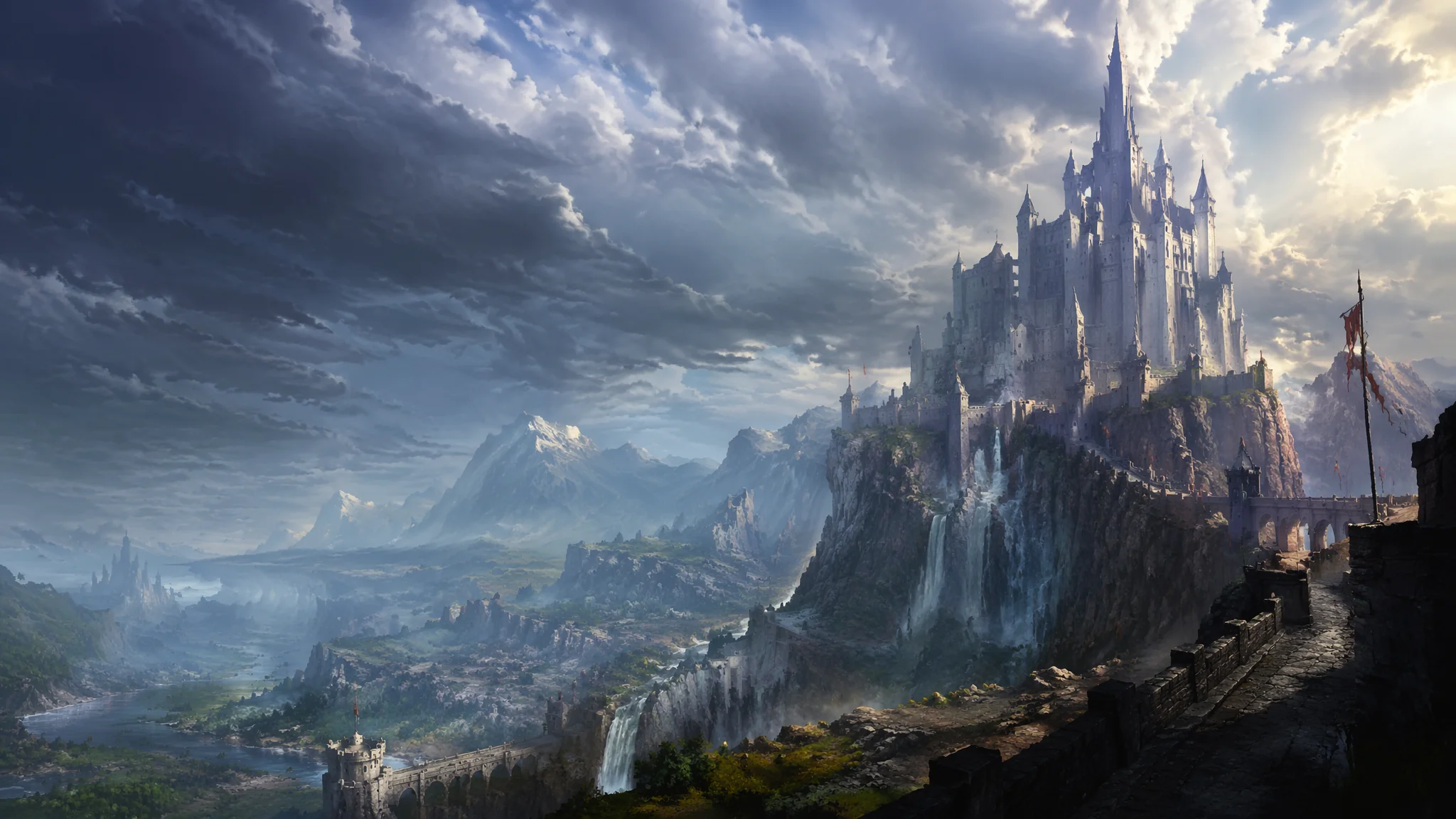
去年帮一个独立游戏团队做概念设计——他们要做一款"后启示录风格的中国江南水乡"的游戏。这个Brief听起来很酷但也让人头疼:江南水乡是温柔婉约的,后启示录是残酷荒凉的——把这两个东西放在一起,AI的默认反应是给你一个"灰色的水乡废墟",两边都不沾。我花了差不多一周的时间才找到破局点:不是让AI"把水乡画得破一点"——而是重新构建一套"在这个世界观里,世界是怎么变成这样的"视觉逻辑。水为什么是黑色的(上游的化工厂泄露)、白墙为什么长满了某种发光的真菌(核辐射后的变异生态)、乌篷船为什么被改造成了水上居住舱(陆地已经不适合居住了)。每一个视觉元素背后都有一个"世界为什么会变成这样"的故事。那是我第一次真正理解:概念场景画的不是"地方"——画的是"世界"。
世界观构建——在动笔(或写Prompt)之前,先回答五个"世界问题"
大多数AI概念场景的失败可以追溯到同一个根源:画之前没有想清楚"这是一个什么样的世界"。AI会给你一个"看起来像概念图的图"——但它没有世界观,所以它给的所有细节都是随机的、没有逻辑的、经不起推敲的。在写Prompt之前,拿一张纸回答五个问题:一,这个世界的"大事件"是什么?(战争/灾难/科技奇点/魔法觉醒——是什么塑造了这个世界现在的样子?)二,这个世界里普通人怎么生活?(他们在哪里获取水和食物?他们害怕什么?他们信仰什么?)三,这个世界的物理规则有没有被改变?(重力减弱?时间流速不同?植物会发光?)四,现在是什么时间节点?(大事件刚发生/事件后几十年幸存者开始重建/事件后几百年已经成为传说)五,这个特定场景在这个世界里扮演什么角色?(庇护所/交易站/圣地/禁区/被遗忘的角落)。
五个问题回答完了——你的Prompt就不再是"a post-apocalyptic city"这种空泛描述,而是从世界观推导出来的具体场景:"a trading post built inside the rusted hull of a capsized cargo ship on a dried-up lake bed, forty years after the water disappeared——the ship is now a permanent settlement with makeshift balconies and clotheslines strung between the propeller blades, the surrounding lake bed is cracked mud as far as the eye can see with the skeletons of dead trees, a wind-powered pump draws groundwater from a deep well——the most valuable resource in this world, the people wear patched clothing made from old sails and plastic tarps, the atmosphere is dusty and hazy with a permanent golden-brown tint from the suspended silt in the air"。每一个细节都是"世界观"的视觉翻译——不是随机堆砌。关于世界观的系统构建方法在AI游戏怪物角色绘画的"生态位推导"部分有类似逻辑——都是"从规则推导视觉"而非"从视觉拼凑视觉"。
光影氛围——概念场景的"情绪操作系统"
在概念场景中,光影不是"照亮物体的工具"——光影是"定义情绪的语言"。同一个构图在不同光影下可以表达完全不同的情感。我梳理了六种概念场景中最常用的"光影情绪配方":
一,希望之光(God Rays/Crepuscular Rays)——"volumetric shafts of warm golden light breaking through dark storm clouds, the light beams are visible as distinct columns due to dust or mist in the air, the light illuminates a specific area——the focal point of the composition——while everything else remains in shadow, the visual message is 'hope breaking through darkness' or 'divine intervention' or 'a new beginning'。——适合:英雄抵达圣地、灾难后的第一个黎明、发现失落文明。二,压迫之光(Low Overcast/Flat Gray)——"heavy low clouds create a ceiling of uniform gray that presses down on the landscape, the light is directionless and diffused——no shadows, no highlights, no depth, the lack of light contrast creates a feeling of oppression and hopelessness, the entire scene is rendered in a narrow range of mid-tones with no pure white or pure black。——适合:反乌托邦日常、战争前的寂静、迷失在荒野中。
三,孤独之光(Single Artificial Source in Darkness)——"total darkness surrounding a single pool of artificial light——a neon sign, a campfire, a computer screen in an empty room, the light source creates a small circle of visibility beyond which is absolute blackness, the contrast between the warm lit area and the cold dark surroundings creates an intense feeling of isolation——the light is a fragile bubble of safety in an infinite darkness。——适合:太空站孤灯、末世地下避难所、深夜便利店。四,记忆之光(Golden Hour Nostalgia)——"the warm golden light of late afternoon——the sun is low and the light passes through more atmosphere creating long shadows and warm amber tones, the light has a nostalgic quality——it makes everything look like a memory, the scene is backlit creating rim-lighting on figures and objects, lens flare and slight overexposure at the edges add to the dreamlike quality。——适合:回忆场景、童年的故乡、理想化的过去。
五,不安之光(Artificial Flickering/Unstable)——"harsh fluorescent lighting that flickers erratically, the light has a sickly green cast typical of old institutional buildings, one of the light fixtures buzzes and casts a strobing effect that freezes motion at irregular intervals, the lighting creates deep harsh shadows in the wrong places——under the eyes, inside open doorways, the overall effect is clinical but unreliable。——适合:废弃医院、政府秘密设施、恐怖游戏场景。六,启示录之光(Blood-Red Sky/Apocalyptic Backlight)——"the sky is an unnatural deep red-orange like the entire atmosphere is on fire, the light source is diffused through smoke and particulate matter——the sun is a faint pale disk barely visible through the haze, everything is backlit in silhouette against the burning sky, the ground-level light is dim and red-tinted as if the world is illuminated by embers rather than daylight。——适合:末日降临、战争进行时、环境灾难的顶峰。每一种光影配方的核心都是"光从哪来+什么颜色+投下什么样的影子"——三个要素写清楚,情绪就立住了。关于光影在更多场景中的运用见AI职业头像绘画进阶和AI恐怖画风绘画进阶——人物光和场景光是同一套语言。
四大主流概念场景类型的Prompt模板
赛博朋克城市——真正的赛博朋克不是"霓虹灯+雨夜+亚洲汉字",而是"高科技低生活"的阶层对比。"a cyberpunk city street at street level——the perspective of the poor who live in the shadow of the towers, the ground level is perpetually dark because the mega-towers block the sky——only slivers of gray light reach down, the street is wet from a recent acid rain shower and the puddles reflect the neon advertisements from above but in broken distorted fragments, street vendors sell synthetic food from repurposed tech-waste stalls, the walls are covered in layers of peeling holographic ads and faded graffiti, above the street level the wealthy live in the high towers where the air is filtered and the sun is visible, flying vehicles pass between the towers far above——their lights are tiny distant specks from ground level, a person in a worn-out coat with cybernetic limb replacements that are clearly outdated models walks through the scene"。关键对比词:"the perspective of the poor, ground level is perpetually dark, outdated cybernetics"——这些建立世界观的不平等。
奇幻森林王国——不是"有魔法的普通森林",而是"魔法本身就是生态系统的物理法则"。"an ancient enchanted forest where magic has replaced physics as the governing law of the ecosystem, the trees are thousands of years old with trunks as wide as houses and bark that glows with faint bioluminescent runes——the runes are the tree's circulatory system visible through the translucent bark, the forest floor is not earth but a shallow layer of clear water that reflects the glowing canopy above——walking through this forest is like walking on a mirror of stars, small spirit creatures made of condensed light drift between the trees like living lanterns, the atmosphere is thick with a golden mist that swirls in slow patterns as if the air itself is alive, at the center of the composition a colossal tree rises beyond the frame——its roots form natural archways and its branches support an entire ecosystem of hanging gardens and rope bridges"。关键点:"magic has replaced physics as the governing law"——不是"魔法存在",而是"魔法是物理法则"。
废土生存据点——核心是"人类如何用废墟重建文明"。"a survivor settlement built inside the remains of a collapsed suspension bridge, the bridge's main cables still span across a dry river bed and the survivors have hung shelters, water collectors and walkways from them like a vertical shantytown, the construction materials are everything from corrugated metal sheets to faded plastic tarps to car doors welded together——this is a society built from the corpse of the old world, wind turbines made from salvaged car alternators spin in the constant dusty wind——providing minimal electricity, a central communal area at the lowest level shows a small garden of hardy desert plants irrigated by a cleverly designed condensation collector, the people wear layered mismatched clothing with goggles and face wraps to protect from the dust, the color palette is rust red, dust brown, and the faded synthetic colors of pre-fall consumer products that have survived decades of UV exposure"。核心概念:"a society built from the corpse of the old world"——废土不是"废墟",废土是"用废墟重建的家园"。
太空文明遗迹——"先进文明的遗骸,但已经沉寂了万年"。"the interior of a Dyson-scale megastructure abandoned for millennia, the scale is incomprehensible——what appears to be a wall is actually the floor curving upward into the distance, the architecture is made of an unknown dark alloy that has no seams or joints——as if the entire structure was grown rather than built, ancient holographic interfaces still flicker with corrupted data——ghostly floating text in a language that has no human equivalent, the only light comes from the faint glow of dying power conduits that trace geometric patterns across the surfaces like the structure's fossilized veins, small drones——possibly maintenance robots or possibly something else——drift silently through the vast space performing tasks whose purpose has been forgotten, a single human explorer in a sealed environment suit stands at the edge of a platform, utterly dwarfed by the scale of the alien architecture, the atmosphere is cold, silent, and overwhelming in its scale——the feeling of walking through the tomb of something far greater than humanity"。核心是"scale contrast"和"the feeling of walking through a tomb"——太空概念场景的独特情绪是"敬畏+孤独",不是"酷炫特效"。更多科幻和神话场景的设计参考ArtStation概念艺术频道和IAMAG的概念设计大师班。
3D辅助构图——用Blender搭积木,用AI做渲染
AI概念场景的一个顽固问题是"透视不可控"——你写"从低角度仰视一个巨大建筑",AI可能会给你一个平视的中景。解决这个问题的最优方案不是写更复杂的Prompt——而是用3D软件搭一个"积木草图"作为ControlNet输入。工作流:一,在Blender里用基础几何体(立方体、圆柱、球体)搭出场景的粗略布局——不需要建模细节,只需要"这个位置有一个大块、这个位置有一个小块的相对关系"。二,设置基础摄像机角度——焦距、位置、朝向。三,导出渲染图(不需要材质和灯光——只需要"灰度深度图"或者"线框渲染")。四,把这张图作为ControlNet(Canny或Depth模式)的输入,AI在保持你设定的透视和构图的基础上填充所有细节。
这个方法的投入产出比极高:在Blender里搭一个"积木级"的场景大概只需要15到30分钟——你不需要会建模,会拖拽基本几何体就行。但这30分钟解决了AI绘画中最大的不可控变量——透视和构图。尤其适用于客户项目:客户说"建筑要再往左一点、视角再低一点"——你改Blender里的摄像机位置(30秒)再重新跑AI(30秒),而不是花半小时重写Prompt碰运气。这个"3D积木+AI渲染"的管线在AI草图绘画软件推荐和AI产品绘画软件对比中都有类似的"结构控制+AI填充"逻辑。
常见问题
AI概念场景经常犯"比例失调"——门比人大五倍或者窗户小得钻不进去?
比例失调的根源是AI没有"人体尺度参照系"。解决方法:在Prompt里用人体尺寸来描述建筑元素。"the doorway is approximately 2.5 meters tall——just high enough for a tall person to walk through comfortably, the windows are positioned at eye-level for a standing adult——approximately 1.6 meters from the floor, the steps of the staircase are each about 15 centimeters high——a comfortable stride for human legs, the railing is at waist height——about 1 meter from the ground"。用"人体可测量的尺度"来描述场景中的所有元素——AI就可以通过这些参照物来推算整体比例。如果你的场景里没有人——在Prompt里放一个"临时人物"来校准:先写"a person stands in the scene for scale reference",等出图比例对了之后再把人物去掉。
如何让AI画出的概念场景有"时间感"——像是一个有历史的真实世界?
时间感来自"不同时间层的共存"——一个世界不是"一瞬间建成"的,场景中应该有"不同时期留下的痕迹叠加在一起"。Prompt中加入时间层:"the scene shows multiple layers of history visible simultaneously: the original 19th century brick building with its ornate cornices and arched windows, the crude concrete reinforcement added during a 20th century war——functional and ugly against the elegant brickwork, the 21st century holographic advertisements projected onto the concrete surface, and the green overgrowth of vines and moss that have crept up from the ground over the last decade of neglect——nature reclaiming what humans have layered upon layers"。四个时间层:原始建筑→战时改造→科技叠加→自然回收——每个层用不同的材质和建造逻辑。这就是为什么真实的废墟比"AI的废墟"更有感觉——真实的废墟里有"不同时代留下的不同痕迹",AI默认的废墟只有一个"废墟滤镜"。
概念场景里的"动态暗示"——怎么让静态画面看起来"正在发生什么"?
动态暗示的三种手法:一,运动中的物体被冻结——"a flock of birds has just taken off from the water——their wings are captured mid-flap and the water surface still shows the expanding rings of their takeoff points, dust motes hang suspended in a shaft of light as if something just passed through and disturbed the still air"。二,即将发生的力的积蓄——"a massive stone door is half-open——the chains that lift it are still taut with tension and dust is still sifting down from the ceiling where the mechanism has just been activated, a pendulum at the end of its swing——frozen at the apex before gravity pulls it back"。三,环境对"刚刚发生的事"的回应——"a cup of liquid on a table shows concentric ripples on its surface——something heavy just hit the ground nearby, a curtain is billowing inward——a door has just been opened off-screen letting in a gust of wind"。三种手法的共同点是"让观众看到原因的结果"——观众没有看到事件本身,但看到了事件留下的痕迹。这个"推断"的过程让观众从被动观看变成了主动参与——这就是概念场景"故事感"的来源。